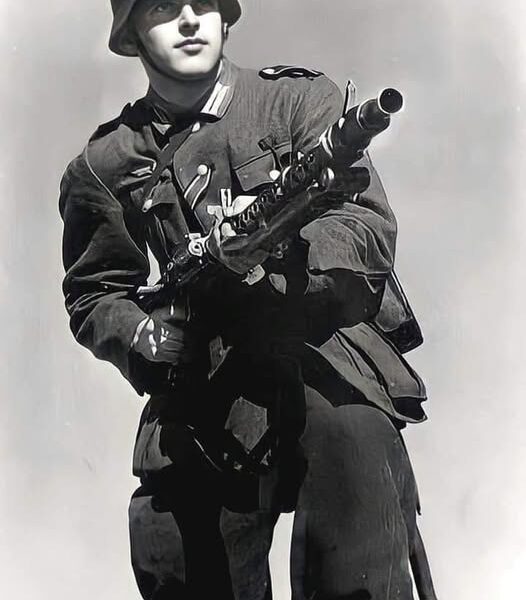

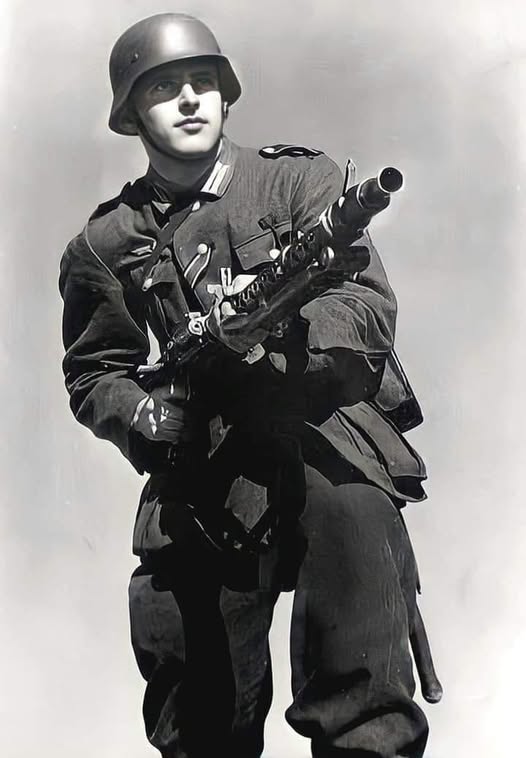

The MG 34 design originated in Germany during the interwar period before the two World Wars. Until World War II, machine guns were typically water-cooled—and accordingly heavy and immobile. Efforts to develop an air-cooled machine gun led to the MG 13. Although it was superseded by the improved MG 34, the design was revolutionary.
German infantry tactics relied on the MG 34 (and the similar, but later produced, MG 42) to increase a squad’s available firepower. Unlike the US, which issued the semi-automatic M1 Garand and the fully automatic Thompson submachine gun, many German infantry troops were armed with repeating rifles such as the Karabiner 98k. This tactic meant that machine gunners provided the bulk of a squad’s offensive firepower, while individual riflemen supplied them with ammunition.
The MG 34’s unique trigger acted as a fire selector. Pulling the top trigger fired single shots, while pulling the bottom trigger allowed full automatic fire. Later MG 34s had an astonishing rate of fire—some reached up to 1,700 rounds per minute. This incredible rate of fire earned the MG 34 platform the nickname “Hitler’s Circular Saw” due to the weapon’s loud, saw-like noise.
Continuous fully automatic fire was used sparingly, as the machine gun barrels could overheat during prolonged firefights, posing a danger to the gunner. To address overheating problems, both the MG 34 and MG 42 were equipped with an additional, replaceable barrel. In the hands of an experienced operator, the barrels could be changed quite quickly and did not significantly affect the machine gun’s rate of fire.
Ultimately, the model was replaced by the MG 42. Although the MG 42 did not offer a significant increase in performance, it was based on cheaper materials and simpler manufacturing processes. Simplifying production allowed more machine guns to be issued to front-line soldiers more quickly, although the MG 32 model continued to be produced until the end of the war.
Addendum
The design remains relevant today. The Bundeswehr still uses the MG3 multi-purpose machine gun. Although the design has been somewhat modernized, it is still equipped with a rear sight instead of a more modern optical sight and is chambered for the 7.62x51mm NATO cartridge. True to its heritage as a multi-purpose machine gun, the MG3 is mounted on a number of German vehicles as secondary armament and at the infantry squad level. Not bad for a design that’s almost a century old.

Related Posts

Old Times, Old Stories: The Life of German Soldiers (Part 44) _de
A fully camouflaged German soldier with a drum-loading MG 34 on the Eastern Front. A German paratrooper eats during a lull in the fighting at the Battle…

The downfall of Germany in World War II in 30 pictures
Ruins of the Berlin Cathedral City Palace Lustgarten Willys MB Jeep 1945 After France was recaptured by the Allies, the Germans gathered their own forces for a comprehensive…

Faces of War – German Soldiers at the Front (Part 711) _de
A German soldier sits with his head in his hands next to a destroyed heavy artillery piece and the body of one of his comrades during the Battle of Kursk in…

The Panzerkampfwagen VI Tiger I – Heavy Tank _de
If one compares the small number of Panzerkampfwagen VI Ausf. E (Sd Kfz 181) Tigers (only 1,346) with the total of over 120,000 T-34s and Shermans, the psychological…

1,700 rounds per minute: The MG34 was Hitler’s super weapon _de
The design of the MG 34 originated in Germany during the interwar period. Until World War II, machine guns were typically water-cooled—and accordingly heavy and immobile. Efforts to…

Tiger! Panzer VI – Combat and Operational Assessment – 252 Hits in Combat – World War II
Currently, “real life” is taking up most of my free time, so I’ll only be publishing a few short articles over the next few weeks to keep you all awake…
LEAVE A RESPONSE