
“Before there was a number, there was a name: Aron Löwi.
Five days in Auschwitz and a photograph that survived his tormentors.
To remember is to resist.”
Who was Aron Löwi?
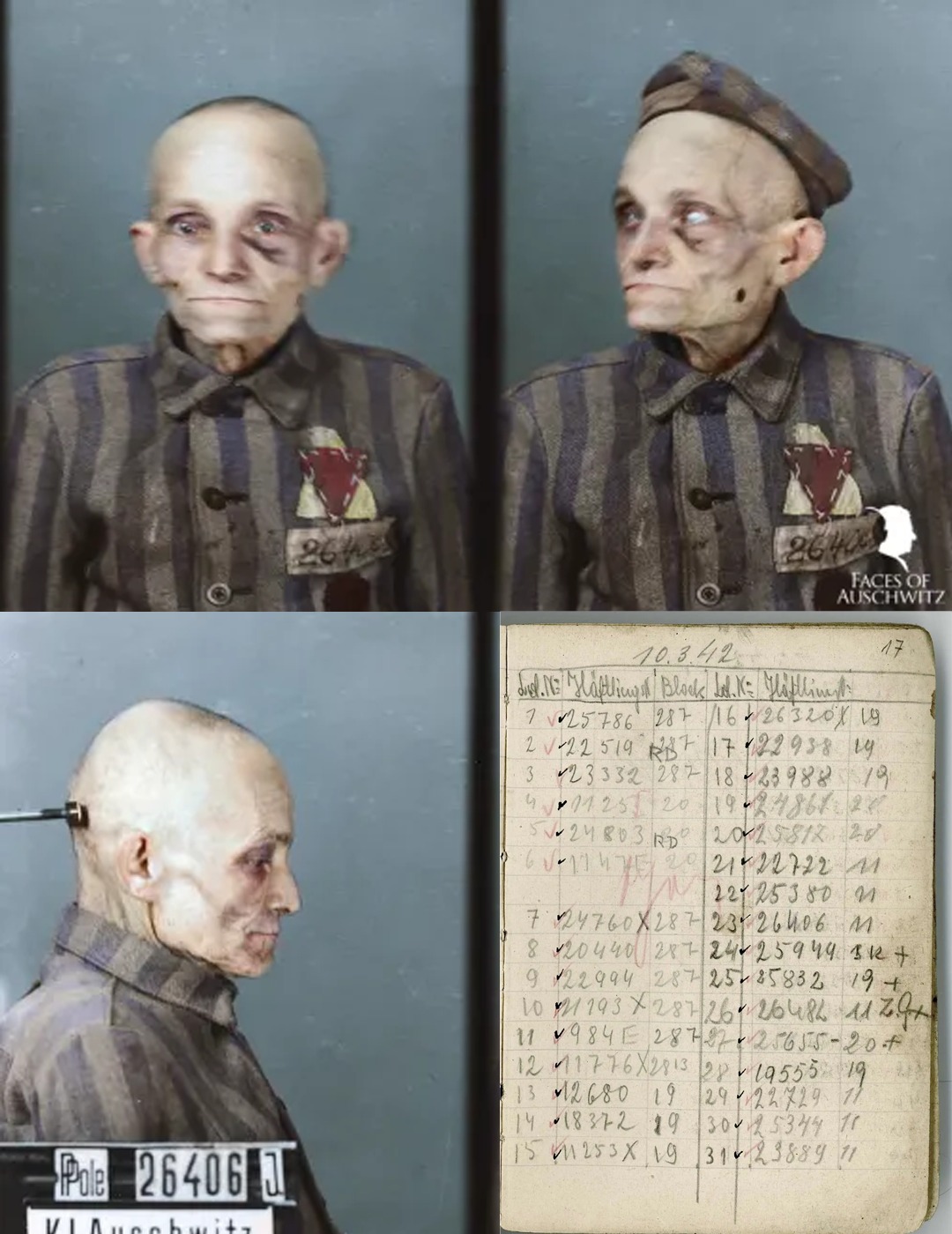
Aron Löwi was a Jewish merchant from Zator , a small town in Poland. On March 5, 1942, his name was reduced to a number: 26406. Transferred from the prison in Tarnów to Auschwitz, he was 62 years old—old enough to have known a full life, young enough to still hope for peace. He died five days later , on March 10, 1942 .
What the photographs reveal:
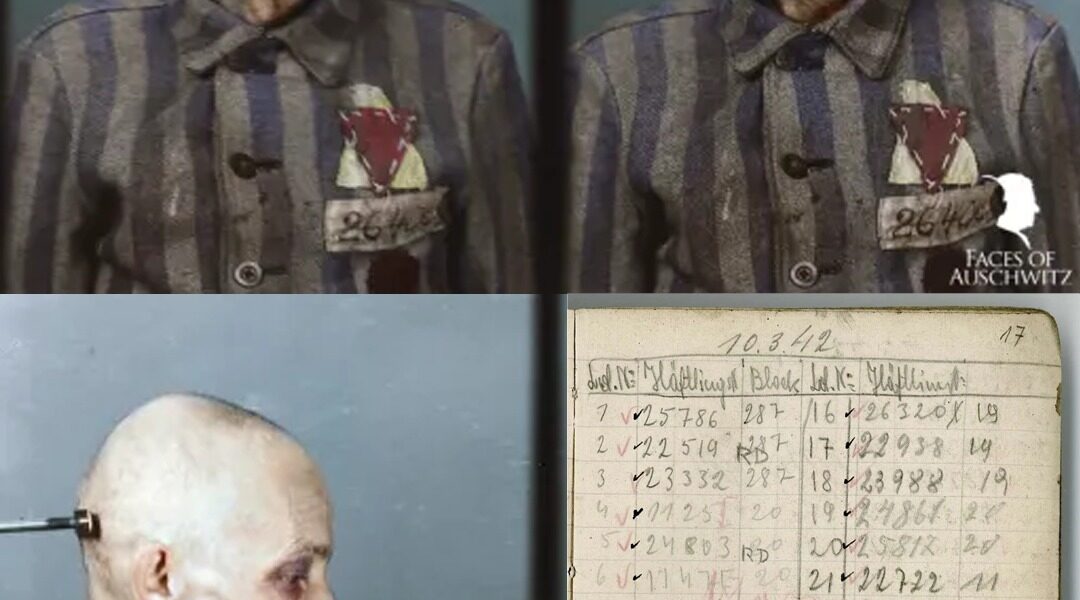
The three portraits (frontal, profile, and three-quarter view) follow the protocol of the camp’s identification service. Aron
‘s striped jacket bears the triangular badges prescribed by the SS.
- Yellow to mark Jewish identity ;
- Red for the category “political” .
In many cases, these triangles were superimposed to create a two-colored six-pointed star — a system that depersonalized and classified prisoners through colors and categories .
In his sunken eyes, in the still-visible bruises, we read disbelief , exhaustion , and that form of silent resistance in the face of the unimaginable. The photographs were taken at the moment when heads were shaved, personal belongings confiscated, and a name replaced by a number .
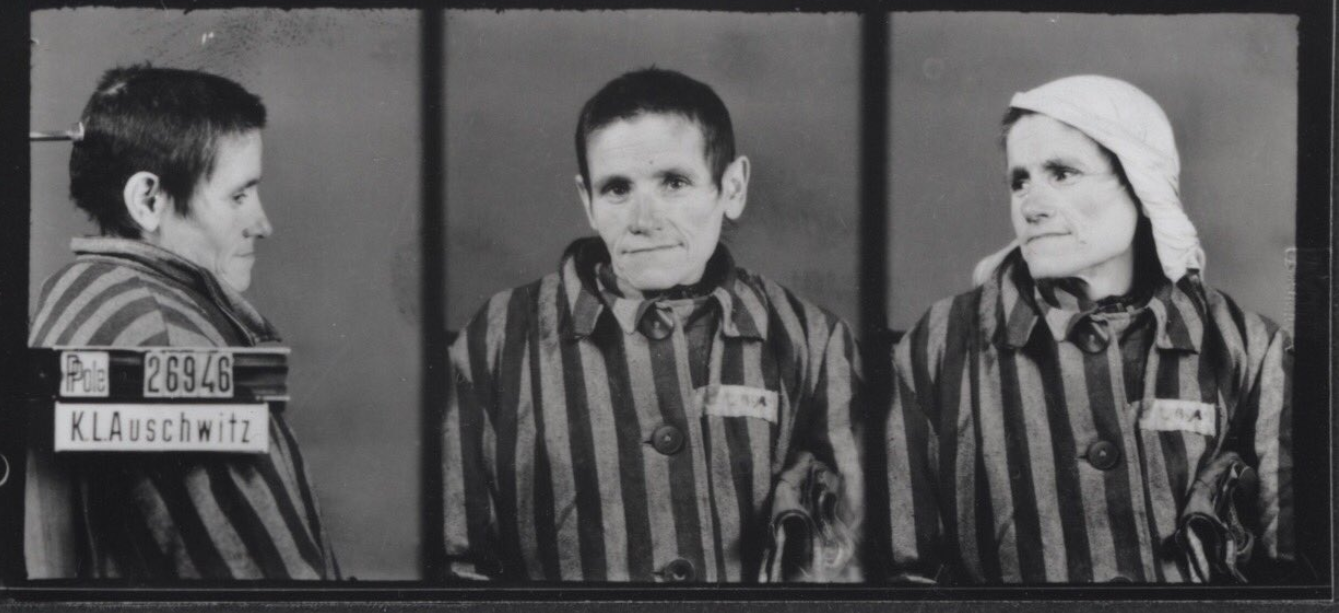
Five days, a single line in the register.
A register page dated March 10, 1942 , documents the administrative registration of Aron Löwi . As with so many others: no grave, no farewell —just a brief line in a notebook and a few photographs. Early deaths—often within the first week—were frequent: hunger, cold, disease, violence .
Portraits as evidence — and as restitution.
The Auschwitz-Birkenau State Museum preserves tens of thousands of registration photographs today — only a fraction of the total collection destroyed during the Nazi retreat. Restoration and contextualization projects like Faces of Auschwitz give back a face, a biography, a voice to those whom the bureaucracy of murder had reduced to codes .
These images are legally admissible evidence , but also moral dialogues : they compel us to look, to name, and to recognize the person behind the striped uniform. Every time we utter the name Aron Löwi , the machine that claimed to be able to erase him fails anew .
Why look any further?
Because photography has outlived those who took it .
Because memory lasts longer than hatred .
Because remembrance is a form of resistance —a way to give Aron Löwi and so many others back what was violently taken from them: their humanity .

Related Posts
THE LAST MOMENTS OF WILLI HEROLD: The story of the “Executioner of Emsland” and his crimes in the Second World War _de503
WARNING: VERY SENSITIVE HISTORICAL CONTENT!  This article deals with events from the final weeks of World War II and a post-war trial. The text serves solely for historical context and…
THE BEAUTIFUL SOLDIER, THE FIRST WOMAN TO BE PUBLICLY EXECUTED BY THE NAZIS IN WORLD WAR II: After three days of torture, Elżbieta Zahorska – the courier who never spoke a word – became a symbol of martyrdom for a free Poland. _de507
EXTREMELY SENSITIVE CONTENT – ONLY FOR INDIVIDUALS 18 YEARS OLD AND OVER This article deals with the first public execution of a woman in occupied Europe during the Second World War. The…
FROM ATTRACTIVE PILOT TO NAZI MONSTER: Herbert Cukurs – The “Butcher of Riga”, who, despite 20 years in hiding, was tracked down and executed by Israeli agents for the murder of 30,000 Jews _de504
WARNING: VERY SENSITIVE HISTORICAL CONTENT This article deals with the genocide during the Holocaust in Latvia and the fate of one of the perpetrators after the war. It is intended solely for…
THE TRAGIC FATE OF THE PRISONED SOVIET WOMEN SOLDIERS IN THE WAR: How the Germans treated them – The forgotten sides of history _de502
WARNING: VERY SENSITIVE HISTORICAL CONTENT This article deals with the treatment of prisoners of war on the Eastern Front (1941–1945). It is for educational and commemorative purposes only. There is absolutely no intention to incite violence…
JUSTICE FOR 6,000 LATVIAN SOULS: The horrific execution of the Nazi butchers in the Latvia massacre – The darkest chapters of world history remain unrevealed _de501
WARNING: This post contains sensitive information about the genocide of World War II. It serves solely for historical education and commemoration of the victims. The Liepāja Massacres (1941)…

FROM ARROGANT OFFICER TO GROVELING COWARD BEFORE THE GUN: Maximilian Grabner – The Nazi officer who knelt, kissed boots, and begged for the life he had denied millions _de500
WARNING: This article deals with war crimes in Auschwitz and the post-war trials. It serves solely for historical education and commemoration of the victims. Maximilian Grabner – Head of the Political…