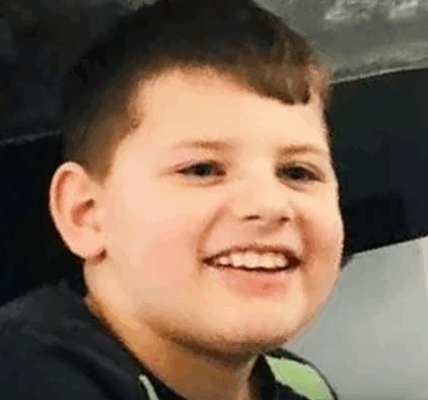

It was supposed to be a normal school day.
A quiet morning filled with routines, backpacks, and the kind of innocence that makes parents believe their children are safe the moment they walk through the school doors.
Eleven-year-old Lenny Diaz carried his favorite tacos dorados, packed lovingly by his mother—a small taste of home, comfort, and the belief that nothing bad could happen on an ordinary day.
But only a few hours later, that ordinary day shattered.
And the world that once felt familiar to Lenny suddenly became unrecognizable.

Emily Diaz never expected her phone to ring with the call every parent fears.
A trembling voice told her that her son had been injured—so badly, so violently—that his skull had fractured and bone fragments had pierced his brain.
In that instant, Emily’s world stopped.
There were no explanations.
No details.
Just a wave of terror so overwhelming that she struggled to breathe as she rushed toward the hospital.
When she arrived, doctors were already fighting to keep her son alive.
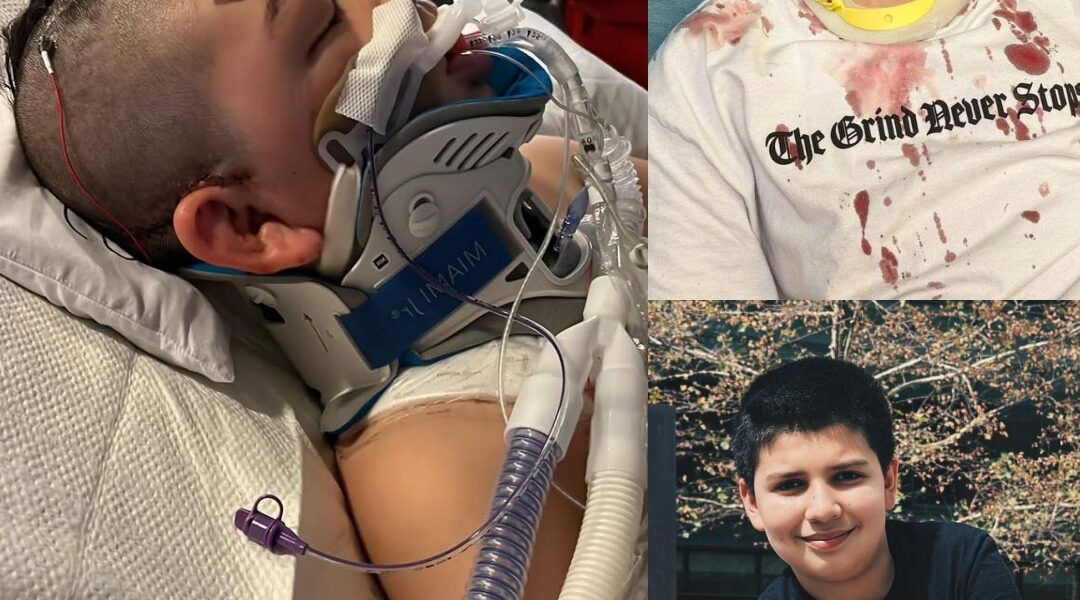
Lenny spent days on life support, motionless except for the rise and fall of his chest guided by machines.
Weeks passed in intensive care, where sunlight rarely entered and hope had to be held onto with fragile, shaking hands.

Doctors still cannot predict what his future will look like.
They speak in careful phrases—“we’ll have to wait,” “it’s too early to know,” “these injuries are severe.”
They cannot promise that he will speak normally again.
They cannot guarantee that he will walk the way he once did.
They cannot assure his mother that his memories, his personality, or his childhood will remain untouched.
But what breaks Emily even more is knowing the system failed her child long before the ambulance arrived.

Lenny himself called her before the school did.
A frightened, pain-filled voice whispering that something terrible had happened.
The principal waited eleven minutes before contacting her.
Police took hours to respond.
A mandatory safety report—required by law—was delayed for seven days.
And the student who caused the life-threatening injury is already back in class, as if nothing life-altering occurred.
To Emily, every one of these failures feels like a fresh wound.
A reminder that adults who should have protected her son instead hesitated, delayed, and dismissed the severity of what he endured.

Now, the hospital room has become her second home.
She spends every day beside Lenny’s bed, holding his hand through the tangle of tubes and monitors.
Each small movement he makes is a victory.
Each flicker of his eyelids feels like a miracle.
Each tiny improvement is enough to keep her fighting through exhaustion and heartbreak.
At night, Emily listens to the rhythm of the machines—steady beeps, soft hums, the sound of hope measured in numbers glowing green on screens.
She watches nurses whisper updates, adjust wires, check oxygen levels.
She watches her son breathe, fight, and try to find his way back to the world he once knew.

And still, she carries anger.
A heavy, justified anger toward a system that did not act when her child needed it most.
She wonders how many things could have gone differently if someone—anyone—had responded sooner.
If someone had taken the situation seriously in the first minute instead of the eleventh.
If someone had called police immediately instead of waiting until the damage was irreversible.
But even in her grief, something extraordinary has happened.
The community has begun to rise.
People—neighbors, strangers, friends of friends—have come forward with prayers, donations, messages of love, and calls for accountability.
They gather behind Lenny, behind Emily, behind the belief that no child deserves to be hurt this way and no parent deserves to face this nightmare alone.

Their support has become a lifeline.
A reminder that while a system can fail, people can still stand up.
They can still fight for justice when institutions refuse to move.
Lenny’s therapies have now begun, slow and painful but filled with moments of hope.
He lifts his hand a few inches.
He tries to form words, even when they come out faint and broken.
He attempts to remember details from before the injury, grasping for pieces of his life that once came effortlessly.
These steps—small to the world—are monumental to his mother.
They are proof that he is still here.
Still fighting.
Still refusing to let the darkness take the childhood that was stolen from him.

Emily watches him every day with a mixture of strength and sorrow.
She is learning to live inside two worlds: the world where she must grieve what has been lost, and the world where she must fight for what might still be saved.
She holds onto hope because it is the only thing strong enough to keep her standing.
She holds onto love because it is the only thing that has not failed her.
And she holds onto Lenny—every breath, every struggle, every victory—because he is her son, and she refuses to let this be the end of his story.
Lenny’s tragedy is not just another headline.
It is a warning.
A spotlight on the cracks in a system that promises safety but sometimes delivers silence.
A plea for schools to act faster, for administrators to take responsibility, for parents to be informed immediately, and for accountability to be more than a word.

Because no child should return home from school in an ambulance.
No mother should hear of a life-threatening injury from her child before hearing it from the adults in charge.
And no community should watch a system dismiss the suffering of a boy who deserved so much better.
Lenny is proof of resilience.
Emily is proof of a mother’s unbreakable strength.
And the community standing behind them is proof that even in the darkest moments, people can demand change.

This story is not over.
It is still unfolding, written each day in hospital rooms, therapy sessions, and the unwavering determination of a family refusing to give up.
Lenny’s story is more than a tragedy.
It is a call to action.
A plea for safer schools.
And a testament to how far a mother’s love can reach when the world falls apart.
13-Year-Old Bryan Ceja Killed in Multi-Vehicle Crash on 210 Freeway in Sylmar.5806

The holiday season in Sylmar, Los Angeles, was meant to be filled with joy, shopping trips, and family gatherings.
Streets were lined with twinkling lights, and the spirit of Christmas seemed to hang in the air like soft snow — even in the sun-soaked city. But for the Siordia and Ceja families, that warmth was shattered in an instant.
On a Sunday afternoon, December 2025, a routine Christmas shopping trip ended in unthinkable tragedy.
Thirteen-year-old Bryan Ceja, full of energy, curiosity, and an unmistakable love for sports, was killed in a
multi-vehicle crash on the 210 Freeway, a collision that closed the freeway for hours and left multiple families reeling.
Bryan’s stepfather, Alfredo Siordia, spoke about the heartbreak with a voice thick with grief. “An amazing kid. I’m the luckiest stepfather ever to have him in my life,” he said.
The words were simple, yet heavy — the weight of loss palpable in the quiet pauses between sentences.

The Boy Behind the Tragedy
Bryan Ceja was more than just a number in a police report. He was a
vibrant, athletic teenager, whose energy lit up every room he entered. Friends and family remember him as playful, curious, and always ready for a game of baseball, football, or anything that challenged his boundless energy.
“He was just this energetic kid, and wanted to play sports. That was mostly his thing,” Siordia explained, recalling the countless afternoons spent cheering Bryan on from the sidelines, whether in football scrimmages or weekend baseball games. “Sorry, baseball, football, you name it. He was just very athletic.”
His love for activity was matched only by his warmth and kindness.
Those who knew Bryan described him as a teenager who could brighten a room with a smile, a boy whose laughter was infectious, and whose presence demanded attention not for mischief, but for the warmth he brought to family and friends alike.
For Siordia, the stepfather who had entered Bryan’s life years earlier, the bond was unbreakable. He recalls how, despite the typical challenges of blending families, Bryan taught him lessons of love, patience, and joy.
“For him being a little kid, he taught me how to love as well, and just like, I really miss him,” Siordia said.

The Day That Changed Everything
On that fateful Sunday, Bryan and his mother were out Christmas shopping. The mood was one of excitement and anticipation — the final touches before the holidays.
Gifts were selected, lists were checked twice, and the pair likely shared laughter over candies and trinkets along the way.
But on the 210 Freeway, a routine drive turned into
a scene of chaos and horror. Multiple vehicles collided in what authorities later described as a violent chain-reaction crash.
Emergency services were called immediately, and first responders rushed to the scene.
For the Siordia family, the day that had begun with anticipation and joy ended in devastation.
Bryan did not survive the crash. His mother, severely injured, was transported to a nearby hospital, where she began a long road to recovery.
Miraculously, she survived, but the emotional scars and trauma from witnessing her son’s death are immeasurable.

The Aftermath: Grief and Healing
In the days following the accident, the community of Sylmar rallied around the family. Friends, neighbors, and schoolmates offered support, prayers, and gestures of kindness, but none could bridge the gap left by Bryan’s absence.
For Alfredo Siordia, the grieving process was deeply personal, yet public in a way he hadn’t anticipated. Every conversation, every memory recounted to reporters or friends, became a testament to the life of a boy gone too soon.
“I go inside his room and, you know, picture the times he was there, and it’s just not going to be the same,” Siordia admitted.
The bedroom, once alive with the sounds of a young teenager — laughter, music, the shuffle of sports gear — now stands as a silent monument to memory.
Grief, Siordia notes, is not linear. It is a cycle of memories, reminders, and raw emotions that surface at the least expected moments: a stray baseball rolling across a driveway, the sight of a football helmet, or even the simple act of setting the table for Christmas dinner.

A Community in Mourning
While the Siordia family bore the personal grief, the accident reverberated across Sylmar. Highway closures on the 210 Freeway affected countless drivers, but beyond the inconvenience, the tragedy became a symbol of fragility in everyday life.
Local schools held moments of silence. Teachers spoke to students about safety, the unpredictability of life, and the importance of cherishing loved ones.
Church congregations offered collective prayers, lighting candles for Bryan and others injured in the crash. Social media feeds overflowed with messages of condolence, remembering a life cut short and a community united in sorrow.

The Father-Stepfather Bond
Alfredo Siordia’s role as stepfather was not just about guidance or discipline. It was about shared experiences, mentorship, and mutual respect.
Despite the legal distinctions of family, Siordia speaks of Bryan as a son, a friend, and a companion through life’s small and significant moments. From simple breakfasts to weekend sports games, their relationship was rooted in genuine love and understanding.
“He was just an amazing kid, and he brought joy into our home,” Siordia said. “It’s a void I don’t think can ever be filled, but I carry him with me in every decision, every thought, every day.”
In the wake of such sudden loss, Siordia also underscores the fragility of life and the importance of cherishing time with loved ones. Each moment — a hug, a conversation, a shared laugh — becomes infinitely more precious when the future is uncertain.

Remembering Bryan: Legacy Beyond Tragedy
Though his life was brief, Bryan left an indelible mark on everyone who knew him. Friends remember his sense of humor, his athletic prowess, and the way he could rally teammates or classmates with a single word of encouragement.
Teachers recall a student attentive and engaged, with a spark of curiosity that extended beyond the classroom. For family members, Bryan represented the very essence of joy, energy, and love.
In memory of Bryan, community members have suggested establishing scholarships, sports programs, or memorial events that honor his life.
Each act of remembrance is not only a tribute to him but also a testament to the collective healing of those affected by the crash.
The Accident and Safety Conversations
While grief remains the central focus, the crash also sparked broader conversations about road safety, highway conditions, and driver awareness. Multi-vehicle collisions, particularly during busy holiday weekends, underscore the fragility of life on the road.
Authorities have urged drivers to exercise caution, reduce distractions, and maintain safe speeds, especially in congested areas.
The Sylmar crash, with its devastating consequences, serves as a cautionary tale for the entire Los Angeles area. Though nothing can reverse the tragedy, the hope is that lessons learned can prevent similar losses in the future.
Coping, Healing, and Moving Forward
The Siordia and Ceja families have leaned on faith, counseling, and community support as they navigate the impossible task of mourning a child.
While grief is ongoing, there are moments of comfort, such as sharing memories, recounting stories of Bryan’s accomplishments, and celebrating the life he lived, however brief.
Siordia has also emphasized the importance of holding onto love in the face of loss. “He taught me how to love,” he said. “I carry that with me, and I will keep his memory alive in everything I do.”
As the holiday season approaches, the pain is undeniably sharper, but it is also tempered with gratitude for having known such a remarkable young boy.
The balance of sorrow and remembrance forms a delicate tapestry of love and loss, one that will endure for years to come.
A Call to Cherish Life
Bryan Ceja’s story is, at its core, a reminder of life’s fragility and the enduring power of love.
In a world often taken for granted, the events on the 210 Freeway illustrate how quickly circumstances can change, how precious each moment truly is, and how a single life can leave a lasting impact.
From his athletic feats to the warmth he shared with family and friends, Bryan’s legacy continues.
Though he is no longer present physically, his spirit and influence remain, a guiding force for those who loved him and for the Sylmar community.
Moving Forward, Together
The road to healing is long and uneven. Yet in every conversation, every tear, and every memory, Bryan’s life inspires action, reflection, and connection.
Family members are committed to honoring him, friends are motivated to cherish every moment, and the community is reminded to protect the most vulnerable among us — especially children.
Through tragedy, Sylmar has been forced to confront the intertwined realities of life, loss, and love.
And while nothing can replace the young boy whose energy once filled rooms and fields, his presence endures in every memory and story shared.
Bryan Ceja may have been only 13, but the life he lived, the love he gave, and the joy he brought continue to resonate, shaping a community forever changed by loss and strengthened by remembrance.