
“Cyborg.”
It sounds like something out of a comic book — a name that belongs to a superhero, not a boy born with a rare bone condition. But once you see the way he walks, the light in his eyes, and the quiet determination in his voice, you understand.

He earned that name.
Because this is the story of Mateus, a child who was told his body would never be “normal.”
And instead of surrendering, he decided to rebuild it.

A Diagnosis That Changed Everything
Mateus was born with a condition so rare it affects only one in a million children: congenital short femur associated with hemimelia — a complex skeletal malformation that causes one leg to be significantly shorter than the other.

For most people, the femur — that long bone in the thigh — is one of the strongest and most stable bones in the body. But in Mateus’s case, it was underdeveloped from birth. One leg was visibly shorter. One hip was higher than the other. Walking, balance, running — all of it would be a challenge.

Doctors explained the condition gently but honestly.
He would need multiple surgeries.
He might spend years in physical therapy.
And even then, they warned, his gait might never look “normal.”
But what the doctors didn’t account for — what no medical chart could predict — was Mateus’s spirit.

The Birth of “Cyborg”
From the beginning, Mateus refused to see himself as limited.
He gave himself a nickname that captured how he saw his journey — not as something broken, but as something being rebuilt stronger.
Cyborg.

It started as a joke, whispered between his parents and nurses after his first major surgery. But soon it became his identity — a symbol of resilience, courage, and transformation.

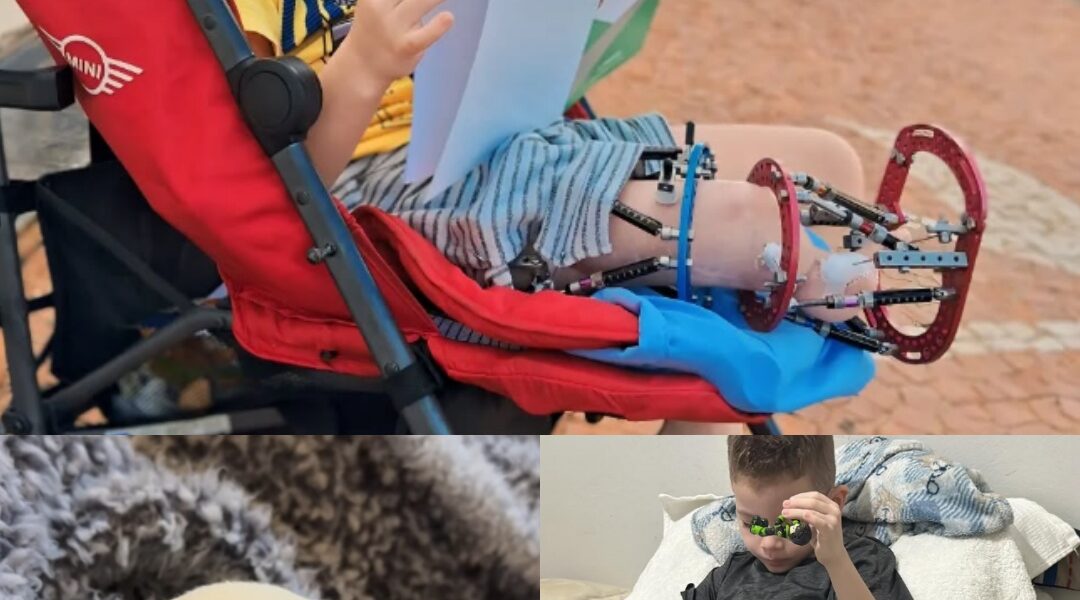
Every time a doctor adjusted his metal fixator or tightened the external rods used to lengthen his leg, he would grin and say,
“See? I’m half metal now. I’m getting stronger.”
May you like

And somehow, that optimism carried everyone around him.

The Science Behind His Recovery
To understand Mateus’s fight, you have to understand the procedure that saved him — a medical technique known as
bone lengthening.
It’s one of the most remarkable processes in modern orthopedics — part science, part miracle.

Surgeons carefully break the bone in a controlled way, attach a special device called an
external fixator, and then, over the course of months, slowly stretch the bone millimeter by millimeter.
As the gap widens, the body begins to generate new bone tissue in the space between — literally creating new bone from nothing.

The process is excruciating, both physically and emotionally.
Every day, screws must be turned. Muscles stretch painfully. Physical therapy sessions push the limits of what seems humanly possible.
But through it all, Mateus fights.

So far, he has completed two full bone-lengthening surgeries, gaining more than 10 centimeters — nearly four inches — in the affected leg.
That’s not just a number. That’s years of pain, months of hospital stays, and countless nights where his mother had to hold him as he cried through the ache of growing bones.
And yet, ask him about it, and he’ll shrug.
“It hurt,” he’ll say with a grin, “but it was worth it.”

The Pause Before the Next Battle
For now, the doctors have pressed pause on his treatment.
Each phase of bone lengthening is followed by a recovery period — time for the bone to harden, for the muscles and joints to adapt, for a growing body to catch up.

The plan is precise:
A new lengthening every two years until growth is complete.

By 2027, if all goes well, Mateus’s legs will be the same length.
That means at least
two more surgeries, possibly three — each one requiring weeks of hospitalization, months of rehab, and unimaginable patience.

Most adults would find that schedule unbearable.
But Mateus? He treats it like a challenge.
“When the next one comes,” he says, “I’ll be ready.”

The Power of Recovery
If you walk into the hospital where he’s treated, you’ll see his name written in the corner of a large whiteboard — underlined twice, with a smiley face beside it.
The nurses call him “our little warrior.”
He’s known for high-fiving everyone in the hall, for joking with the surgeons, and for reminding other children that scars aren’t ugly — they’re proof of survival.

During one physical therapy session, when a younger child cried from the pain of stretching, Mateus rolled up his pant leg, revealing the scars and pin marks that lined his thigh.
“See these?” he said. “They hurt, too. But they made me faster.”
The child stopped crying.
That’s the effect he has — the ability to turn fear into courage just by being himself.

The Man Behind the Record
Mateus’s chief nurse, the one who has followed his case from the very beginning, describes him with pride that borders on awe.
“He’s not just a patient,” the nurse says. “He’s a reminder that medicine isn’t just science — it’s heart.”

He remembers the first time he saw the X-rays — the short femur, the curvature, the hip misalignment. The odds didn’t look promising. But every time Mateus returned, the images told a different story — bone growing where none should have, strength building where weakness once lived.

The nurse keeps a copy of the latest medical summary on his desk.
It reads like a record of miracles:
“Congenital short femur associated with hemimelia. Two bone lengthening procedures performed. 10+ centimeters gained. Full mobility during recovery. Prognosis: Excellent.”
Beneath it, in handwriting, he’s added his own note:
“The boy who refused to stop growing.”

Between Pain and Progress
The hardest part, his mother says, isn’t the surgeries. It’s the waiting.

The waiting between each stage.
The waiting to see if the new bone will hold.
The waiting for the day he can finally run without limping, without braces, without pain.

But she never lets him see her worry.
At home, they celebrate every victory — every centimeter gained, every step taken, every night he sleeps without pain medication.

Their refrigerator is covered with drawings and X-rays, each one marked with dates like milestones on a map.
In bold letters, above it all, one phrase:
“Strong like Cyborg.”

The Mindset of a Fighter
What makes Mateus extraordinary isn’t just his condition — it’s his mindset.
He doesn’t see disability as limitation.
He sees it as transformation.

When he talks about his leg, he doesn’t say “bad leg” or “injured leg.” He calls it “the strong one.” The one that’s been rebuilt. The one that’s fought the hardest.
He dreams of becoming a physiotherapist one day —