Reconstruction of Dresden after the horrific bombing raids at the end of the Second World War, 1945–1970


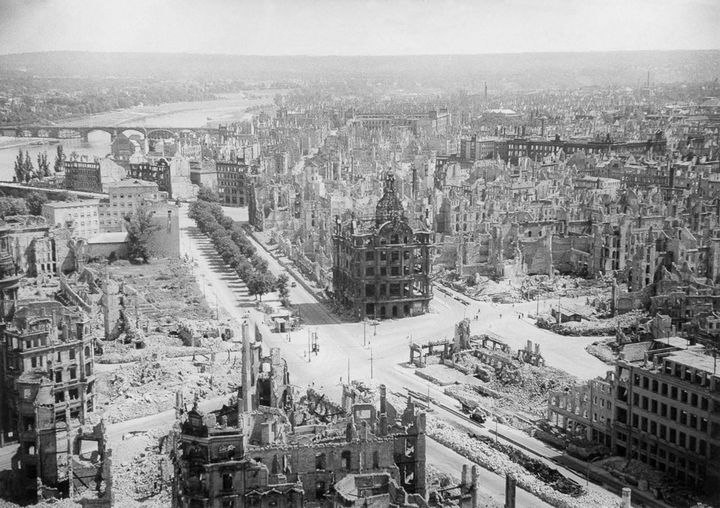
Dresden in March 1945.
In the final winter of World War II, Dresden in eastern Germany was reduced to rubble. Tens of thousands lost their lives, and a bitter debate erupted over whether the attack was justified.
Dresden was the capital of the state of Saxony and lay on the Elbe River. It was a cultural center with famous sights such as the Frauenkirche (Church of Our Lady) and was called the Florence of the Elbe.
The city’s population could largely only be estimated, as refugees streamed into the city shortly before the bombing, when Soviet troops advanced to the east. However, general estimates suggest that the population at the time of the bombing was over 650,000.

The destroyed city as seen from the town hall. 1945.
In early 1945, the Allied commanders met to plan “Thunderclap”, a new plan for the strategic bombing of Germany, particularly to support the advance of Soviet troops.
They argued that Soviet troops could exploit the confusion created by area bombing of large cities in East Germany, thereby hindering the movement of German troops from the west of the target cities.
On January 27, 1945, Sir Archibald Sinclair of the RAF, in view of the conclusion of the Allied Joint Intelligence Command that the Germans could reinforce the Eastern Front with half a million men (up to 42 divisions), sent Churchill a recommendation to bomb Berlin, Dresden, Chemnitz, Leipzig or other large cities with available resources in order to hinder efficient enemy movements, should such a reinforcement be ordered from Berlin.

A view from the town hall of the cleared former city center. 1955.
The bombing of Dresden began on the night of February 13th to 14th, when 796 British Lancaster and 9 Mosquito aircraft were relocated and dropped 1,478 tons of explosives and 1,182 tons of incendiary bombs in the first bombing raid and 800 tons of bombs in the second raid.
The incendiary bombs contained flammable chemicals such as magnesium, phosphorus, or petroleum jelly/napalm.
It was claimed that due to the extreme temperatures inside the buildings caused by the massive fires, air currents formed that sucked people fleeing into the burning buildings.
Three hours later, 529 Lancaster bombers dropped 1,800 tons of bombs. The next day, 311 American B-17 bombers dropped 771 tons of bombs, while the accompanying Mustang fighter planes strafed traffic (without distinction between military and civilian) on the streets, causing further chaos.

A statue of Martin Luther lies toppled in front of the ruins of the Frauenkirche. 1945.
She’s carrying a bundle in her arms; it’s her baby. She runs, she falls, and the child flies in an arc into the fire… A terrible fear grips me, and from then on I repeat a simple sentence to myself: “I don’t want to burn.”

The ruins of the Frauenkirche and the dome of the Academy of Fine Arts.
Lothar Metzger, another Dresden resident who was only nine years old at the time, recalls: “ We no longer recognized our street.”
Fire, nothing but fire, wherever we looked. Our fourth floor was gone. The destroyed remains of our house were burning.
Vehicles and carts carrying refugees, people and horses were burning in the streets; everyone was screaming and shouting in mortal fear.
I saw injured women, children, old people searching for a way through ruins and flames… All the while, the hot wind of the firestorm drove people back into the burning houses they were trying to escape. I cannot forget these horrific details. I will never forget them.

Dresden in ruins. 1945.
The bombing raids used by the Allies aimed at the complete destruction of the buildings: the high-explosive bombs first exposed the wood of the buildings, then incendiary bombs set the wood on fire, and finally various explosives hampered the firefighting efforts.
The consequences were devastating. Of 28,410 buildings in Dresden’s city center, 24,866 were destroyed, many of them schools, hospitals, and churches.
The death toll is estimated at between 25,000 and over 60,000 (the official German report speaks of an estimated 25,000 deaths and 21,271 registered burials).
After the end of World War II, the survivors of Dresden began the monumental task of cleaning and rebuilding their city. Volunteers spent years clearing and transporting the rubble by hand.

Residents ride the tram through the city’s ruins. 1946.
Many of the city’s important historical buildings were reconstructed, including the Semperoper and the Zwinger. However, the city administration decided to rebuild large parts of the city in the style of “socialist modernism.” This was done partly for economic reasons, but also to distance itself from the city’s past as the royal capital of Saxony and a stronghold of the German bourgeoisie.
Some ruins of churches, royal houses and palaces, such as the Gothic Sophienkirche, the Alberttheater or the Wackerbarth-Palais, were not repaired by the Soviet and East German authorities in the 1950s and 1960s, but were razed to the ground.
The Frauenkirche, arguably the city’s central landmark, was not rebuilt until 60 years after the war. In contrast to West Germany, the majority of historical buildings were preserved.

Volunteers spend a Sunday morning clearing rubble. 1946.

Propaganda leader Heinz Grunewald, Mayor Walter Weidauer, and architect Dr. C. Herbert discuss plans for the reconstruction of the city. 1946.

Gustav and Alma Piltz help with clearing rubble. 1946.

Gustav and Alma Piltz help with clearing rubble. 1946.

Women clearing rubble from the Zwinger Gallery. 1946.
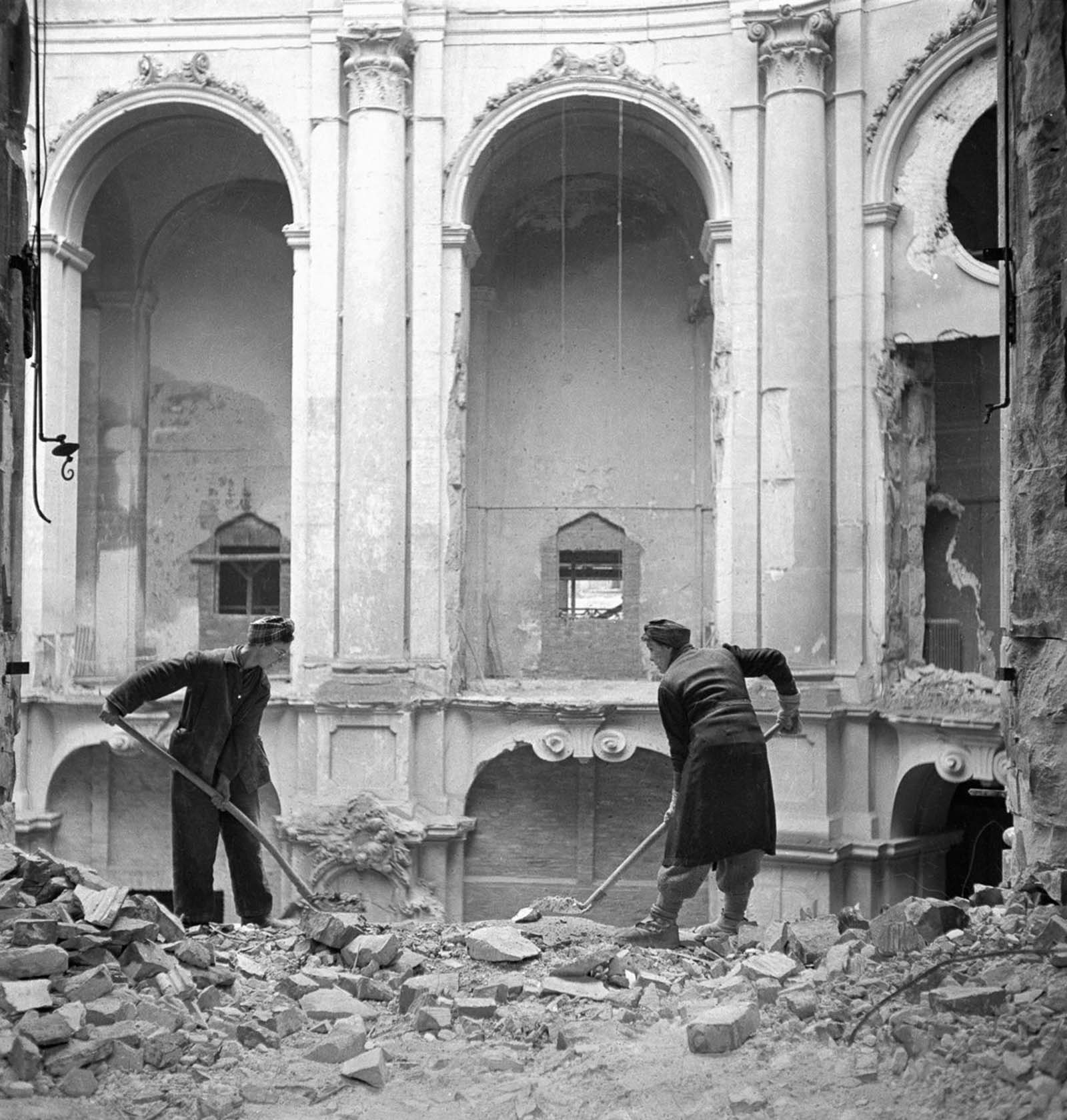
Women clearing rubble from the Zwinger Gallery. 1946.
Workers are building a scale model of Dresden as it was intended to look in 1958 after reconstruction by the Russian occupying forces. 1946.
Volunteers clear rubble on a Sunday morning. 1946.
Reconstruction of Dresden. 1946.

Women pass bricks around on a ruined building. 1946.
People clear rubble from the ruins of the Frauenkirche. 1952.

Dresden in 1956.

Sheep graze near the ruins of the Frauenkirche. 1957.

Dresden in 1961.

A model of the planned development in the city center. 1969.

Dresden 1969.

Related Posts

**Operation Greif:** German commandos in US uniforms cause chaos _de28
When Adolf Hitler developed his strategy for the Ardennes counter-offensive, he knew that capturing at least one intact bridge over the Meuse was crucial. Given…

Irene Stern in Convoy 76 to Auschwitz: Remembering a 13-year-old French girl
Content note (Historical & Educational): This article deals with the Shoah and the persecution and deportation of Jews in war-torn Europe. It serves historical education and…

50+ fascinating color photos capturing street scenes in Germany in 1963
These fascinating photographs, capturing street scenes in Germany, were taken by Roger W. during his summer tour of Europe in 1963. “I had seen a lot of Germany when…”

What you need to know about the Battle of the Bulge
On December 16, 1944, the Germans launched a massive attack on the Allied forces in the Ardennes region of Belgium and Luxembourg during World War II. The…

Over 40 impressive vintage photographs from Bonn from the 1920s to the 1940s _de
The federal city of Bonn lies on the banks of the Rhine in the German state of North Rhine-Westphalia. Approximately 24 km south-southeast of Cologne, Bonn is located in the southernmost part of the Rhine-Ruhr region, the largest…

Young soldiers in the last days of the war – Lauban 1945 _de
It is March 1945. The streets of Lubań (Lauban) in Lower Silesia are filled with cold, destruction, and an oppressive silence. Yet, amidst this scene, columns of troops are marching…