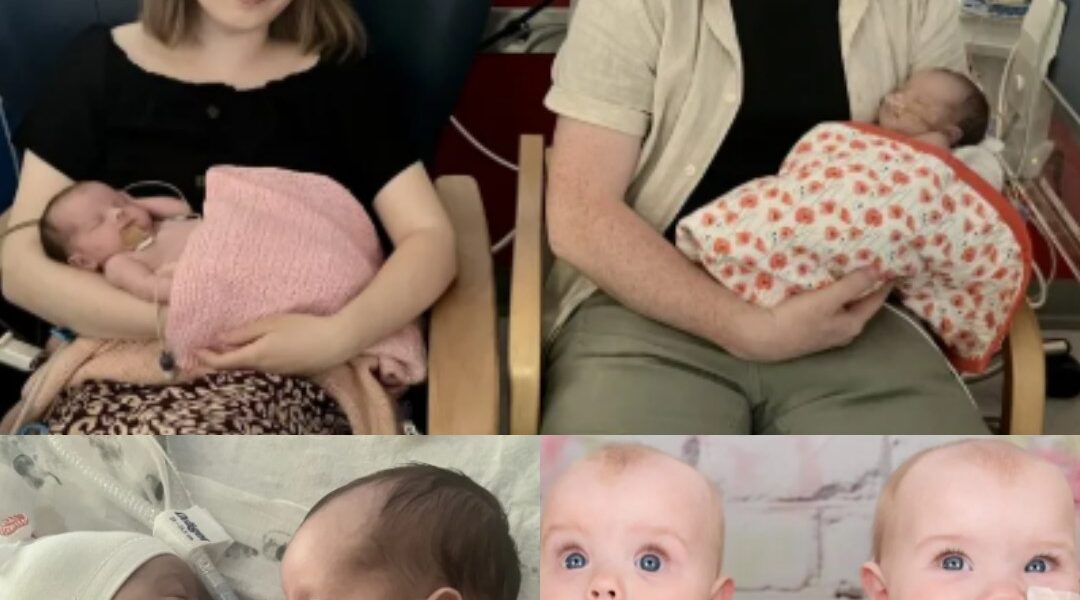

We discovered we were expecting MCMA twins at nine weeks, a rare form of identical twins sharing a placenta and amniotic sac. Because of the complexity, I was referred to a larger hospital for detailed weekly ultrasounds to monitor their development closely.
At 17 weeks, the sonographer noticed that our first twin, Poppy, had transposition of the great arteries (TGA). Neither of us had ever heard of TGA before, but a kind specialist explained the condition in detail and drew diagrams to help us understand. We learned that Poppy would need surgery after birth, and as identical twins, both babies could potentially have the condition.
Weekly fetal echocardiograms became a part of our routine. We were also informed that, due to the risks associated with MCMA twins, we would likely need to deliver early, around 32 to 33 weeks, to minimize complications. The doctors recommended that the birth take place at a specialized cardiac center, ensuring the twins would receive the best possible care.
On 32 weeks and 2 days, I underwent a planned cesarean section under general anesthesia. Posie, our first twin, was born at 14:24, followed just a minute later by Poppy at 14:25—a true miracle and our little TGA fighter. Both babies were quickly stabilized by the medical team, receiving respiratory support and incubator care before being transferred to the NICU.
Doctors warned us that Poppy needed to reach a weight of more than six pounds (about 2.7 kg) before she could undergo corrective surgery. Being premature and weighing only 3 pounds 10 ounces (1.4 kg), we knew that we would face a long wait and a challenging journey before her arterial switch operation. Her weight fluctuated due to breathing difficulties, making each day unpredictable and tense.

Just over a month old, Poppy was moved to the PICU for a balloon atrial septostomy, a procedure intended to provide temporary relief and time before her main surgery. Unfortunately, complications arose after this intervention. On July 7, she suffered a frontal lobe stroke, followed by a Serratia infection caused by the PDA stent, a necessary measure to delay her arterial switch operation.
Poppy continued to face additional challenges, including abdominal distension, oxygen desaturation, and urinary retention. Simultaneously, doctors diagnosed her with coarctation of the aorta (CoA) and unfavorable coronary anatomy, which required close monitoring before and after her arterial switch surgery.
Finally, on July 28, Poppy underwent her arterial switch operation. The surgical team was apprehensive, as her health remained fragile, but delaying surgery was no longer an option. The operation was completed successfully, and her chest was left temporarily open to allow her heart and body to recover safely.
Post-surgery, Poppy’s condition improved steadily. By August 4, she was transferred from the PICU to the cardiac ward. On August 19, she was weaned off the CPAP machine and moved to another hospital for high-flow oxygen therapy. A week later, she was discharged home.
Although Poppy still requires multidisciplinary care, including cardiology, neurology, nutrition, and speech therapy, she is now an 11-month-old happy baby, soon to celebrate her first birthday. She thrives at home alongside her twin sister, Posie, and shows no major health issues apart from mild swallowing difficulties, likely a result of her stroke. She is fed via a nasogastric tube but continues to gain strength and resilience every day.
Poppy attends three-monthly cardiac ultrasounds, and she demonstrates remarkable courage and adaptability. She has brought immense joy and hope to our family, transforming each challenge into an opportunity to celebrate life. Her personality shines through every smile, coo, and playful gesture.

Reflecting on Poppy’s journey, we remain profoundly grateful to the medical teams who cared for her. Every intervention, every consultation, and every moment of vigilance contributed to her survival and progress. Their expertise, compassion, and dedication gave us the confidence that our daughter was receiving the best care possible, even in the most critical moments.
The experience of expecting MCMA twins and facing complex congenital heart disease has taught us about patience, hope, and resilience. Each scan, procedure, and hospital visit reinforced the delicate nature of life and the strength of a family united in love and advocacy. Poppy’s journey is a testament to the power of medical innovation and the unwavering commitment of healthcare professionals.
Today, Poppy is a thriving, joyous baby girl, a living testament to courage and perseverance. She reminds us daily that even the smallest hearts can demonstrate immense strength and that miracles can come in the tiniest packages. Our family cherishes every breath, every milestone, and every moment with her.
Her story also serves as a beacon of hope for other families facing similar diagnoses. It highlights the importance of early detection, specialized care, and community support. Parents navigating high-risk pregnancies and congenital heart conditions can find inspiration and reassurance in Poppy’s journey.
Poppy’s life embodies resilience, determination, and the extraordinary power of love and medicine combined. She has overcome every obstacle with bravery beyond her months, proving that miracles are real. Her presence has strengthened our family and reminded us to treasure every moment, every giggle, and every small victory.

As we celebrate Poppy’s first birthday, we honor her journey from fragile beginnings to her current thriving state. We are grateful for the care she received, the love that surrounds her, and the hope she continues to inspire. Poppy, our little warrior, is living proof that courage and love can prevail, even in the face of the most challenging circumstances.
Six-Year-Old Gentry’s Brave Heart and a Hopeful Christmas.523b

At just six years old, Gentry has already lived a life shaped by courage, hospitals, and battles most adults can barely imagine. Born with Left Hypoplastic Heart Syndrome, a rare and severe congenital heart condition, Gentry survives with one lung and half a heart. Yet what his body lacks in size and strength, his spirit makes up for many times over.
Recently, Gentry returned home after undergoing his fourth open-heart surgery at Stanford University Medical Center in California — another critical chapter in a journey that has demanded resilience from both him and his family since the very beginning.
This latest surgery carried special significance. Doctors were focused on restoring and maintaining proper blood flow to Gentry’s lung, a challenge that has followed him for years. According to his mother, Angel, the procedure was not only successful — it was everything they had prayed for.
“Gentry had his fourth open-heart surgery in California on the 21st, and I’m so grateful to say the surgery went amazingly well,” Angel shared. “Dr. Bishnoi was able to successfully restore blood flow to Gentry’s left lung, something we have been praying and hoping for over a very long road.”

For parents of children with complex heart conditions, hope is often measured in tiny victories. This surgery was one of those moments — the kind families cling to when the path forward has been long and uncertain. For Gentry, restored blood flow means better oxygen, better healing, and a stronger chance at enjoying childhood moments that so many take for granted.
Following surgery, Gentry spent five days in the hospital, closely monitored as his small body recovered from yet another major operation. From there, the family stayed three days at the Ronald McDonald House, a place that offers comfort and stability to families forced to seek life-saving care far from home. On the 28th, after days filled with exhaustion and relief, they were finally able to fly home.
But as Angel has shared time and again, it wasn’t the doctors or machines that impressed people most — it was Gentry himself.
“As always, Gentry amazed everyone around him with his strength and bravery,” she wrote. “Watching such a small boy face so much with so much resilience never stops humbling me. He continues to be our little miracle.”
Those words carry deep meaning. Gentry has grown up knowing hospital rooms, surgical scars, and recovery beds. Yet he continues to face each challenge with a quiet courage that leaves adults in awe. He does not complain. He does not give up. He simply keeps going.

Angel also took time to express gratitude for the support surrounding their family.
“I wanted to sincerely thank you again for taking the time to share Gentry’s story before we left for California,” she wrote. “Your kindness and willingness to help us raise awareness and support meant more to our family than I can put into words. We will always be grateful for that.”
For families like Gentry’s, awareness matters. Support matters. Knowing that others care — even strangers — helps carry them through long nights and difficult decisions.
Despite the good news, the journey is far from over. Gentry’s condition requires ongoing surgical care, and the family already knows what lies ahead.
“We head back to California in April for his fifth open-heart surgery,” Angel shared.
It is a sentence that captures the reality of life with congenital heart disease. Victories are celebrated, but they are never the final chapter. Still, the tone of Angel’s words reflects hope rather than fear — hope built on experience, faith, and the knowledge that Gentry has already overcome so much.
For now, however, there is something especially meaningful waiting for this family: Christmas at home.

After months of preparation, travel, surgery, and recovery, it sounds like Gentry and his parents, Matthew and Angel, will be able to enjoy the holidays together — surrounded by love instead of hospital walls. Moments like these are never taken for granted in families who understand how fragile time can be.
Gentry, after all, is not defined solely by his medical journey. He is a six-year-old boy who loves race cars, firemen and policemen, and chicken nuggets. He adores his siblings, Lucas and Madeline, and shares a special bond with his dogs, Cowgirl and Olive. These details matter because they remind us that behind every diagnosis is a child with joy, preferences, and dreams.
In many ways, Gentry represents what it means to fight quietly and live fully in the moment. He has half a heart by anatomy, but a whole heart in spirit — one filled with resilience, curiosity, and love.
As the year draws to a close, his story offers a powerful reminder of gratitude. Gratitude for medical advances. Gratitude for compassionate doctors and nurses. Gratitude for places like the Ronald McDonald House. And above all, gratitude for time — precious, imperfect, beautiful time.
Let’s send our very best wishes to Gentry and his family. Let’s keep them in our prayers as they prepare for the next surgery and the years ahead. And most of all, let’s hope that this brave little boy is given a long, joyful life — one filled with laughter, love, and all the simple things he enjoys most.