
We discovered that our daughter Violet had Down syndrome when I was 16 weeks pregnant, through ultrasound markers and blood tests. Then, during our routine 20-week scan, we learned she also had a serious heart defect. It was a huge shock, and we were referred to a fetal medicine specialist for a detailed scan.
In a private room, we were told to prepare ourselves for the worst. Termination was offered as an option, but we decided to find out Violet’s gender that same day. Knowing we were having a girl brought a spark of joy amidst the fear.
The following Monday, we attended an appointment at a specialist hospital in London. The team planned a thorough scan and would discuss our options depending on the findings. That weekend was one of the hardest of my life. I called my mother, sobbing uncontrollably — part of me thrilled about a baby girl, part terrified she might not survive pregnancy.
Tiny Tickers on Instagram became a lifeline. Reading stories from other parents gave us hope and a sense of community. It helped us survive that weekend and approach the specialist appointment with a clearer mind.
The detailed scan confirmed that Violet had Tetralogy of Fallot (ToF). Babies with ToF have reduced blood flow to the lungs, which lowers oxygen levels. The cardiologist explained everything carefully, reassuring us that she would be closely monitored and that surgery would be needed within her first year. They emphasized that the surgical team had a high success rate, which gave us some comfort.
Violet was incredibly brave from the start. We attended regular monitoring at our local hospital and in London. Although she was considered high-risk, the team explained she could be born at our local hospital, with the understanding she might spend a few days in the neonatal intensive care unit (NICU).

At 35 weeks and 5 days, a scan revealed reduced amniotic fluid. I was admitted for monitoring, and a cesarean section was scheduled. They gave me an injection to help Violet’s lungs function better. The sudden shift from a natural birth plan to an urgent cesarean was overwhelming, with less than 48 hours to prepare.
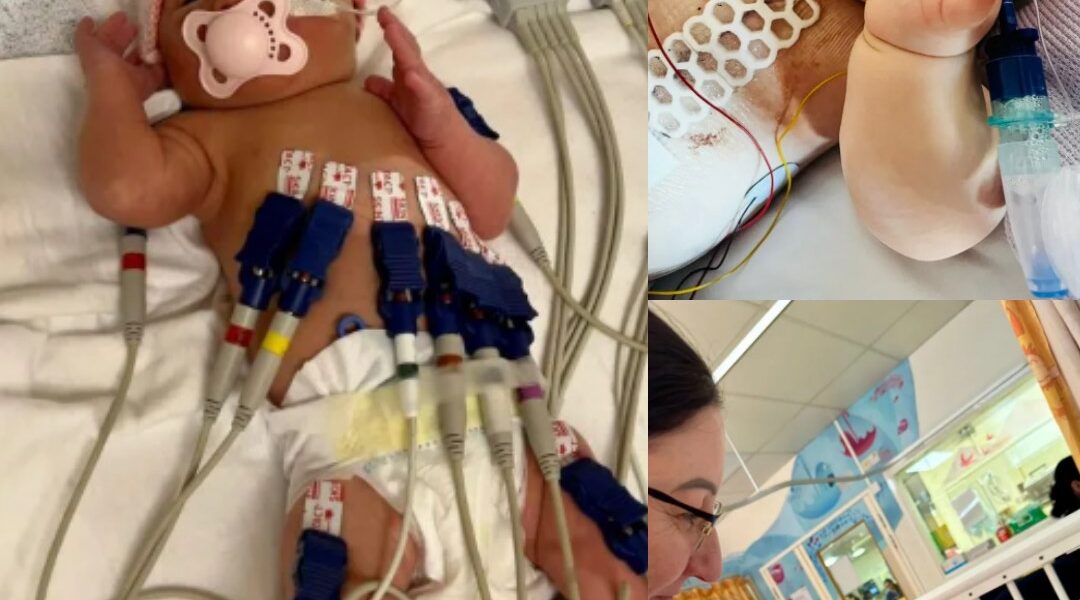
Violet was born at 5:26 p.m., weighing 5 pounds 10 ounces. The operating theatre was full of staff, and she was immediately assessed. She was tiny and required some oxygen. David, my partner, accompanied her to NICU while I recovered in the postnatal ward.
That first night was the longest of my life. I wasn’t allowed to visit Violet until 4 a.m., though David sent constant updates. When I finally held her, she was fragile but strong. She was fed via a nasogastric tube and briefly placed under phototherapy for jaundice.
We stayed in NICU for a week. Initially in an incubator, we were later moved to a private room so we could stay close. I learned to feed Violet through the tube and monitor her oxygen saturation with the support of nurses. They checked in every three hours to ensure she was safe and comfortable.
Two weeks later, cardiac scans revealed that Violet’s heart condition was more complex than initially thought: she had double outlet right ventricle (DORV) alongside ToF. Both the pulmonary artery and aorta were connected to the right ventricle, combined with the four defects typical of ToF.
The information was overwhelming, but the team reassured us that surgery would still proceed. They taught us how to monitor oxygen levels and recognize signs of cyanosis. A nurse visited weekly to monitor her weight and oxygen saturation, ensuring she was prepared for surgery.
Two months later, one of her arteries had narrowed further, reducing her blood oxygen levels. She was prescribed propranolol to slow her heart rate and given a high-calorie formula to promote weight gain. The goal was for her to reach 6 kg, as infants with Down syndrome often have weaker muscles, and optimal weight is crucial before major surgery.

We kept Violet close at all times, watching for any signs of distress. She rarely spent time alone, and the vigilance required was intense. As parents of a child with CHD and Down syndrome, the stress was constant, but we were committed to protecting her.
Our assigned clinical nurse was incredible, always available by phone for advice. After eight months of anxious waiting, we finally received a surgery date. Because we had connected with another mother whose child had undergone ToF surgery, we were somewhat prepared for the hospital experience and the use of medical equipment post-surgery.
Violet recovered well from her operation, returning home with an NG tube for feeding. We celebrated her first Christmas as a family, though we knew her heart could not be fully corrected. Her right ventricle remained shifted, the ventricular septal defect could not close completely, and the pulmonary artery dilation was temporary. She will require additional surgeries in the future, likely during adolescence, depending on her growth and adaptation.
Regular check-ups continue, and Violet has been remarkably brave throughout. I will never forget the anxious waits before surgery, the constant beeping of life-support machines, or the joy of holding her for the first time post-operation.
After the surgery, I even got a tattoo symbolizing Violet’s journey: a heart with ECG lines, three arrows representing our “lucky group,” and the phrase “Love knows no chromosomes.” Looking at it reminds me daily of her resilience and our family’s strength.
Violet is now 28 months old and thriving. I document her adventures on Instagram (violets_extra_adventure), sharing her life despite Down syndrome, aspiration issues, CHD, and developmental delays. She reaches milestones more slowly than peers, and she cannot yet speak, but she is incredibly determined. We celebrate every small achievement.

Over the past two years, we have learned so much from Positive About Down Syndrome (PADS), Tiny Tickers, hospital staff, and friends. They helped us understand her cardiac condition and reinforced that Down syndrome does not define Violet. I hope to support others in a similar way.
Life isn’t always easy, and the future can be worrying. Yet the support we’ve received and the community we are part of has been incredible. We are fortunate to have family and friends who love and support us unconditionally.
I feel incredibly lucky to be Violet’s mother. She is a true warrior, bringing joy to everyone she meets. Her smile is infectious, and I hope she grows up knowing how deeply loved she is.
Love knows no chromosomes.
Seven Years of Learning, Growing, and Thriving in Hospital.118b

For Gio, the hospital has been more than just a place for treatment—it has been a second home for the past seven years. Since first arriving as a young child, Gio has faced medical challenges that would be daunting for anyone. But with the support of our dedicated pediatric team and the unwavering commitment of on-site teachers, Gio has not only managed his health but has continued to grow, learn, and thrive academically.
Gio’s parents first brought him to our hospital worried about his health and whether he would be able to keep up with his classmates. For many children facing long-term or repeated hospital stays, missing school can feel like falling behind in life. Each day away from the classroom can be isolating, leaving children unsure if they will be able to catch up once they return home. Gio’s parents feared he might feel disconnected from his peers, and they worried about how this could impact his confidence and love for learning.
From the very beginning, our hospital’s child life and education teams worked together to make sure Gio’s experience was as normal as possible. One of the most important pieces of that support came from our on-site teachers. These dedicated educators provide individualized lessons, help children with homework, and create opportunities for patients to continue advancing academically despite medical challenges. For Gio, they became more than just teachers—they became mentors, friends, and pillars of support during some of his toughest days.

Gio quickly grew to love his time in the classroom, where he could engage with subjects he enjoyed, ask questions, and see progress despite being in the hospital. Each completed assignment, each new concept learned, brought a sense of normalcy and accomplishment. While medical treatments can be overwhelming and tiring, the classroom became a place of consistency and encouragement, where Gio could feel proud of his achievements and build confidence in his abilities.
The past seven years have not been without challenges. Gio has had to undergo multiple treatments, adjust to new routines, and cope with the uncertainty that often accompanies long-term health conditions. At times, the hospital can feel isolating, even with family nearby. But through it all, Gio’s determination to keep learning has been inspiring. His resilience and positive attitude have not only helped him succeed academically but have also lifted the spirits of everyone around him. Nurses, doctors, and staff often remark on how Gio’s enthusiasm for learning and playful curiosity bring light and energy to the wards.
Gio’s story is a testament to the power of dedicated support systems and the importance of education for children with medical needs. The hospital’s on-site teachers do more than just teach—they help children maintain a sense of identity, purpose, and normalcy. For Gio, staying engaged in schoolwork has allowed him to continue dreaming, setting goals, and planning for the future, even while facing medical uncertainty.

Outside the classroom, Gio has also grown in countless other ways. He has built meaningful friendships with other patients, learned to advocate for himself, and developed coping skills that will serve him for a lifetime. The hospital environment, while challenging, has provided opportunities for him to discover resilience, independence, and creativity. From reading and writing to exploring new interests, Gio has embraced each chance to grow and flourish.
Gio’s parents reflect on this journey with gratitude. “The teachers here have been incredible,” they say. “They’ve made such a difference in Gio’s life, not just academically but emotionally. He feels supported, encouraged, and motivated every day, even when he’s had tough medical days. We couldn’t imagine this journey without them.”
The story of Gio reminds us all of the importance of seeing beyond a child’s diagnosis. While medical care is essential, nurturing a child’s mind, spirit, and sense of normalcy is equally vital. Gio’s experiences demonstrate that with the right support, children can continue to thrive, even in the face of long-term health challenges.
As Gio prepares for the next steps in his education and life, he does so with a foundation of strength, knowledge, and resilience built over seven years of learning in the hospital. His journey is not only a story of medical courage but also a celebration of the dedication of teachers, staff, and families who make it possible for children like Gio to continue growing, dreaming, and achieving.

Gio’s journey is far from over. Every school project completed, every lesson learned, and every small success in the hospital classroom is a victory that echoes far beyond the walls of the hospital. It is a reminder that, even in the face of health challenges, children can thrive academically, emotionally, and personally—when they are supported, encouraged, and believed in.
Seven years may have been spent navigating hospital rooms and treatments, but for Gio, they have also been seven years of learning, growth, and hope. And as he looks toward the future, there is no doubt that his curiosity, determination, and courage will continue to guide him every step of the way.