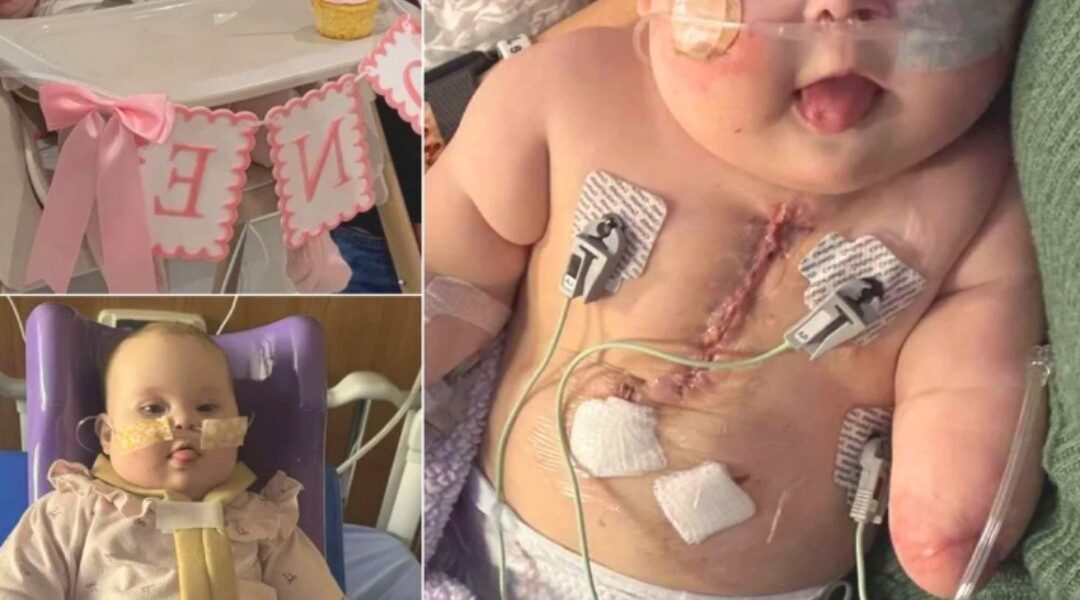

Yesterday, a small gathering of family and friends filled the room with laughter, love, and joy.
Balloons floated gently near the ceiling, the smell of cake and sweet treats lingered in the air, and tiny hands reached for colorful decorations, curiosity shining in their eyes.
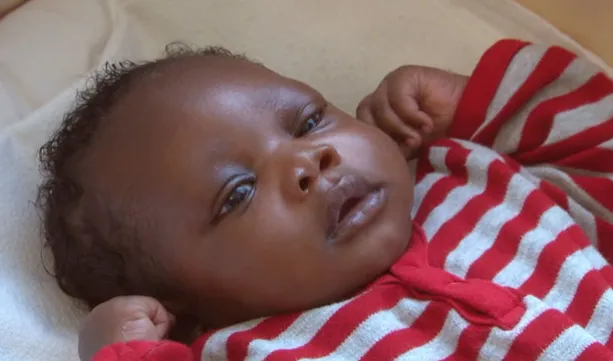
It wasn’t just any birthday party; it was Janie Rose’s first. A milestone that, for many parents, seems like a simple moment in time, but for her parents, Jake and Chasity Clark, it was a celebration of hope, strength, and the miracle they had been praying for since the moment they learned they were expecting her.
Janie Rose was born on January 8th, 2025.
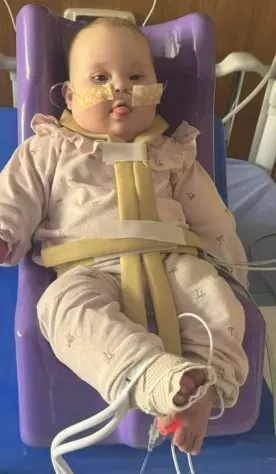
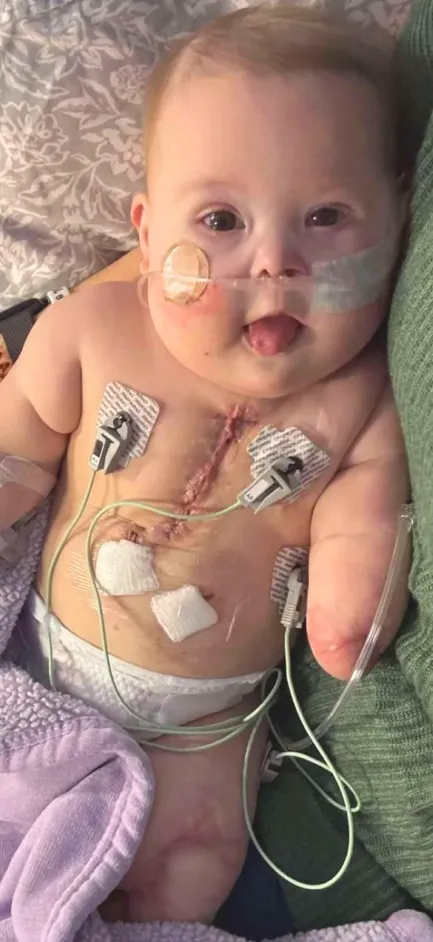
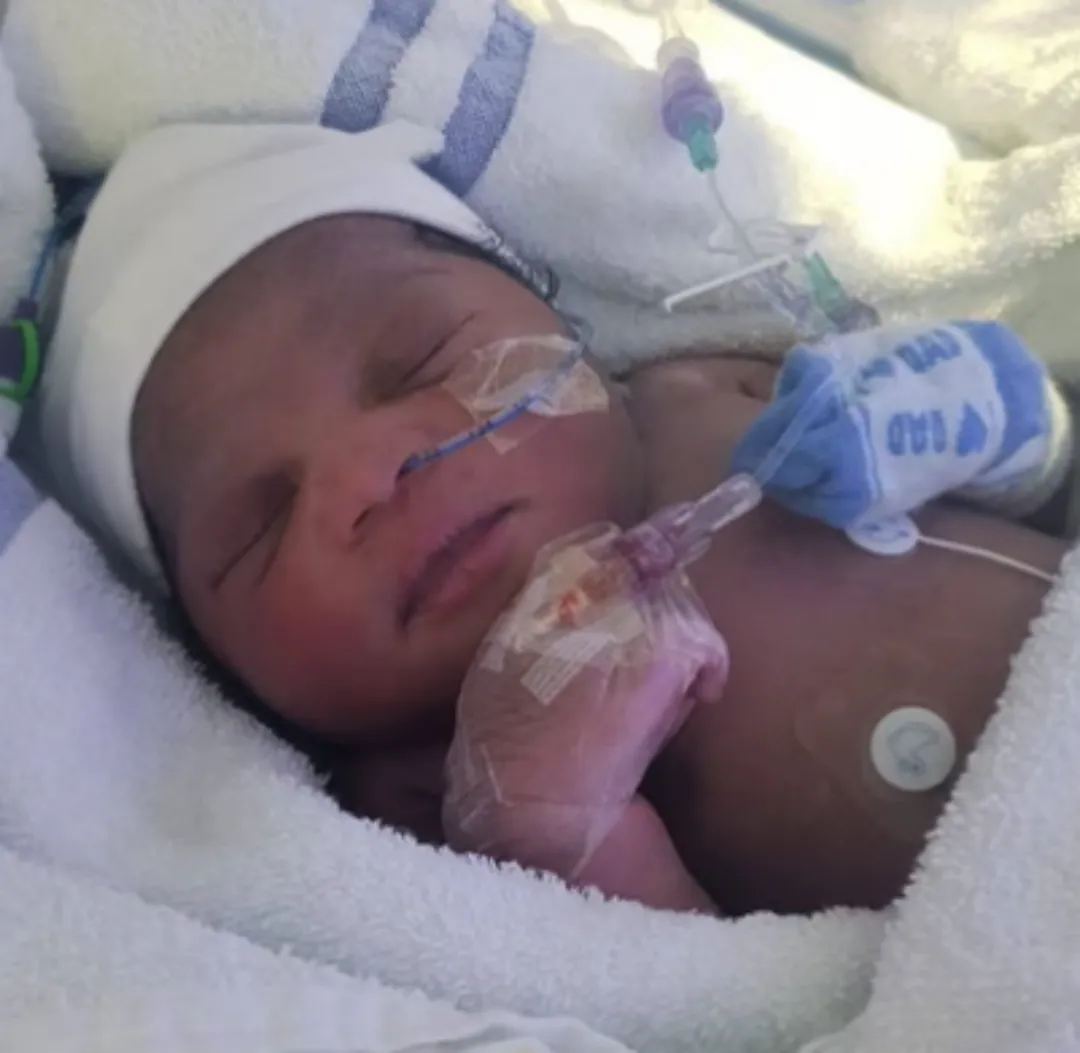
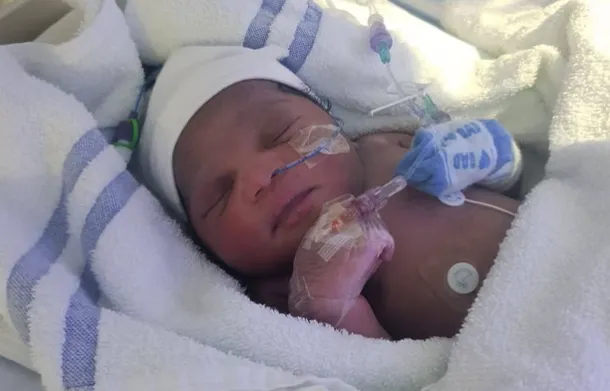
Her arrival into the world was both joyous and fraught with fear. Diagnosed with Down syndrome and a congenital heart defect, her first days were spent in the hospital, connected to monitors and under the constant watch of medical teams who carefully observed every breath, every heartbeat, and every small movement.
The initial prognosis was uncertain, and her parents faced the terrifying possibility that she might not survive the first months of her life.
From the very beginning, Chasity and Jake committed themselves to being present, vigilant, and fiercely loving, even when the days were long and the future unclear.
The hospital became a second home, and each night spent at her bedside was filled with quiet prayers, whispered encouragements, and a steadfast hope that their little girl would overcome every obstacle. They celebrated small victories—stable oxygen levels, a full feeding, or a calm sleep—as triumphs in a battle that seemed to stretch endlessly before them.
The early months of Janie’s life were a mixture of anxiety, love, and perseverance.
Every heartbeat was precious, every coo and smile a reminder that their daughter’s life was worth fighting for. Chasity shared that during the most difficult days, it was her unwavering belief in Janie’s resilience that carried her through.
“She’s my miracle baby in so many ways,” she said, tears glistening in her eyes. “Every day has been a gift.”
Each day survived was not simply measured in hours but in the tiny moments that demonstrated Janie’s growing strength, her ability to endure, and her capacity to bring joy even in the midst of uncertainty.
Jake, too, reflects on the challenges and the beauty of witnessing his daughter grow.
He remembers the early hospital nights, the quiet moments when Janie would grasp his finger with surprising strength, and the first time she smiled, a small curve of her lips that seemed to light up the entire room.
For both parents, every milestone became a profound reminder that life, no matter how fragile at the start, is full of possibilities. Their love, combined with expert medical care, created a foundation on which Janie could flourish.
As the months passed, Janie’s progress amazed everyone who knew her story.
Therapies, check-ups, and follow-ups became routine, yet each achievement—sitting up, rolling over, responding to her parents’ voices—was monumental.
Every day, she proved that determination, resilience, and the unwavering support of loving parents can overcome even the most daunting challenges.
The first smile, the first laugh, and the first gentle coo were all milestones that held immense meaning beyond their simplicity.
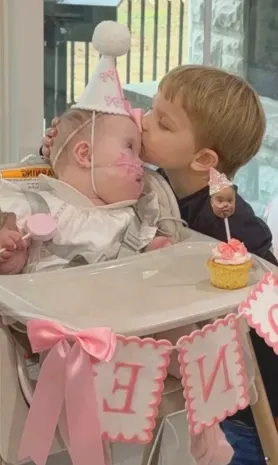
Yesterday’s birthday party was a culmination of this journey.
Family and friends gathered not just to celebrate a year of life, but to honor the strength and courage that Janie and her family had displayed.
Laughter filled the room, mingling with the clinking of spoons against plates and the soft singing of “Happy Birthday.”
There were decorations, a tiny cake, and gifts, but the true celebration was far more profound—it was a celebration of survival, of hope realized, and of love that had never wavered even in the darkest days.
The party also served as a testament to the importance of community and support.
Friends and family had been present throughout the journey, providing encouragement, helping with hospital visits, and celebrating each small victory along the way.
Their presence reminded Jake and Chasity that they were not alone in the journey of raising a child with special needs and medical challenges.
Every hug, every smile, every word of encouragement became part of the fabric that had supported Janie’s first year of life.
As they watched Janie explore her tiny cake with curious hands, tasting frosting for the first time, her parents reflected on how far they had all come.
From the uncertainty of her birth to the careful navigation of her medical needs, every moment had led to this celebration.
The party was not just a birthday—it was a marker of triumph, of resilience, and of the extraordinary journey of a family who never gave up on their daughter.
Janie Rose’s first birthday reminds us that life is fragile, precious, and full of possibilities.
It is a testament to the power of love, perseverance, and community support.
It is proof that even in the face of daunting medical challenges, moments of joy, laughter, and hope can emerge.
For Jake and Chasity, every day with Janie is a gift, every milestone a reminder of the miracles that life can hold, and every smile a reason to celebrate not just her first year, but the incredible journey that continues.
Her story inspires those around her to recognize the strength of the human spirit, the importance of unwavering love, and the remarkable impact of hope sustained by family and community.
Janie Rose may be just one year old, but her journey is a lifelong testament to resilience, courage, and the extraordinary joy that comes when a miracle unfolds before our eyes.
A Cry Beneath the Earth
The quiet village of Baghpat in Uttar Pradesh had just settled into the cool calm of evening when the unthinkable happened. Children were playing in the dusty courtyard, their laughter echoing through the narrow lanes, when a sudden, sharp cry pierced the air. It came from the direction of an unfinished construction site—an open patch of land cluttered with pipes, tools, and half-dug holes.
Little Aarav, barely three years old, had been chasing a rubber ball. In the fading light, he didn’t see the narrow tube well opening hidden by a thin layer of dust. One misstep, a slip, a gasp—and he was gone.
A moment later, his terrified wail rose from deep underground.
His mother screamed.
Neighbors rushed toward the sound. Someone shined a flashlight down the tube. They saw nothing but darkness—and heard the faint, echoing sob of a child too young to understand what had happened to him.
Within minutes, the village was in chaos.
“We need help! Call the authorities!”
“Bring ropes!”
“Find the engineers!”
The well was barely a foot wide—too narrow for anyone to fit through. Aarav was trapped at least 20 feet below the surface.
Soon, the police, fire department, and disaster response teams arrived, their vehicles cutting through the night with flashing lights. Floodlamps were erected. A crowd formed. Silent. Praying.
The rescue teams lowered a small camera into the narrow tube. The screen flickered, blurred, then focused—showing the tiny face of Aarav, streaked with dirt, his cheeks wet with tears. He was sitting awkwardly, squeezed between the walls of the tube, shivering in the cold.
“Aarav! Beta! We are here, baby!” his mother cried, falling to her knees.
At the sound of her voice, the boy whimpered, reaching upward though he couldn’t move freely.
The rescue commander took charge. “We dig parallel. Slowly. If the soil collapses, he could be buried.”
Their plan: dig a second pit beside the well, reach the depth where the child was trapped, then carefully break through the wall to pull him out. It was delicate, dangerous, exhausting—and it had to be done through the night.
And so the race began.
Machines roared, cutting through the earth inch by inch. But as the minutes turned into hours, the challenges mounted. The soil was unstable. Night dew made the ground slippery. Every vibration risked loosening debris into the narrow tube.
To calm Aarav, rescuers constantly spoke to him through a small pipe lowered into the well.
“We are coming for you, little one.”
“You are very brave. Just hold on.”
“Your mama is right here.”
They lowered a small oxygen tube to help him breathe and a wrapped chocolate bar that he clumsily grasped, soothed by the sweetness amid the terror. His cries softened into whimpers, then into exhausted silence.
His mother barely moved. Friends held her shoulders as she stared at the pit, whispering prayers through trembling lips.
Hours passed. Midnight came and went.
The village, usually asleep by then, remained awake—residents gathered with blankets, flasks of tea, and candles. Even strangers who heard the news arrived to help or simply stand in solidarity. No one left. No one even considered it.
By the 10th hour, rescuers reached the correct depth. But the final stage—clearing a horizontal path—required the utmost precision. They used hand tools only, scraping the soil grain by grain.
Every few minutes, they tapped the wall and called out, “Aarav? Can you hear us?”
A faint, tired cry answered.
As dawn lightened the sky, the rescuers finally broke through the last layer of soil. A tiny hand appeared first—covered in dirt, trembling, reaching for life.
One rescuer gently took that small hand and whispered, “You’re safe now.”
Moments later, Aarav was pulled from the darkness and into the arms of the world waiting for him.
The crowd erupted into shouts, tears, applause. Women cried openly. Men, who had stood silent all night, wiped their eyes. His mother collapsed around him, sobbing into his hair as he clung to her, confused but alive.
Paramedics rushed forward, wrapping the boy in warm blankets. Though shaken, dehydrated, and bruised, he was stable—miraculously.
As he was carried toward the ambulance, tiny arms wrapped around the rescuer’s neck, Aarav looked back at the pit that had imprisoned him for fourteen long hours. He didn’t understand the danger or the fear he had endured—only that many people had come together, worked through the night, and refused to give up on him.
One reporter later wrote:
“It was not the machines or the lights that saved the child, but the unstoppable determination of human hearts that would not allow him to die in the dark.”
The story of Aarav spread across India—then beyond. People everywhere were moved by the villagers who stayed awake all night, the rescuers who dug through exhaustion, the mother whose love kept the team going, and the small boy who held on in the narrow darkness, waiting for the world to reach him.
And when they finally did, hope rose with the sun.