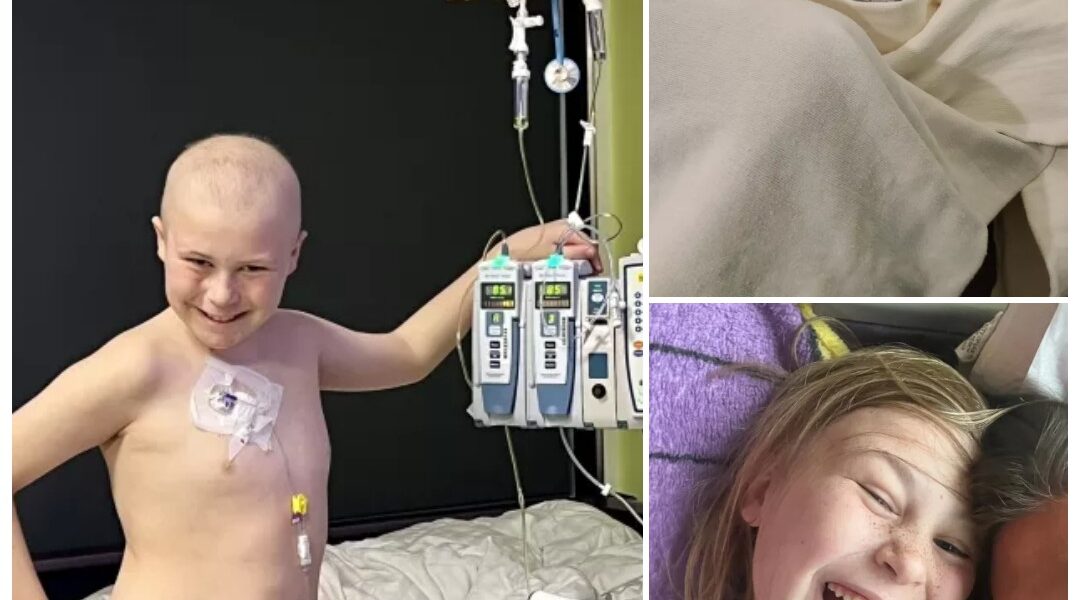
Cooper Estenson: Fighting Leukemia with Courage, Laughter, and an Incredible Team. Hyn

In November 2021, something felt very wrong to the parents of Cooper Estenson. Their energetic young boy, fresh off a successful modified flag football season, suddenly became pale, exhausted, nauseated, and bruised in alarming ways. “I just wanted to lie on the couch and sleep,” Cooper recalls. “I didn’t really have an appetite.”
His mother, Kim Pederson, remembers the sinking feeling that something serious was happening. “This isn’t my child,” she thought. His father, Mike Estenson, shared the same concern. The family knew that the cheerful boy they knew was unrecognizable, but the cause remained a mystery.
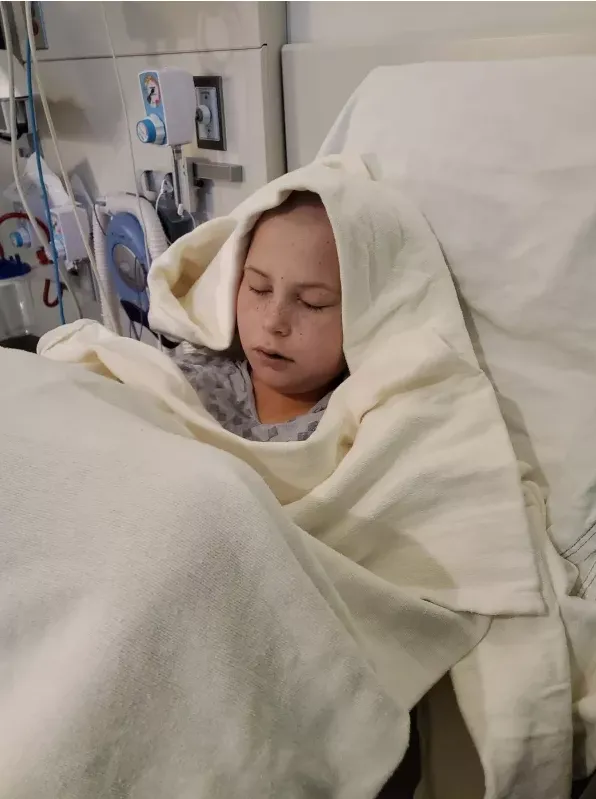
In early December 2021, Cooper was admitted to University of Iowa Stead Family Children’s Hospital for testing. The results were devastating: Cooper had T-cell acute lymphoblastic leukemia, T-ALL, a blood cancer that originates in the bone marrow and can spread to other organs. The news hit the family like a tidal wave, bringing fear, uncertainty, and heartache.
Kim, who had lost a childhood friend to leukemia, struggled to balance her grief with the hope that Cooper could survive. “Cooper looked me in the eyes and asked, ‘I am never going to get out of here, am I?’” she recalls. “He was very sick. I couldn’t lie to him because I didn’t know what the future held. I replied, ‘I don’t know, baby. But we are in good hands.’”
Treatment began immediately. High-dose steroids attacked the leukemia, but also placed stress on Cooper’s kidneys and liver, requiring a short course of dialysis. “This was a really concerning time for us,” Mike says. Cooper was in the Pediatric Intensive Care Unit, under continuous monitoring, including complete blood counts every four hours. The dialysis helped stabilize his body, and soon he was transferred out of the PICU.
By the time dialysis ended, Cooper was released home just in time for Christmas. The reunion was especially meaningful, as the family had been unable to visit during the holidays due to COVID-19 restrictions. At home, Cooper struggled with weakness, nausea, and difficulty absorbing his medications. “Steroids do an amazing job short-term, but long-term, they’re pretty hard on the body,” Mike explains. The hospital team adjusted his treatment plan, balancing the need to fight leukemia with the importance of his strength and well-being.
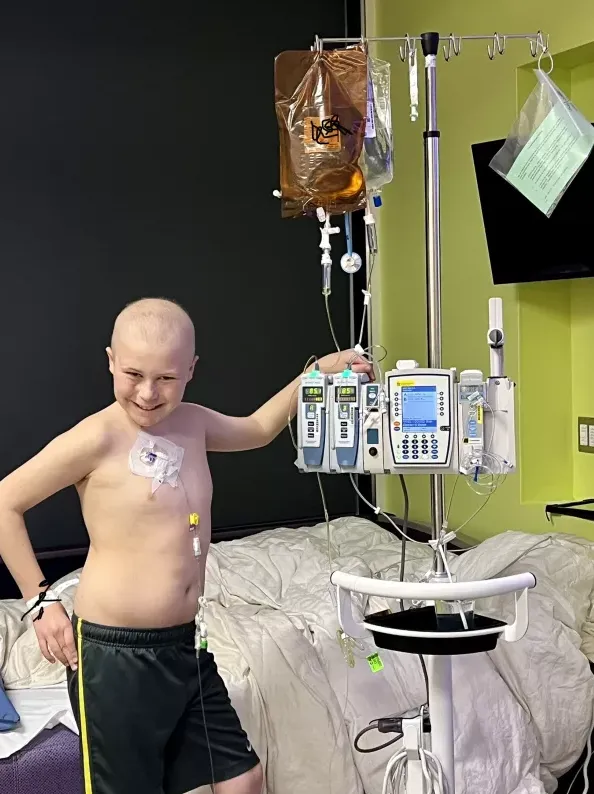
Over the following months, Cooper faced multiple readmissions, including a serious bacterial infection in August 2022 that could have required emergency surgery. Thanks to his immune system and the skill of his medical team, surgery was avoided. Cooper gradually recovered, and his family gained a profound appreciation for the care he received. “We now have a very different perspective on just how amazing this hospital is,” Kim says. “They always had the time to sit in the room and answer our questions. They knew how overwhelmed we felt as parents, and how overwhelmed Cooper was.”
Even during the most challenging moments, the hospital staff went above and beyond. Nurses, doctors, psychologists, housekeeping staff, and teachers all ensured Cooper’s medical, emotional, and educational needs were met. “They’re not just doing their job,” Mike says. “You can tell that they care.” That care, attention, and human connection became a lifeline for Cooper and his family.
Through every needle, scan, and treatment, Cooper’s spirit remained unbroken. Despite the pain and isolation, his humor and love of life persisted. A devoted Hawkeye football fan, Cooper’s favorite part of the game is “the Wave.” To celebrate his progress and bring joy, family, friends, local businesses, and first responders organized a massive wave outside the hospital. They waved glow sticks, held handmade signs, and played music. “It was tear-jerking,” Kim recalls. “It made Cooper and a lot of other kids smile.”
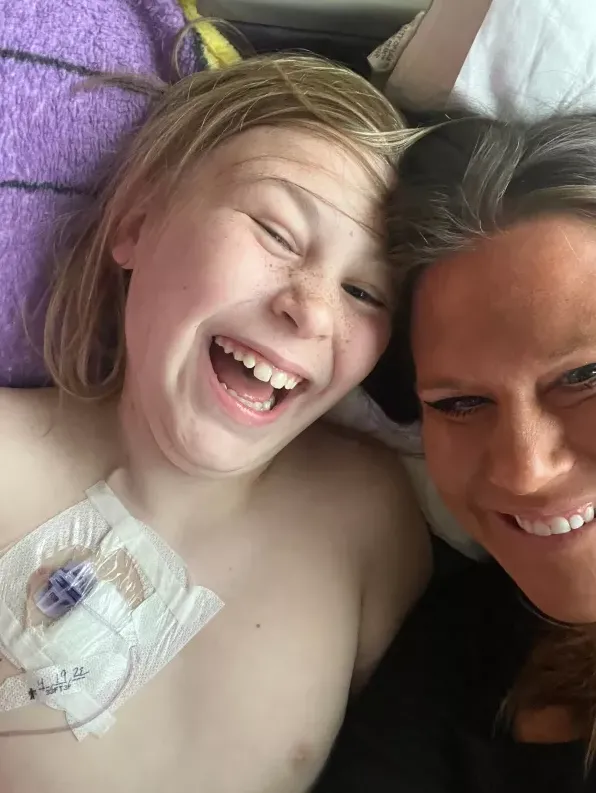
Cooper’s journey demonstrates the incredible resilience of children facing life-threatening illness. Every setback, every hospital stay, every procedure was met with courage and laughter. His ability to maintain optimism and humor amid treatment inspired not only his family but also the medical staff and the community around him.
Now 11 years old and a fifth grader in North Liberty, Cooper thrives. He enjoys art, basketball, swimming, hunting, fishing, golf, and playing with the family dogs. He is also an avid Minnesota Vikings fan, with a favorite player in Justin Jefferson. Through it all, his perseverance has been matched by the unwavering support of his family and the hospital team that treated him not just as a patient, but as a person.
Kim reflects on the experience with gratitude and awe. “We could not have hand-picked a better team to trust our child’s life with. From Day 1, the staff have been our angels. From our amazing doctors and nurses to housekeeping, teachers, psychologists, and everyone involved—this hospital has been our lifesaving miracle.”
Mike adds his heartfelt thanks to the core medical team who guided Cooper through the most difficult year of his life. “We want to recognize and thank all the medical professionals who have helped care for Cooper,” he says. Their expertise, dedication, and compassion made an unimaginable situation navigable.
Cooper Estenson’s story is one of resilience, courage, and hope. From the moment of diagnosis through countless treatments, hospital stays, and procedures, he has faced adversity with humor, determination, and an unbreakable spirit. Each day brings a reminder that love, expert care, and perseverance can create miracles, even in the face of rare and aggressive illness.
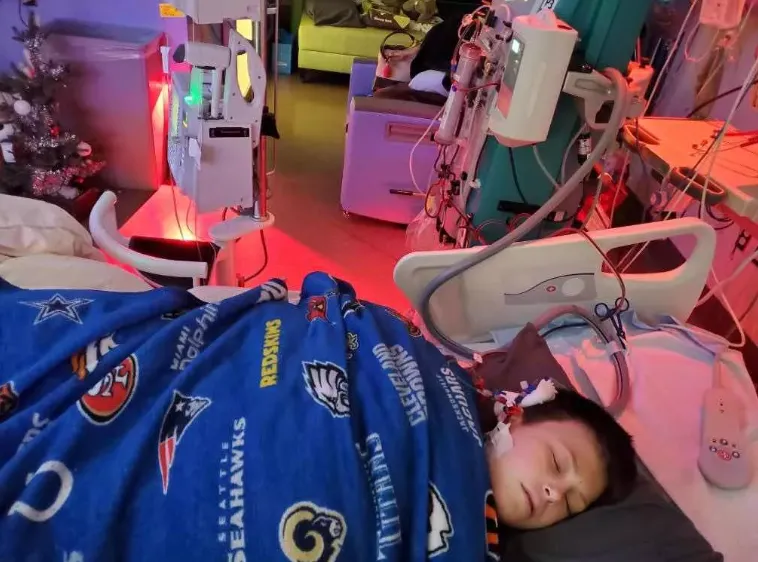
His journey continues with ongoing chemotherapy, both at home and through hospital infusions. Yet Cooper approaches each day with optimism, laughter, and a determination that inspires everyone who knows him. He demonstrates that even in the darkest moments, the human spirit can shine brightly.
Through Cooper, families and communities are reminded that courage is not the absence of fear but the choice to keep moving forward, one small step at a time. His story illustrates how love, dedication, and an extraordinary team of professionals can transform overwhelming circumstances into a journey of hope and triumph.
Cooper’s laughter, his love for football, his curiosity, and his strength in the face of illness all serve as daily reminders that miracles are possible. His family’s advocacy, combined with compassionate care, continues to ensure that Cooper can enjoy childhood to the fullest, despite the challenges of leukemia.
Every hospital visit, every procedure, every day spent recovering represents a victory—not just over disease, but over fear, uncertainty, and the limitations imposed by circumstance. Cooper’s journey is living proof that resilience, humor, and community support are as powerful as medicine itself.
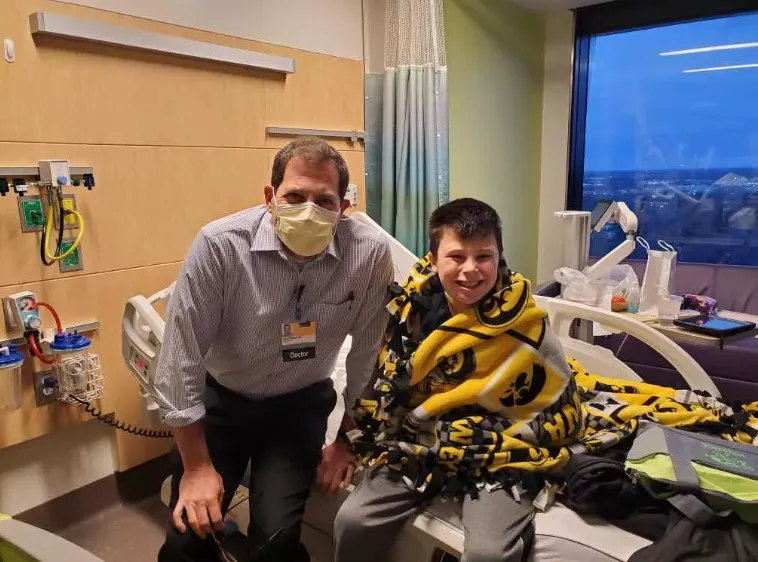
Today, Cooper is thriving academically, socially, and physically. His story continues to inspire other families navigating pediatric cancer, demonstrating that even in the face of serious illness, hope, love, and expert care can create extraordinary outcomes.
Cooper Estenson is more than a patient. He is a fighter, a beacon of hope, and a testament to the extraordinary power of courage, determination, and unwavering support. His journey reminds us that even in the most difficult chapters of life, the human spirit can prevail, and joy, laughter, and love can still flourish.
Yesenia’s Impossible Survival: A Little Girl Who Defied Death
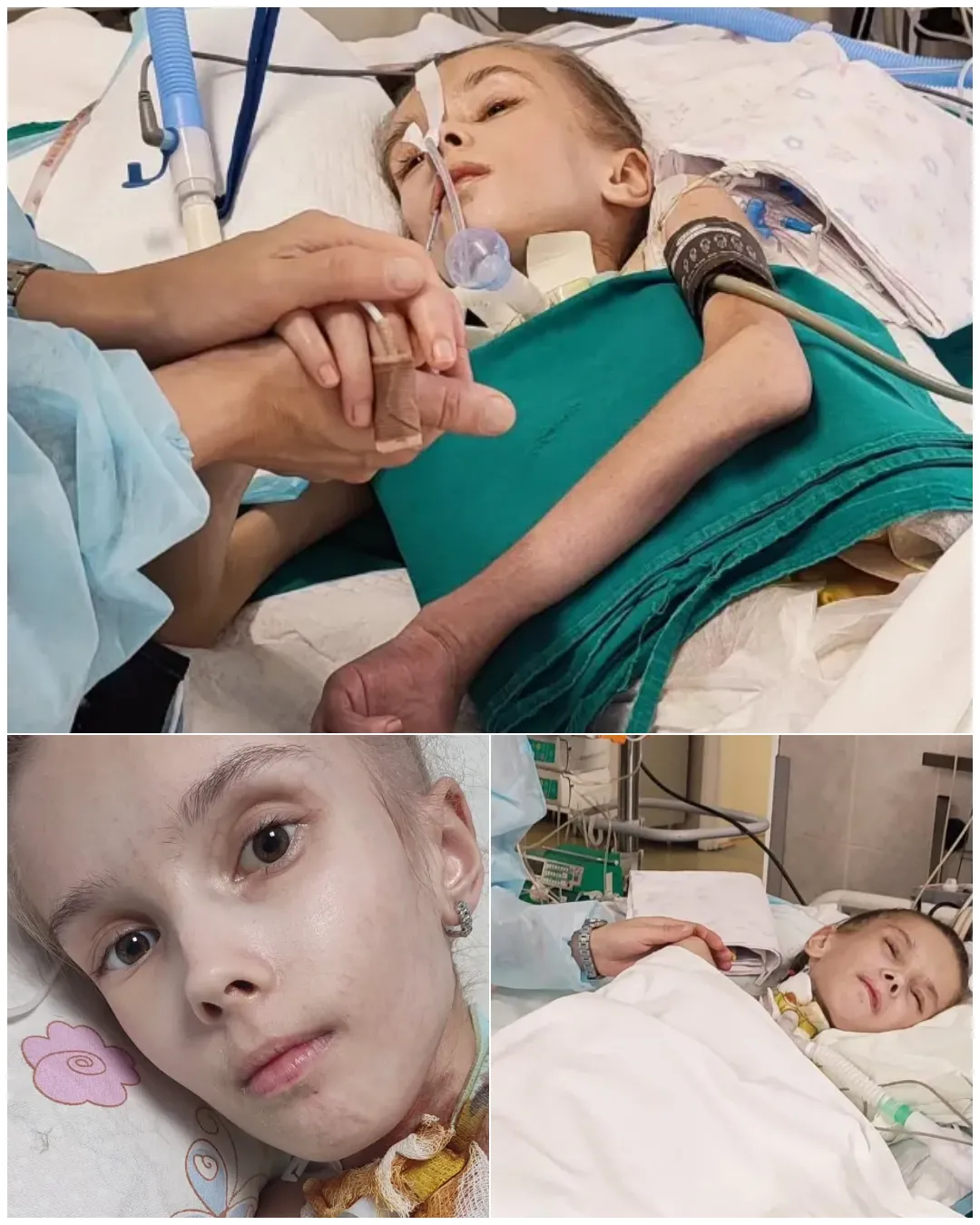
When the doctors first saw what was inside her tiny body, they froze. What they found wasn’t just shocking — it was nearly impossible. Yesenia, a little girl from Kazakhstan, had been rushed to the hospital in Moscow on November 6, 2024, clinging to life by a thread. Her diagnosis: Hirschsprung’s Disease — a rare and dangerous condition that prevents the intestines from functioning properly. By the time she arrived, her body was on the edge of collapse. Infection had spread, her abdomen was swollen and hard, and her temperature was dropping. Every minute mattered. And when surgeons opened her up, they were met with something that would stay with them forever.

The room went silent. Even the most experienced doctors — the kind who had seen every kind of trauma — stopped in disbelief. Inside Yesenia’s abdominal cavity, her intestines were filled with hardened waste, packed so tightly that it had begun poisoning her from the inside. Her organs were inflamed, the tissue dark and fragile. It was a sight no one expected to see in a child so small. The team sprang into action. What began as a diagnosis turned into a race against time — a life-or-death operation that would determine whether Yesenia would live to see another sunrise. One doctor whispered later, “When we opened her up, it was as if her body had been fighting a silent war for months.”

For nearly six hours, the operating room became a battlefield. Scalpel, suction, sutures — every movement had to be exact. One wrong move could end it all. And yet, even as machines beeped and monitors screamed, the surgeons refused to give up.
Hirschsprung’s Disease is merciless. It attacks the body slowly — first by causing chronic constipation, then by trapping waste inside the intestines, leading to infection, swelling, and finally, sepsis. By the time Yesenia reached Moscow, she was barely conscious. Her skin was pale, her breathing shallow, her heartbeat faint. Many thought she wouldn’t survive the night. But Yesenia had something that medicine couldn’t measure — willpower. “She should not have been alive,” said one of the doctors. “But she was. And not just alive — she was fighting.”
When the surgery ended, her condition was labeled “critical unstable.” The team could only wait. Machines breathed for her. Tubes fed her. Her tiny body was connected to life through wires and hope. Every hour was a victory. Every small movement, every flicker of her eyelids, was a miracle.
For the next month and a half, Yesenia remained in intensive care, suspended in the fragile space between life and death. Nurses described her room as “a place of constant prayer.” Alarms rang. Fluids dripped. Doctors rotated in shifts, adjusting medication, monitoring vitals, watching for even the smallest sign of improvement. Some nights were pure terror. Her heart would slow, her temperature would drop, and teams would rush in to stabilize her again and again. Her mother — exhausted, hollow-eyed, but steadfast — refused to leave her side. She slept in a chair beside the bed, holding her daughter’s hand through layers of gauze and tubing. “She’s strong,” she whispered. “My girl is strong. She’ll fight this.” And fight she did.

By mid-December, something began to change. Her fever broke. Her blood pressure stabilized. The infection that once spread like wildfire began to retreat. It wasn’t a sudden miracle — it was slow, fragile, like watching dawn creep over the horizon. For the first time, doctors began to hope. One morning, a nurse leaned close to check her vitals — and Yesenia opened her eyes. Weakly, slowly, but with unmistakable awareness. “She looked right at me,” the nurse said later. “I’ll never forget that moment. It felt like watching life come back into the world.” Tears filled the room that day. The impossible had begun to happen.

Hirschsprung’s Disease is not just a stomach problem — it’s a genetic disorder that leaves part of the intestines without the nerve cells needed to push waste through. Without surgery, it becomes fatal. For Yesenia, that meant her body had been silently building up toxins for months, each day bringing her closer to collapse. Doctors in her hometown tried to help, but the infection moved faster than anyone expected. By the time she reached Moscow, her organs were shutting down. “She came to us at the last possible moment,” said one of the specialists. “Another few hours, and it would have been too late.” But fate — and perhaps something greater — had other plans.

Even after surviving the surgery, Yesenia’s journey was far from over. Her intestines had been partially removed. She needed a colostomy bag. Her immune system was fragile, and every meal had to be measured and monitored. Some days she could barely move. Other days, she smiled. The hospital staff called her “the little phoenix” — because she seemed to rise again and again from the ashes of pain. Slowly, she began to respond — first to sound, then to light, then to her mother’s voice. Her fingers twitched. Her breathing improved. And one afternoon, she reached up and brushed her mother’s cheek. That single touch felt like a miracle.
There’s a kind of courage that can’t be taught — the kind you see in children who should be broken, but aren’t. Yesenia became that symbol. Visitors came — nurses, cleaners, even other patients — all wanting to see the little girl who refused to die. They brought small gifts: paper cranes, stuffed bears, handwritten notes that said things like “You are our miracle.” Her story spread across social media. People from across Kazakhstan and Russia began sending prayers, donations, and messages of support: “Stay strong, Yesenia.” “Little warrior.” “God is with you.” And somehow, she seemed to hear them all.
The doctors had done all they could — the rest, they admitted, was beyond medicine. They called it resilience. Her mother called it grace. Every test result that came back stronger than expected felt like a whispered answer to prayer. Every stable night felt like a small victory against fate. And though no one dared to say the word miracle, it hung in the air — quiet but undeniable. “She was supposed to die,” one surgeon said softly. “But she didn’t. Sometimes, you can’t explain that. You can only stand back and thank whatever power allowed it.”

After six long weeks, the monitors that had once screamed danger began to quiet. The nurses started removing one tube, then another. Her oxygen levels improved. Her body, once frail and gray, slowly regained color. And then — for the first time since that terrible November night — Yesenia sat up. Her mother broke down in tears. Doctors clapped quietly in the corner. It was more than recovery; it was rebirth. The same child who had arrived at the hospital barely alive was now looking out the window, pointing at the snow, smiling faintly. “She made it,” the head nurse whispered. “She actually made it.”

Yesenia’s case became a story whispered across hospitals and households — not just for its medical rarity, but for what it represented. In a world often numbed by tragedy, this little girl reminded people of something simple and profound: hope still exists. Her fight was not just against disease — it was against despair, against the odds, against every reason to give up. And she won.

Today, Yesenia is still healing. She faces more surgeries, more rehabilitation, and a long journey ahead. But the hardest part — the part between life and death — is behind her. Her scars are reminders, not of pain, but of power. Her story is no longer just about sickness — it’s about strength. “She was born to fight,” her mother says. “And now, she’s teaching the rest of us how.” Every heartbeat she has is a victory. Every smile, a celebration.

When the doctors first opened her up, they said she had no chance. But sometimes, chance is overrated. Sometimes, it’s not medicine or logic that saves a life — it’s faith, will, and love that refuses to let go. Yesenia’s journey is proof that miracles don’t always look like lightning or angels in the sky. Sometimes, they look like a tiny heartbeat on a monitor… that keeps going. A little girl who wasn’t supposed to live — and yet, somehow, she did. Her name is Yesenia. And she is still here. Still breathing. Still shining. Because miracles, after all, are just another word for impossible things that refuse to stay impossible.