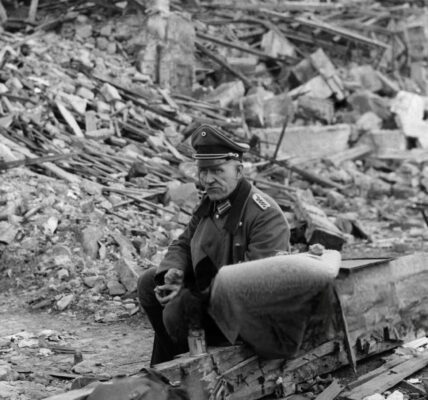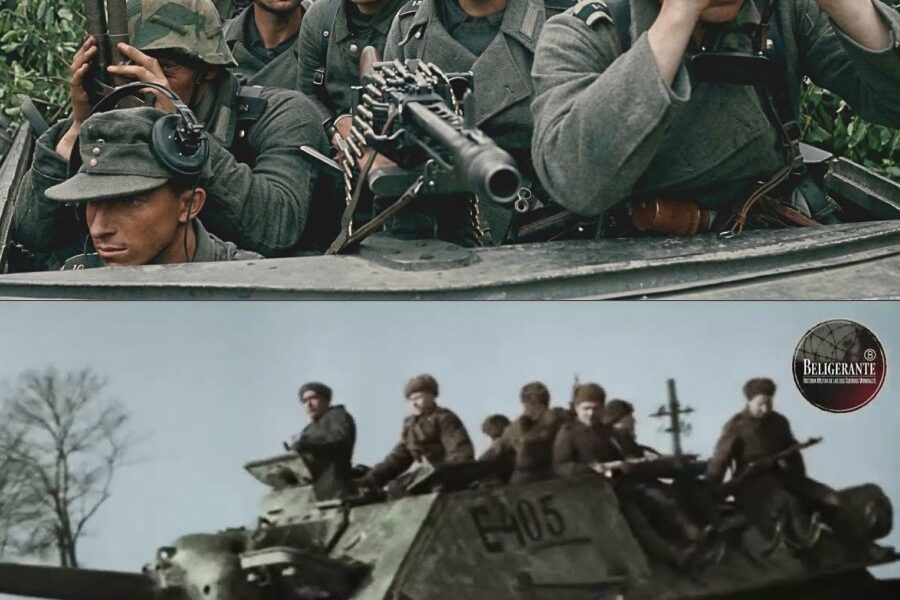


CURLANDIA: El ejército intacto que sobrevivió a la caída del Reich
On May 8, 1945, while the Soviet flag flew over the ruined Richstag and representatives of the German high command signed the unconditional surrender in Carlshorst, something unprecedented in modern military history was happening on a Baltic peninsula called Courland . Twenty veteran German divisions with approximately 200,000 men, hundreds of tanks, heavy artillery and ammunition reserves, received news of the end of the war in intact defensive positions, which the Red Army had failed to break through in six successive attempts
over 8 months. They had not been destroyed, they had not been surrounded in desperate conditions like the Sixth Army at Stalingrad. They were ready to fight, organized with a functional chain of command, awaiting orders from a government that had ceased to exist 48 hours earlier.
The question that this image generates is not heroic or epic, it is technical and brutally practical. How did Germany get into the situation of having its largest reserve of veteran troops from the Eastern Front immobilized in a Baltic swamp while Berlin burned without enough defenders? It was a miscalculation, an ideological obsession, or the logical consequence of a series of decisions that seemed reasonable at the time they were made, and which, viewed as a whole, constitute the greatest waste of military assets of World War II.
The answer begins in Hitler’s mind and in a concept that the German high command had turned into official doctrine with consequences that the Eastern Front would repeatedly prove to be catastrophic. La Festung, the fortress. The idea that a city, region, or position could be declared a fortress and defended to the last man regardless of its actual strategic value, the real possibilities of supply, and what was happening on the rest of the front.
a conviction of Hitler’s that his generals questioned in private and accepted in public, because the cost of questioning it in public had been demonstrated on multiple occasions. Landia, the western strip of what is now Latvia, was declared a position to be defended when Army Group North was cut off from the main German lines in October 1944 by the Soviet offensive that reached the Baltic Sea at Memel.
At that moment, the command of Army Group North requested permission to break the encirclement southward before it became consolidated, exactly as Paulus had requested permission to break the encirclement of Stalingrad two years earlier. The answer was the same, wasn’t it? Courland would defend itself like a fortress.
The Crix Marine would maintain the maritime lifeline, and the Soviet divisions needed to contain those 20 German divisions would not be available for the advance towards Berlin. That last argument, that Courland was tying down Soviet forces that would otherwise advance westward, was the core of the German strategic justification for holding the position.
And it was, in terms of real operational analysis, an illusion built on data that no one in the top command wanted to verify rigorously. The Red Army did not need 140 front-line divisions to hold off the Germans in Courland. It needed sufficient strength to maintain the perimeter of the encirclement, absorb German offensives, and ensure that no breakthrough would change the overall strategic situation.
That role could be performed by second-line units, by reconstituted divisions with young replacements, by formations that the Soviet command would not have considered suitable for the type of deep offensive operation it was conducting westward. The Soviet elite units, the guard tank corps, the most experienced rifle divisions were elsewhere.
They were crossing Poland, they were on the banks of the Oder, they were preparing the final assault on Berlin. The Courland encirclement was the first documented case in World War II of a situation where the encircled side perceived itself as the force exerting strategic pressure on the enemy, while the side closing the encirclement simply ignored it as a determining factor in its main operational plans.
German generals in Courland reported tactical victories in repelled Soviet attacks, counted the enemy divisions identified on their fronts, and concluded that they were fulfilling a vital strategic function . Meanwhile, the Soviet General Staff was planning Operation Vistula- Oder with the resources it considered necessary, and the existence of Army Group Courland did not significantly alter those calculations.
But the analysis of strategic illusion is not the only angle from which Courland deserves to be examined, because there is a logistical dimension that is equally revealing and considerably less discussed. The maritime umbilical cord that the Creigs Marine maintained towards Courland for 8 months was a naval operation of such complexity and cost that the records of the German naval command allow us to quantify it with considerable accuracy.
Keeping 200,000 men fighting for 8 months in a position with no local production of any of the necessary supplies required a constant flow of fuel, ammunition, food, medicine, spare parts and replacement personnel. Standard German army logistics calculations for a force of that size in active operations gave a minimum requirement of between 3,000 and 4,000 tons per month in fuel and ammunition alone, not counting the rest of the supplies needed to maintain the combat capability of the units.
Every ton of cargo that CRICX Marine ships carried to Courland was a ton that did not reach the front lines, where that cargo would have had an impact on operations with real strategic value. Fuel is the most revealing element of that equation, because in the autumn and winter of 1944, Germany was already in an energy crisis that the Allied bombing of synthetic refineries had precipitated in a way that German planners could not ignore.
German synthetic fuel production had fallen from a peak of 316,000 tonnes per month in May 1944 to less than 17,000 tonnes in September of the same year. A reduction of more than 94% in 4 months as a direct result of the Allied bombing campaign. In that context, every ton of fuel sent to Courland represented an opportunity cost that was measured in tanks not moved there, in planes that could not take off at Rik airfields and in supply trucks stranded on German roads.
General Heines Guderian, who as Chief of the Army Staff since July 1944 was responsible for the distribution of resources on the Eastern Front, repeatedly requested authorization to evacuate Courland and use those forces in the defense of the RAIK. His arguments were precise and well-documented. The 20 divisions in Courland represented between 15 and 20 equivalent divisions in actual combat capability , enough to create a strategic reserve that the Eastern Front did not have anywhere else.
Evacuating them was not a defeat, it was the conversion of a fixed asset into a usable asset. Hitler rejected every request. The reasons he gave varied depending on the moment, but they boiled down to two recurring arguments. That abandoning Courland meant giving up the possibility of a future offensive from the Baltic and that troops in Courland tied up Soviet forces that would otherwise be available on other fronts.
The first argument was in October 1944 a fantasy with no basis in the available resources. The second, as we have seen, was an incorrect reading of how the Soviet command was actually allocating its forces. The Pancer Division is the most documented example of what Courland did to the units that defended it.
It was a division with a history that included the French campaign, Barbarossa, the battles of the Don and the fighting on the Southern Front. By 1943, their tank crews had accumulated experience that could not be replaced by any training program in the time available. In Courland, that division functioned for 8 months as what the officers who wrote the post-war reports bitterly and accurately called a fire brigade.
When the Soviet front broke or threatened to break through in any sector of the perimeter, the 10th Panzer was transferred to that point, contained the crisis , and was transferred to the next breaking point before it had time to reorganize, receive maintenance, or rest. This cycle of permanent crisis had an effect on the equipment that the division’s maintenance records clearly reflect.
A tank that fights for 8 months without the scheduled maintenance periods that its mechanical system requires is not the same asset in the eighth month as it was in the first. Tolerances in transmission systems are being widened. Hydraulic joints develop micro-leaks that turn into larger leaks. The barrel accumulates wear on the rifling, which reduces its accuracy.
None of these deteriorations are immediately disabling , but each one marginally reduces the effectiveness of the vehicle, and the sum of these marginal reductions over 8 months of continuous operations produced in January 1945 a division that bore the name and organizational structure of the Pancer, but had a fraction of the combat capability that such a designation should imply.
The six battles of Courland, as the German command termed the successive Soviet offensives between October 1944 and April 1945, were not serious Soviet attempts to destroy the pocket. These were operations designed to maintain pressure, prevent voluntary evacuation, and force the German command to commit its local reserves to the defense of the perimeter.
From the Soviet operational perspective , every battle of Courland that forced the Germans to move the 10th Panzer Division from one sector to another was a successful battle, regardless of how much ground was gained or lost, because the objective was not the ground, but the attrition of the enemy asset in a position of no strategic value.
General Ivan Bagramian, who commanded the First Baltic Front for much of the Courland operations, described the Soviet logic in his memoirs with a clarity that contrasts sharply with the confusion reflected in German documents from the same period. We did n’t need to destroy the Courland group.
We needed to make sure it stayed where it was. Every week they spent with those divisions in Latvia was a week they weren’t on the Oder. Bagramian was right, and the accuracy of his analysis is exactly the measure of the German error. Hitler’s argument that Courland anchored Soviet forces was correct in reverse. Landia was pinning down German forces that the Soviet command was perfectly capable of containing with units it didn’t need anywhere else, whereas the 20 German divisions that remained in that Baltic swamp were precisely the ones that would have made
a real difference in the defense of the Odder. Operation Vistula Oder, launched on January 12, 1945, found the Oder front defended with a density of forces that the German generals themselves described as insufficient in a proportion that made an effective defense impossible. UKV and Kev broke through German positions in days, advanced 500 km in 23 days and reached the Oder less than 80 km from Berlin in the fastest operation on the Eastern Front.
The divisions that could have slowed down that advance and made it more costly were in Courland, fighting the fifth and sixth battles for a perimeter that led nowhere. The Courland opportunity cost simulation is not gratuitous historical speculation; it is the type of analysis that General Staffs routinely conduct to evaluate past alternatives, and the numbers it produces are consistent enough among different military historians to deserve to be taken seriously.
If the 20 divisions of Army Group Courland had been evacuated by means of the naval operation that the Crix Marine was capable of carrying out between July and September 1944, when the logistical window was still viable, and redistributed on the Oder front and in the defensive positions of central Poland, the Vistula- Oder operation would have encountered a defensive system.
significantly denser . Quantifying exactly how much longer it would have taken the Red Army to cross the Oder with those additional forces on the other side is an exercise that produces wide ranges depending on the assumptions used. The most conservative estimates speak of additional weeks. The most ambitious estimates suggest that the Soviet arrival in Berlin could have been delayed by between two and four months.
In the context of 1945, with the war in Europe ending in May and with negotiations on the configuration of the postwar period still underway, those months had geopolitical implications that went beyond the purely military outcome. But there is something more to Courland’s calculation than division numbers and kilometers; they do not fully capture the specific type of loss represented by a veteran unit that is neutralized rather than destroyed.
A soldier killed in combat is a loss that the system can eventually absorb by recruiting and training a replacement. A veteran soldier with 3 years of experience on the Eastern Front who spends 8 months in Courland holding a position of no strategic value and then marches towards the Soviet camps in May 1945.
It is a different kind of loss. It is the loss of the very experience accumulated over years at enormous cost, without that experience having been converted into any outcome that changes the course of the war. The final surrender of Army Group Courland took place between May 8 and 10, 1945. The 200,000 men who had defended the perimeter for eight months without being destroyed marched into Soviet captivity, which for many of them lasted for years.
The percentage of survivors from Soviet camps among the Courland prisoners was significantly lower than that of the general post-war German population. And those who returned did so mostly between 1953 and 1956, a decade after the end of the war. The balance sheet of Courland, reduced to its fundamental elements, is this.
Germany maintained for 8 months, at a logistical cost that accelerated the collapse of the Reich’s supply system , a force of 20 veteran divisions in a position with no real strategic value that did not change the outcome of any of the operations that determined the end of the war and that in the end was handed over intact to captivity, without having fulfilled any of the objectives that supposedly justified its stay there.
There was no glory in Courland. There was tactical competence applied to the wrong objective, bravery invested in defending a perimeter that nobody needed to defend. And the clearest demonstration that World War II produced of a truth that modern wars repeatedly confirm is that an army without a strategic objective is not a reserve, it is an accounting cost waiting to be liquidated by history.
The 200,000 men who marched out of Courland toward the Soviet camps in May 1945 had not been defeated on the battlefield. They had been defeated in the offices where someone decided that keeping them in a Baltic swamp was preferable to using them where they would have made a difference.
They didn’t make that decision , they paid for it.