In the early hours of August 29, 1937, the stillness of downtown Detroit was violently shattered by a massive explosion that sent shockwaves through the city. Residents were jolted awake as the deafening blast echoed between buildings, leaving behind confusion, fear, and a rapidly growing crowd of stunned onlookers.
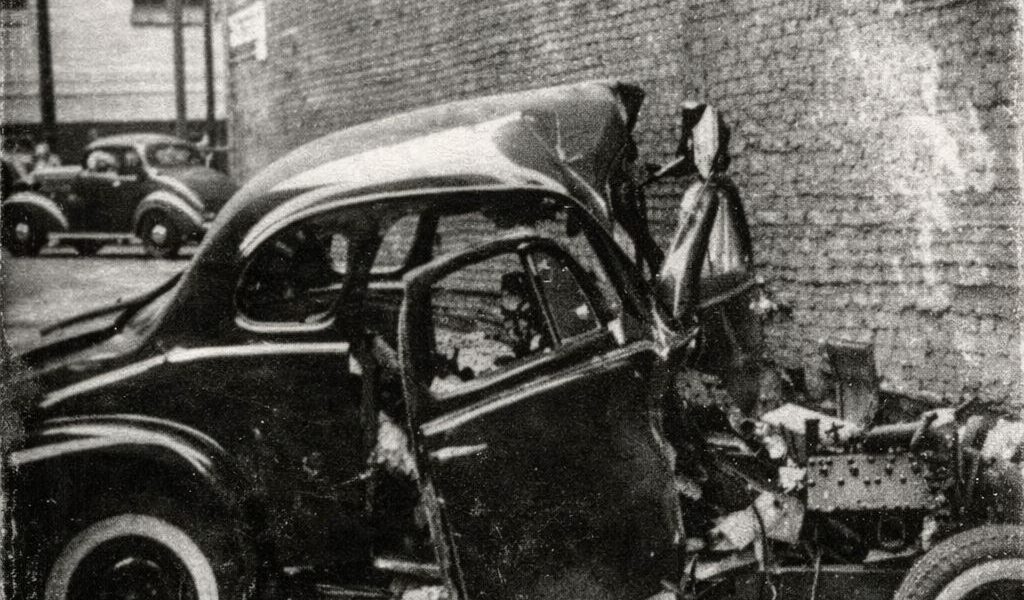
At the center of the destruction was a Cadillac LaSalle—once a sleek symbol of wealth and power—now reduced to twisted, smoking wreckage. The car belonged to Harry Millman, a feared enforcer for the infamous Purple Gang, a criminal organization that had dominated Detroit’s underworld during Prohibition and continued to exert influence long after.
The force of the explosion was staggering. Witnesses reported that parts of the vehicle were hurled across the alley behind Club Ten-Forty, with the car’s hood blown clean off and discovered on the roof of a nearby five-story building. The scene looked less like a car bombing and more like the aftermath of a battlefield detonation.
Yet in a twist that seemed almost unbelievable, the intended target—Harry Millman—was nowhere near the vehicle when it exploded.
Millman, known for his brutality, heavy drinking, and ruthless extortion of brothels and gambling dens, had narrowly escaped death by chance. Just moments earlier, he had handed his car keys to a valet attendant. Unaware of the danger, the valet approached the car—only to be caught in the devastating blast. The bomb, clearly meant for Millman, instead claimed the life of an innocent man.
The tragedy underscored the cold and indiscriminate nature of organized crime violence. In the world Millman inhabited, loyalty was fragile, enemies were everywhere, and collateral damage was often ignored.
Investigators quickly concluded that the explosion was no accident. It bore all the hallmarks of a calculated assassination attempt, likely tied to internal conflicts or rival factions within Detroit’s criminal networks. By 1937, the Purple Gang was no longer at its peak, but tensions, betrayals, and power struggles still fueled deadly confrontations.
As for Millman, his brush with death proved only temporary.
Just three months later, his luck finally ran out. He was gunned down at Boesky’s Restaurant and Deli—an establishment known as a gathering place for figures connected to the underworld. This time, there was no escape. The man who had survived a bomb meant to obliterate him was ultimately brought down by bullets, marking the end of his violent career.
Millman’s death was not an isolated incident, but part of a broader pattern that defined Detroit’s gangland era—a time when crime syndicates operated with boldness, and disputes were settled with bombs and gunfire rather than words.
👉 The 1937 explosion remains one of the most chilling reminders of how unpredictable and ruthless life in the underworld could be—where even a simple decision, like handing over your car keys, could mean the difference between life and death.