
From the moment she was born, Fatima’s heart was different.
Doctors called it Type 4 pulmonary artery abnormality — a rare and life-threatening congenital heart defect.
To her parents, it was something simpler, and far more terrifying: a countdown.

Her tiny heart wasn’t built the way it should be. Blood couldn’t flow properly through her lungs. Her skin, once pink and warm, began to take on a bluish hue — the silent mark of oxygen deprivation.
And so, before she could even speak her first word, Fatima was already fighting for her life.

The First Battle: Open Heart Surgery at Five Months
Most babies spend their first year learning to crawl.
Fatima spent hers under bright surgical lights.

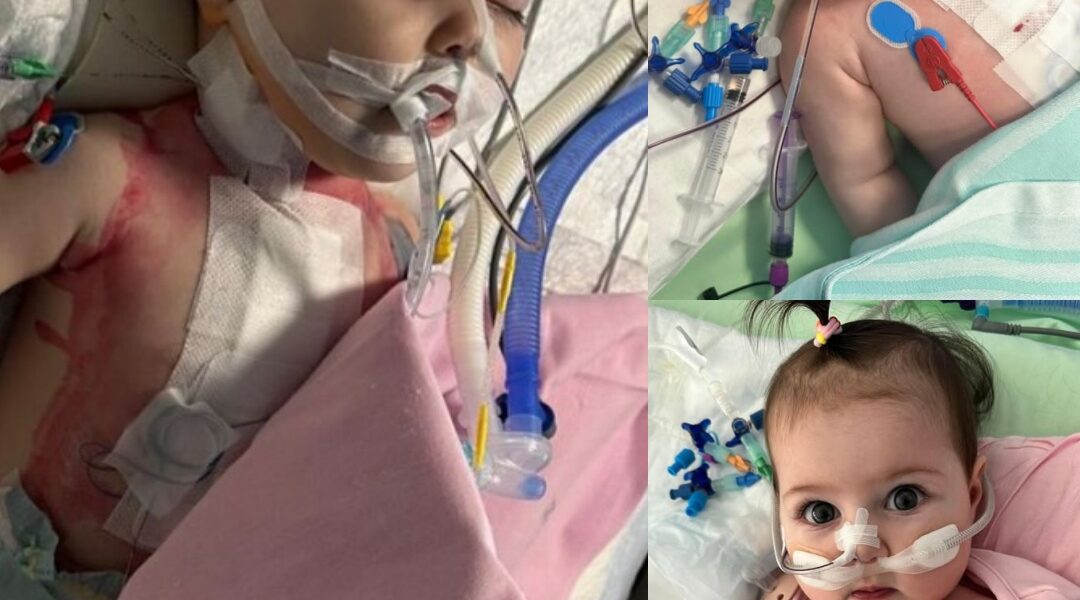
At just five months old, she underwent her first open-heart surgery. Doctors opened her chest, working delicately to repair what nature had not finished. But when they reached her tiny heart, they discovered something far more complex than expected — her arteries were twisted and fused in ways that made a full correction impossible.
So they did what they could: a partial reconstruction, a bridge of hope.

When she woke up, her parents wept — not just because she had survived, but because they knew this was only the beginning.
Her recovery was long and painful. Fevers came and went. Antibiotics changed again and again. There were nights when her mother slept sitting up, holding Fatima’s fragile body against her chest just to make sure she was still breathing.
But the worst was still to come.

The Second Surgery: Through the Pain, Through the Arm
A month after her first procedure, doctors decided to attempt something few surgeons dared.
Because of Fatima’s complex anatomy, the only safe way to reach her left lung was through an incision under her arm — a path less traveled, far riskier, and unimaginably painful.

The second operation involved installing an artificial conduit, a small graft designed to improve blood flow. It was their best chance to give her body more oxygen, more time, more life.
The surgery lasted for hours. Her parents sat outside, counting seconds on a clock that refused to move.

When it was over, the surgeon emerged with tired eyes and said quietly:
“She made it. But it will be a long road.”
And it was.
Fatima’s small chest rose and fell unevenly for days. Every breath seemed like a struggle between willpower and exhaustion. She cried less — not because she didn’t feel pain, but because she had learned that crying made it harder to breathe.
Her body healed slowly. Her spirit did not.

A Childhood Measured in Numbers
For most children, life is measured in birthdays, school years, and growth charts.
For Fatima, it’s measured in
oxygen levels.
Doctors watch her saturation rate — the percentage of oxygen in her blood.
A healthy child should have around 95 to 100 percent.

Fatima’s number? Seventy-two.
That’s how she lives — with a heart that works too hard, and lungs that can never quite catch up. Her lips are often tinged with blue. Her fingers, slightly purple. And yet, she still smiles, still laughs, still clings to life with a strength that defies her fragile frame.
But lately, even that strength is fading.

Her breathing has become shallow. Her energy has dropped. The same child who once played quietly in the corner now spends much of her day lying still, her small chest heaving with effort.
Every few minutes, her mother reaches over, pressing a hand to her daughter’s forehead — counting breaths, listening for the rhythm that keeps their world turning.

The Hope That Keeps Her Alive
Doctors have made one thing clear: Fatima needs another surgery — and soon.
Her veins, they say, may have grown enough to allow for the next stage of correction. But time is running out. The longer they wait, the more strain her body endures — and the greater the risk of irreversible damage.
“Her condition is severe,” one cardiologist explained. “We can stabilize her for now, but without surgical intervention, she won’t survive the next few years.”

The operation would be complex and expensive. It would require advanced equipment, a specialized surgical team, and weeks — possibly months — of postoperative care.
But it could also save her life.
And for a mother watching her child fade day by day, “could” is enough reason to fight.

The Weight of a Mother’s Love
Fatima’s mother has become her nurse, her caretaker, her guardian against despair.
She knows the smell of antiseptic better than perfume.
She knows the sound of her daughter’s heart monitor better than her own heartbeat.
She knows the price of medicine down to the last coin — and the cost of missing even one dose.

“Sometimes,” she says, “I pretend everything is normal. I braid her hair, I tell her stories, I make her laugh. Because I don’t want her to see my fear. But at night, when she’s asleep, I fall apart.”
There are nights when she cries quietly into her hands, afraid to wake her daughter. There are mornings when she counts every dollar left and wonders which bill she can delay to buy another day of medicine.
And still, she smiles for Fatima — because that’s what mothers do.

The Unfairness of It All
It’s hard not to ask why.
Why does a child have to fight for air while others run and play freely?
Why must a mother beg strangers for the chance to save her daughter’s life?
Why does hope have a price tag?

Every day that passes without surgery makes the questions heavier.
The medical team is ready. The hospital is ready. But the cost — tens of thousands of dollars — stands like a wall between Fatima and her future.
Her family has nothing left to sell. They’ve given up savings, jobs, even their home. All that remains is love — and the desperate hope that somewhere, someone will hear their story and care enough to help.

The Girl Who Smiles Through the Blue
Despite everything, Fatima remains extraordinary.
She colors pictures of the sky in deep shades of blue — maybe because it’s the color she knows best.
She names her dolls after nurses. She listens to her heartbeat through a toy stethoscope and giggles when it’s too fast.

“She’s our miracle,” her grandmother says softly. “Every time she smiles, it feels like the world stops hurting for a moment.”
But miracles, as her family knows too well, need help to survive.

A Future Hanging by a Thread
Fatima’s doctors are watching closely. Her oxygen levels continue to drop. Her body is weakening under the constant strain of her damaged heart.
The next surgery could change everything — or it could be her last.
No one can say for sure.

But everyone agrees on one thing: doing nothing is no longer an option.
Every delay pushes her closer to the edge. Every day without surgery is a day stolen from her future.
The team is ready. The hospital awaits. The only thing standing in the way is funding — a number that grows more impossible with each passing week.

The Meaning of Courage
Courage doesn’t always roar. Sometimes, it breathes quietly in a hospital bed.
Sometimes, it has a small blue face and eyes that still sparkle with hope.
Fatima’s story is not one of defeat — it’s one of defiance.

She has survived against the odds before, and with help, she can do it again.
Because somewhere inside that fragile chest beats a heart that refuses to quit.
A heart that, though flawed, burns with the will to live.

A Call to Action
Fatima’s doctors say she is running out of time.
Her surgery must happen soon — while her veins are still strong enough to sustain it.
Her family cannot do it alone. They need help — financial, medical, emotional.

This is not just a story about illness. It’s a story about possibility — about how strangers can change the course of a child’s life.
Because when love, medicine, and compassion come together, miracles happen.

Fatima is waiting — her mother by her side, her small chest rising and falling like a fragile flame.
Every second counts.
Every breath is borrowed time.
Every act of kindness could be the one that saves her life.

She doesn’t want much — just the chance to breathe freely, to grow up, to run under the same sky she colors every day.
And maybe, if the world listens, she’ll get that chance.
Because every child deserves a heartbeat that doesn’t hurt.
Page 2
From the moment she was born, Fatima’s heart was different.
Doctors called it Type 4 pulmonary artery abnormality — a rare and life-threatening congenital heart defect.
To her parents, it was something simpler, and far more terrifying: a countdown.
Her tiny heart wasn’t built the way it should be. Blood couldn’t flow properly through her lungs. Her skin, once pink and warm, began to take on a bluish hue — the silent mark of oxygen deprivation.
And so, before she could even speak her first word, Fatima was already fighting for her life.
The First Battle: Open Heart Surgery at Five Months
Most babies spend their first year learning to crawl.
Fatima spent hers under bright surgical lights.
At just five months old, she underwent her first open-heart surgery. Doctors opened her chest, working delicately to repair what nature had not finished. But when they reached her tiny heart, they discovered something far more complex than expected — her arteries were twisted and fused in ways that made a full correction impossible.
So they did what they could: a partial reconstruction, a bridge of hope.
When she woke up, her parents wept — not just because she had survived, but because they knew this was only the beginning.
Her recovery was long and painful. Fevers came and went. Antibiotics changed again and again. There were nights when her mother slept sitting up, holding Fatima’s fragile body against her chest just to make sure she was still breathing.
But the worst was still to come.
The Second Surgery: Through the Pain, Through the Arm
A month after her first procedure, doctors decided to attempt something few surgeons dared.
Because of Fatima’s complex anatomy, the only safe way to reach her left lung was through an incision under her arm — a path less traveled, far riskier, and unimaginably painful.
The second operation involved installing an artificial conduit, a small graft designed to improve blood flow. It was their best chance to give her body more oxygen, more time, more life.
The surgery lasted for hours. Her parents sat outside, counting seconds on a clock that refused to move.
When it was over, the surgeon emerged with tired eyes and said quietly:
“She made it. But it will be a long road.”
And it was.
Fatima’s small chest rose and fell unevenly for days. Every breath seemed like a struggle between willpower and exhaustion. She cried less — not because she didn’t feel pain, but because she had learned that crying made it harder to breathe.
Her body healed slowly. Her spirit did not.
A Childhood Measured in Numbers
For most children, life is measured in birthdays, school years, and growth charts.
For Fatima, it’s measured in
oxygen levels.
Doctors watch her saturation rate — the percentage of oxygen in her blood.
A healthy child should have around 95 to 100 percent.
Fatima’s number? Seventy-two.
That’s how she lives — with a heart that works too hard, and lungs that can never quite catch up. Her lips are often tinged with blue. Her fingers, slightly purple. And yet, she still smiles, still laughs, still clings to life with a strength that defies her fragile frame.
But lately, even that strength is fading.