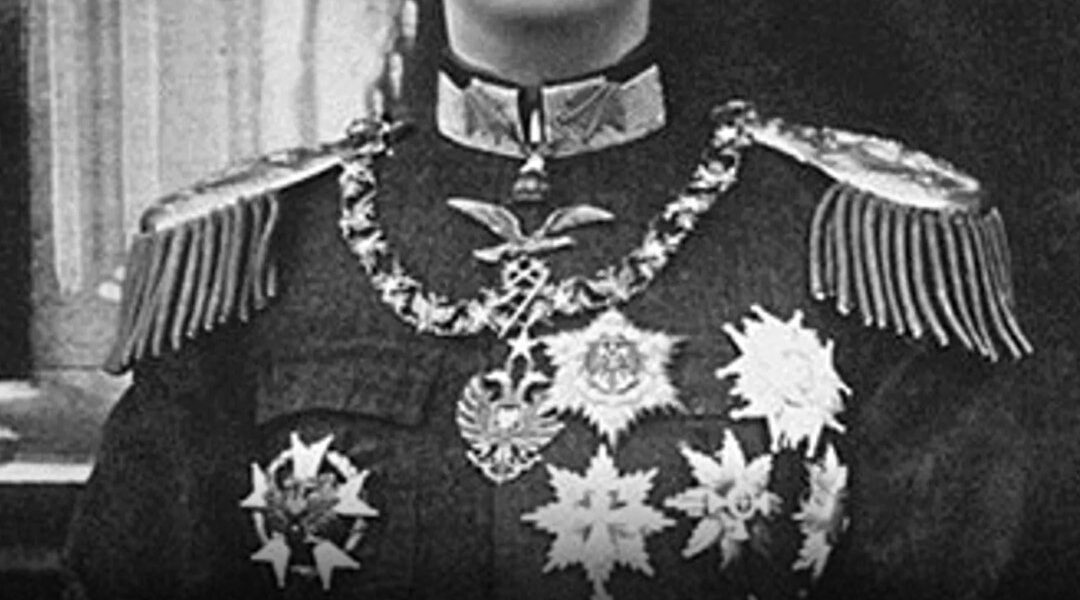
He ruled a small Balkan country, but lived like the main character in an action thriller no publisher would dare to print. King Zog I of Albania chain-smoked nearly 200 cigarettes a day while surviving more than fifty assassination attempts. He dodged bullets, poison, bombs, and once returned fire on would-be killers outside the Vienna State Opera in full evening dress. Surrounded by enemies at home and foreign powers abroad, simply staying alive became his greatest political skill. His life proves that some real stories are so outrageous they sound completely made up—even by Hollywood standards. Hyn

King Zog I of Albania lived a life that sounded closer to pulp fiction than to actual monarchy. On paper, he ruled a small Balkan nation during one of Europe’s most unstable eras. In reality, he spent his reign chain-smoking, dodging bullets, and surviving a relentless series of assassination attempts that would have killed most men several times over. His story isn’t well-known outside Albania and historical circles, which is remarkable considering it reads like a thriller novel someone wrote and then decided was too implausible to publish. Born Ahmet Muhtar Zogolli in 1895, Zog came from a powerful Muslim landowning family in Albania—a small, mountainous country wedged between Greece, Yugoslavia, and the Adriatic Sea. Albania had only gained independence from the Ottoman Empire in 1912, and by the 1920s, it was a fractured nation torn between rival clans, foreign influences, and competing visions of what Albanian independence should actually mean. Zog navigated this chaos through a combination of political cunning, military force, and sheer survival instinct. By 1925, he’d maneuvered himself into the presidency. By 1928, he’d transformed Albania into a monarchy with himself as King Zog I—the only Muslim king in modern European history. But ruling Albania meant living with a target painted on your back. Rival clan leaders resented his consolidation of power. Political opponents saw him as a dictator. Foreign powers—particularly Italy and Yugoslavia—wanted to control Albania’s strategic position, and Zog’s independence made him an obstacle. Communists, nationalists, monarchists who opposed him, republicans who rejected monarchy entirely—everyone had reasons to want him dead. And many of them tried. Records from the period, including diplomatic reports and memoirs from Zog’s staff, describe more than fifty separate assassination attempts on his life. The exact number is disputed—some sources claim 55, others suggest even more—but what’s undisputed is that King Zog survived an extraordinary number of attempts to kill him. Poisoned food. Ambushes on mountain roads. Bombs planted in his residence. Shootings in public. Palace attacks. The creativity of his would-be assassins was matched only by their consistent failure. Zog developed habits that reflected this constant danger. He rarely followed predictable routines. He varied his routes. He surrounded himself with loyal guards—though loyalty in Albanian politics was always provisional. He reportedly slept with weapons nearby and trusted almost no one completely. But his most famous habit had nothing to do with security. King Zog smoked. Constantly. Obsessively. Nearly two hundred cigarettes a day, according to diplomats and staff members who observed him. That’s not a typo—two hundred. That’s roughly one cigarette every five minutes during waking hours, assuming he slept at all. He kept cigarettes everywhere. Matches by his bedside so he could wake in the night and immediately light up. Cigarette cases in every pocket. Staff members whose job included keeping him supplied. Chain-smoking doesn’t begin to describe it—this was smoking as a full-time occupation that happened to occur while he was also running a country. The habit became part of his legend. Foreign diplomats mentioned it in their dispatches. Visitors commented on the perpetual haze of smoke around him. Photographs from the era often show Zog with a cigarette in hand or dangling from his lips. Some psychologists might suggest the smoking was a coping mechanism for constant stress—and constantly dodging assassination attempts would certainly qualify as stressful. Others might argue it was simply an addiction that spiraled out of control. Either way, the king’s nicotine consumption became as famous as his political survival. But the smoking habit, while memorable, wasn’t what defined Zog’s reign. It was the danger. The unrelenting sense that death could arrive at any moment. The most dramatic incident—the one that made international headlines and cemented Zog’s reputation as a survivor—occurred on February 21, 1931, in Vienna. Zog was in Austria’s capital for both political and personal reasons. He was exploring potential marriage arrangements (he would eventually marry Hungarian Countess Geraldine Apponyi in 1938), and Vienna offered a brief respite from Albania’s intense political pressure. On that February evening, King Zog was attending the Vienna State Opera with his mother and two of his sisters. It should have been a civilized cultural evening—the opera, high society, the kind of diplomatic normalcy that monarchs were supposed to enjoy. Instead, it became a gunfight. As Zog and his family approached the opera house entrance, two Albanian assassins emerged from the crowd. Ndok Gjeloshi and Aziz Çami—political opponents who’d followed the king to Vienna specifically to kill him. They opened fire. Chaos erupted on the opera house steps. Screams. Panic. Gunshots echoing off Vienna’s elegant architecture. And then King Zog did something that most monarchs would never consider: he drew his own pistol and shot back. While escorting his mother and sisters to safety, Zog returned fire at his attackers. A king—in formal evening wear, at the Vienna Opera—engaged in an actual shootout with assassins on the street. His adjutant, Colonel Llesh Topallaj, was wounded in the attack, shot while trying to protect the royal family. But Zog himself emerged unharmed. The assassins fled. Vienna police eventually apprehended them. The incident made newspapers across Europe. A reigning European monarch exchanging gunfire with assassins outside the opera—it was unprecedented. Scandalous. Thrilling. The kind of story that confirmed everything people suspected about Balkan politics being wilder and more dangerous than the staid monarchies of Western Europe. For Zog, it was just another day. Another attempt. Another narrow escape. He returned to Albania and continued ruling, continued chain-smoking, continued surviving. But his luck couldn’t hold forever. The danger he’d navigated for years came from internal Albanian politics and individual assassins. When the threat became external and overwhelming, survival required a different strategy. In April 1939, Fascist Italy invaded Albania. Benito Mussolini wanted control of the Adriatic coast, and Albania’s strategic position made it valuable. Italy had been Albania’s primary creditor and economic partner for years, giving them leverage over Zog’s government. When diplomatic pressure failed to turn Albania into an Italian puppet state, Mussolini simply invaded. Zog fought briefly, but Albania’s small military couldn’t resist Italian forces. Rather than die in a hopeless defense or submit to Italian occupation, Zog made a choice: exile. He fled Albania with his wife (pregnant with their son), his mother, his sisters, and loyal supporters. They left with whatever wealth they could carry—reportedly including Albania’s gold reserves and the crown jewels. The group escaped through Greece, eventually making their way to England and then France. Zog would never return to power. He lived in exile for the rest of his life, mostly in Egypt and France, still smoking prodigiously, still technically claiming to be Albania’s rightful king even as Albania became first an Italian protectorate, then Nazi-occupied, then communist under Enver Hoxha’s brutal regime. King Zog I died in France in 1961, at age 65. Cause of death was never definitively established, though decades of smoking two hundred cigarettes a day probably didn’t help. He died in exile, never having reclaimed his throne, survived by his wife and son. His body was eventually returned to Albania in 2012—51 years after his death—and reburied in Tirana with state honors. Post-communist Albania had reassessed his legacy, acknowledging him as a modernizer who’d tried to build Albanian independence even if his methods were autocratic. Looking back, King Zog’s life captures something essential about the interwar period in the Balkans—the instability, the violence, the constant maneuvering between great powers, the thin line between survival and death. He survived more than fifty assassination attempts. Returned fire at the Vienna Opera. Chain-smoked his way through one of Europe’s most dangerous political positions. Modernized Albania while ruling as an autocrat. Married a countess. Fled into exile with a country’s gold reserves. His reign lasted just eleven years as king (1928-1939), plus seven years as president before that. But in that time, he became one of the most colorful, controversial, and unlikely monarchs in modern European history. History often remembers the grand monarchs—the powerful kings of major nations, the diplomatic geniuses, the military conquerors. King Zog wasn’t any of those things. He was a chain-smoking survivor who ruled a small, poor, fractured Balkan nation, dodged bullets constantly, shot back when he had to, and somehow stayed alive through sheer stubbornness and luck until external forces too large to fight made survival mean exile instead of resistance. Two hundred cigarettes a day. Fifty-plus assassination attempts survived. A shootout at the Vienna Opera. King Zog I of Albania: proof that sometimes the most implausible lives are the real ones