

Investigations editor Zak Garner-Purkis tracked down a begging kingpin in Romania (Image: Jeremy Selwyn)
Given the chaos we regularly see on Britain’s borders, it is probably naive to think those in charge have any understanding of the people coming to and from this country.
But you would think that when it comes to the safety of our children, it’s not unreasonable for UK citizens to expect those in positions of power to prioritise safety.
The bad news is that this simply isn’t happening.
My latest investigation found a migrant criminal who posed a clear risk to children; not only was he not checked at the border, but he got a welfare check from police officers and was offered services by the local council when he arrived.
Last summer, a highly organised set of Romanian migrants took over a patch of land in one of London’s most expensive postcodes.
Erecting large tents, tables and chairs, they quickly upset local residents with noisy late-night drinking sessions and public defecation.

Zak teamed up with expert Romanian journalist Matei Rosca for the investigation (Image: Daniel Dove)
The camp also acted as the headquarters for an organised begging operation.
I saw with my own eyes how men would leisurely wake up in mid-morning, check their phones, eat breakfast and then change into rags and plead for cash.
Collecting pre-written signs, they’d pose theatrically in some of the capital’s most lucrative spots where sympathetic passers by would hand them money.
It was a cynical exploitation of Londoners’ good intentions, but, crucially, also not a new phenomenon for anyone who knows the city’s homelessness situation.
Begging gangs from Eastern Europe have been targeting central London for decades, trafficking people from remote rural areas and exploiting them for financial gain.
The scandal was most explosively exposed by the 2011 Țăndărei case, which saw a group from Southern Romania brought to justice for child trafficking on a massive scale by the British police.
It was estimated that the kingpins that the investigation targeted earned £160,000 per year for each child they had beg on the street. When their properties were raided in Romania, the police found an arsenal of weapons, from AK47s and hunting rifles to knives and pistols.
However, understanding of the massive dangers and horrific exploitation that can lie behind organised begging groups appears to have been lost.
When the group appeared in Park Lane last summer, the mayor of London Sadiq Khan and Westminister Council treated it as a ‘migration’ and ‘homelessness’ issue.
Had they spoken or listened to locals, as I did, they would quickly have learned how members of this group rarely stay more than three months before disappearing and often included elderly or underage people with no English skills.
It doesn’t take a detective to realise those are massive red flags for human trafficking at the least and modern slavery.
The UK’s failure to recognise that, I was told by three respected leaders in human trafficking from Romania, is complicity in the modern slavery that organised crime profits from.

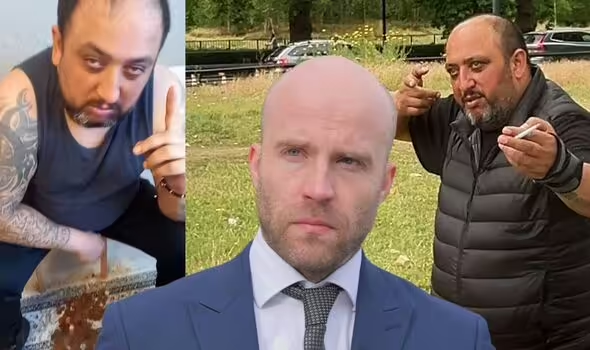
Iliuta Gruia poses with a pile of coins on social media (Image: -)
But that isn’t even the most egregious part.
When I visited the camp, there was one man who frequently became aggressive, shouting and, during a trip with Shadow Home Secretary Chris Philp, pursuing the MP around the site to point an imaginary gun at the camera and accuse him of “racism.”
Thanks to the help of one of my trusted long-time collaborators, journalist Matei Rosca, I was able to identify this man as Iliuta Gruia; a violent criminal from Botosani in the north of the country.
Almost unbelieavably we discovered that, not only was he a violent thief who’d been to prison several times, when he first shouted abuse at me in Park Lane, it was in the wake of him skipping a court date for a horrific incident in his hometown of Botosani.
During that hearing, Gruia was slapped with a restraining order for wielding an axe and threatening to kill an entire family, including the children.
What’s clear is that the violent thug fled Romania soon after being summoned to court and found a safe haven from the consequences of his actions in London’s most expensive postcode.
It is bad enough that someone who posed a recent threat to children could just waltz into the UK. What is unforgivable is the approach taken to the man when he got to Britain.
Gruia was visited by police officers during his time living in Park Lane, who conducted a ‘welfare check’ to see if he was OK in the sweltering summer sun.
When the Westminster Labour councillor responsible for housing, Liza Begum, was asked about these checks by a Conservative member in June, she revealed that outreach officers were “always at the encampment and work very closely with the people [there]”.
She added that “unfortunately, a lot of them have complex needs and some are not willing to take the outreach services available”.
This failure to consider the potential for criminality and exploitation at the Park Lane site didn’t just put the British public at risk; it also potentially made things more dangerous for the vulnerable people those in power have claimed to be acting in the interests of.
That should scare us all.