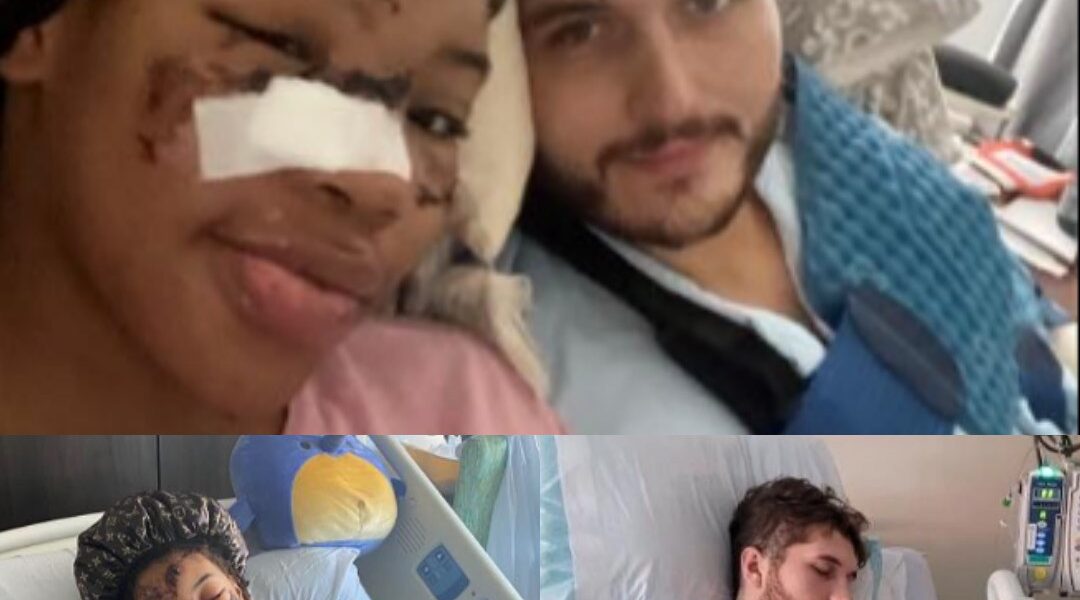

Jordan and Zania’s story didn’t start in a hospital room or with tragedy—it began on a sunny day at DeSoto Falls, where the roar of cascading water set the stage for a young romance. Their first date had been just a few months earlier, a simple hiking adventure that promised laughter, shared moments, and the thrill of getting to know someone new.
“We took pictures, had our first kiss at the top. It was a moment,” Zania recalls, her smile warm but tinged with memory. It was a day that should have been ordinary, perfect even in its simplicity. But nature had its own plan. As they lingered at the summit, a sudden storm rolled in. The rocks grew slick, the falls more dangerous, and in an instant, life changed.
Zania lost her footing and fell face-first down the waterfall. Without hesitation, Jordan followed instinctively. “Without hesitation or a second thought, I just went to go get her. It was instinct,” he said. The fall left both of them gravely injured. They lost consciousness, their bodies battered, bruised, and bleeding.
When they awoke, the reality of their situation became terrifyingly clear. They were in the wilderness, and to get help, they would have to hike for 30 minutes despite the injuries they’d just sustained. Step by painful step, they moved together, leaning on each other for strength. “I kept telling her, you’re brave, you’re strong, and you’ve got this,” Jordan says. His words became a lifeline for both of them, a mantra that would carry them through recovery and into battles neither could have anticipated that day.
When they finally reached the ER, the severity of their injuries was undeniable. Zania was in critical condition. Her face was extensively damaged, bruised and swollen from the impact. Jordan had broken both shoulder blades, injuries that made even the smallest movements agonizing. The physical trauma was staggering, but the emotional and psychological scars would soon reveal themselves as just as challenging.

“I didn’t like what I looked like anymore. I felt ugly. I didn’t think he would like me,” Zania admitted, reflecting on the days following the fall. In the chaos of pain, surgery, and recovery, self-doubt crept in. But Jordan, steadfast in his devotion, looked past the injuries. The first time he saw Zania after the accident, he didn’t see scars—he saw her. And he asked her to be his girlfriend. “She said, how do I look? And I said, you look beautiful. Just seeing her that way, it built a bond that won’t ever be broken,” Jordan said.
They are both so young—Jordan had just turned 23, and Zania was 20—but the intensity of their shared experience forged a connection far deeper than most couples encounter in decades. Through months of rehabilitation, surgeries, and physical therapy, they supported each other relentlessly. When one faltered, the other held steady. Together, they learned resilience, patience, and the raw power of love in the face of adversity.
As Zania began to improve, the path forward for Jordan grew increasingly uncertain. He began losing weight rapidly; his appetite disappeared. His mother, Lori Chafin, recalls the worry with a tremor in her voice: “He lost a lot of weight, it was just falling off him. He didn’t have an appetite.” Initially, doctors suspected internal injuries from the fall, perhaps a ruptured esophagus caused by the impact on his shoulders.
But further testing revealed something far more serious—something that had nothing to do with the fall itself. Jordan had stage 3 stomach cancer, aggressive and urgent. The news was devastating. He would need to have his stomach removed in March, a life-altering procedure that would change everything he knew about his body, his health, and his future.

“It’s your baby. Of course it’s hard,” Lori said. “I can’t help him. I can’t take it from him. I can help with everything else, but I can’t take it from him. And that’s hard.” For Jordan and Zania, the irony was profound: without the fall, doctors might never have detected the cancer so early. The accident that had seemed purely tragic became, in a strange twist, a life-saving revelation.
For Zania, the experience reaffirmed a truth she had long held—vigilance matters, and paying close attention to subtle changes in health can make all the difference. Together, she and Jordan approached his diagnosis with the same courage they had mustered after their fall. They adopted the same mantra he had once used to guide her through their hike: “You’re brave, you’re strong, and you’ve got this.”
“I remember Jordan telling me, you’re brave, you’re strong, and you’ve got this. That stuck with me. He’s got this,” Zania says now. Those words, born of a moment of sheer survival, became a guiding principle for both of them, giving Zania strength and determination to stand beside him, and giving Jordan the belief that he could face this next challenge with courage and resolve.
Their shared mantra is now a constant reminder of their bond and resilience. “She tells me that all the time,” Jordan said. “I’m strong, I’m brave, this is my fight.” And in those words, the essence of their journey is clear: survival, love, and unyielding support are as important as any medical intervention. They face the future hand-in-hand, young but unbroken, committed to each other through every trial, every setback, and every victory along the way.

Jordan and Zania’s story is one of love forged in adversity, of courage revealed in moments of terror, and of hope that endures even when life turns unexpectedly dark. From the falls at DeSoto Falls to the diagnosis that would have otherwise gone unnoticed, their lives have been irrevocably altered—but so has their connection, stronger than ever.
In the quiet moments between hospital visits, therapy sessions, and treatments, they find solace in each other’s presence. They remind themselves of the bravery they displayed during their fall and the strength they’ve discovered in the months since. Their journey is far from over, but the lessons they carry—resilience, trust, and unwavering love—will guide them through every challenge ahead.
Through heartbreak and healing, fear and hope, Jordan and Zania have discovered that even in life’s darkest moments, love can be a compass, courage can be found in the unlikeliest places, and together, two young hearts can face anything. Their bond, forged at the edge of a waterfall and tested by illness, is unbreakable—and it is a reminder to all of us that true love is not just about happiness in good times, but steadfastness in the hardest ones.
A Young Warrior’s Battle Against Ewing Sarcoma.763b

Freddie Stewart’s mum, Nicole, has courageously shared her son’s story to raise awareness about primary bone cancer and to inspire other families facing similar challenges.
It all began when Freddie, a lively six-year-old, started complaining of chest pain after a weekend of very active play. At first, the family assumed it was just a pulled muscle and tried simple remedies like rest and Ibuprofen, which brought only temporary relief. The pain never fully went away and often returned after typical rough-and-tumble play, making it easy to dismiss at first.
A few months later, Freddie began complaining of jaw pain. Initially, neither the family nor the GPs linked it to his previous chest pain. The pain gradually intensified, especially at night, keeping him awake and increasingly distressed. Multiple misdiagnoses followed, including ear infections treated with antibiotics, temporomandibular disorder, and teething. Each misstep caused precious time to be lost, prolonging Freddie’s suffering.
Progress finally came when a locum dentist noticed slight swelling near Freddie’s temple during a routine check. Although the X-ray appeared normal, the dentist expressed concern and advised immediate referral to a facial specialist at Oxford Hospital A&E. The family waited anxiously, but the specialist could not see Freddie that day. The following day, after scans and multiple consultations, the doctors admitted they did not yet have a full diagnosis. Nicole remembers the doctor saying, “we don’t know what it is yet, but I can’t sugar coat this for you, it’s not good.” The uncertainty, combined with the severe pain, filled them with dread.

A biopsy revealed that the tumour near Freddie’s temple was growing rapidly, even pushing his eyeball forward. Despite the fear, it was decided to start chemotherapy around late November 2019, presuming it was Ewing sarcoma. Just as Nicole was about to sign consent forms, the final biopsy results arrived, confirming the diagnosis. The cancer was aggressive, present in Freddie’s skull, chest wall, spine, and with small metastatic nodules in the lungs. The inward-growing tumour in his chest wall explained why it had gone unnoticed, while the temple tumour’s visible swelling made urgent intervention necessary.
Freddie’s chemotherapy regimen was brutal and relentless. Every two weeks, he was admitted for several nights. The first two nights of each cycle were spent in close observation, followed by five nights of extended hospitalization. High fevers and infections became routine, and the family lost count of the nights spent at the hospital.
Towards the later stages of treatment, Freddie underwent six weeks of daily radiotherapy (weekends off), each session taking several hours, including travel time. The side effects were severe: mucositis, high temperatures, swelling from radiotherapy, difficulty eating and speaking, and near-constant fatigue. At one point, he nearly required a feeding tube, which Nicole had to administer carefully using soft foods like angel delight mixed with cream, a painstaking process that took hours. In addition, he underwent multiple blood and platelet transfusions, sometimes within a fortnight.
Despite the grueling treatment, Freddie’s resilience was extraordinary. By the second cycle, the pain had started to subside, and his natural humor and energy began to shine through. Nicole recalls glimpses of her “old happy, hyper, crazy Freddie,” which provided hope and strength during the darkest moments.

On 24th July 2020, Freddie completed his radiotherapy, with chemotherapy concluding during this period. At last, the family could glimpse light at the end of the tunnel. Recovery continued with close monitoring, physiotherapy, and careful management of lingering side effects.
Now, Freddie is a typical eight-year-old boy. The main lingering effect is dry eyes, requiring drops and gels, and occasional soreness from physical activity. His muscle resilience is gradually improving, and he is steadily gaining strength. Regular follow-ups every three months, including MRI and chest X-rays, ensure his continued health, reducing “scanxiety” compared to the earlier, more frequent monitoring.
Beyond his physical recovery, Freddie has flourished emotionally. He has become a kind and playful older brother to his two younger siblings, bringing laughter and warmth to their household. Nicole emphasizes the importance of a strong support network; Freddie’s courage has been bolstered by the love, care, and solidarity of family, friends, and medical staff. Their unwavering presence has been a lifeline throughout the ordeal.
To further support children with Ewing sarcoma, the Stewart family has established a Special Fund with the Bone Cancer Research Trust called Freddie’s Future, dedicated to funding research into more effective treatments. Their goal is to ensure that children like Freddie have a stronger chance of survival and a better quality of life.

Nicole’s reflections underscore critical lessons: early recognition, advocacy, and compassionate care are essential. Freddie’s journey highlights the physical and emotional challenges of aggressive childhood cancers, while also showing the power of resilience, hope, and familial support. It is a story of courage, a reminder that even in the face of rare and aggressive disease, children can survive, thrive, and reclaim their childhood.
Her message to other families is clear: be persistent, trust your instincts, and seek help when something feels wrong. Celebrate every small victory, lean on your community, and never underestimate the strength of a child facing cancer. Freddie’s journey is a testament to the indomitable spirit of young patients and the enduring power of love, hope, and perseverance in the fight against bone cancer.