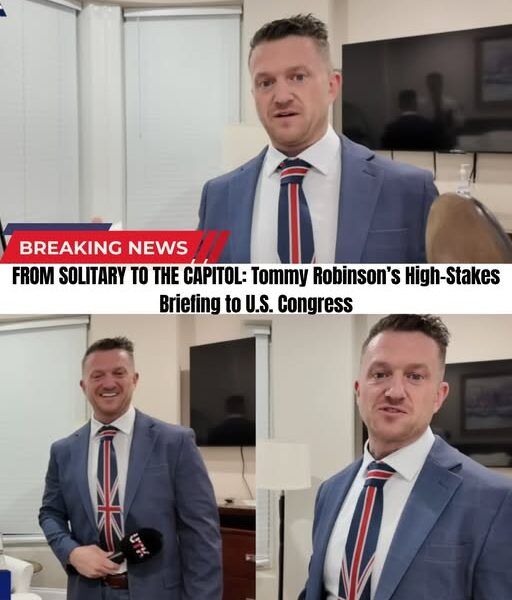
Just 12 months ago, he was in a solitary cell in the UK. Today? He’s briefing US Congress behind locked doors!🇺🇸 Tommy Robinson has just dropped a bombshell on Republican lawmakers about the “hidden blueprint” he claims is destroying the West.T

In a dramatic reversal of fortune, controversial British activist Tommy Robinson is preparing to address a private briefing for Republican members of the U.S. Congress this morning. The event marks a stark personal journey from a solitary confinement cell in the United Kingdom to the halls of American political power.
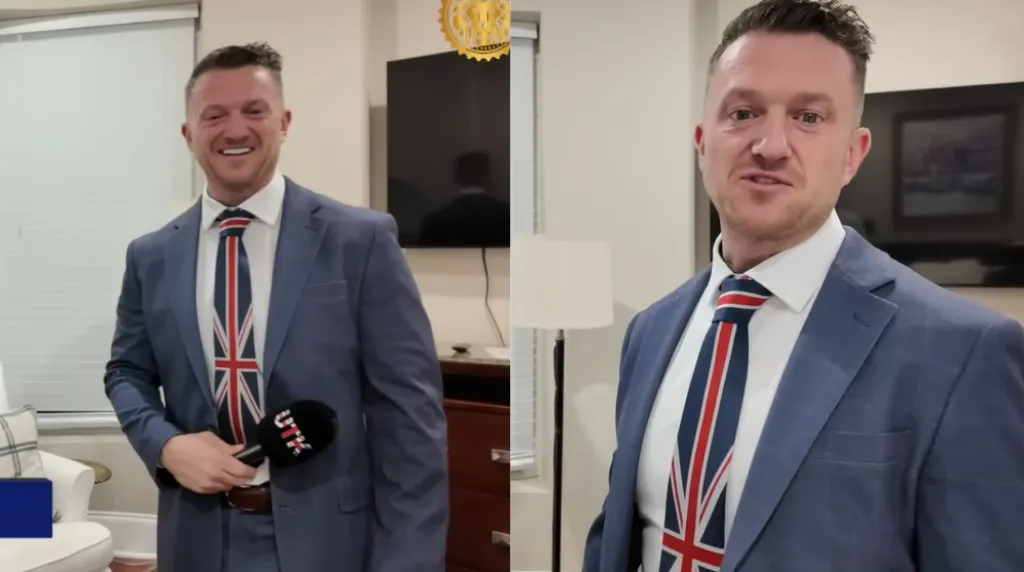
Robinson, whose real name is Stephen Yaxley-Lennon, revealed the high-stakes meeting in a pre-dawn video recorded hours before the presentation. He stated the briefing would focus on Sharia law and its perceived threat to Western nations. The activist framed the session as a critical educational moment for lawmakers.
“I prepared a start to finish presentation on Islam and Sharia,” Robinson said, detailing his intended talk. He plans to outline the foundations of Islamic law, citing the Quran and the teachings of Muhammad as its core sources. His central thesis is that Sharia is inseparable from the religion itself.
The briefing comes amid a growing political movement on Capitol Hill. Robinson noted that a congressional caucus formed to oppose Sharia law has rapidly expanded from 36 to 57 members in recent weeks. He positioned the issue as an emerging litmus test for Republican candidates ahead of the upcoming election cycle.
“Everyone in America is going to be looking at their candidate,” Robinson asserted, suggesting voter pressure will mount on officials to declare their stance. His presentation aims to equip legislators with what he describes as a detailed understanding of a complex ideological system.
Robinson’s scheduled appearance underscores his evolving role from a street-level protest organizer in the UK to an international figure lobbying foreign governments. His previous engagements, like a contentious speech at the Oxford Union, have often been marked by significant controversy and protest.

Logistical anxieties surfaced in his remarks, from choosing a tie to condensing an 80-minute presentation into an unknown timeframe. The event will be closed to press and recording devices, held as a private gathering away from public scrutiny. No official congressional confirmation has been released.
The activist’s presence in Washington is part of a broader American tour. He promised future public events would be filmed for his supporters. His platform merges political activism with a media brand, seeking sponsors to fund what he terms “independent media” and the protection of free speech.
This Capitol Hill briefing represents a significant escalation in Robinson’s campaign against what he labels “political Islam.” It grants his views a direct channel into the legislative process of a major allied nation. The move is likely to provoke strong reactions from civil rights groups and Muslim advocacy organizations.
Critics condemn Robinson’s rhetoric as inflammatory and Islamophobic, arguing it demonizes an entire faith. Supporters view him as a vital whistleblower on issues of national security and cultural preservation. The congressional briefing will test the receptivity of U.S. lawmakers to these polarized arguments.
The outcome of this meeting could influence policy discussions and legislative priorities within a faction of the Republican Party. It also highlights the transnational nature of anti-extremism debates, where European political tensions are increasingly reflected in American domestic discourse.
Robinson’s personal narrative—contrasting his incarceration last year with his current status as a congressional invitee—forms a powerful backdrop. He explicitly referenced this journey, noting he was in solitary confinement just twelve months ago, uncertain of his future.
His stated goal is to prevent the United States from following, in his view, the same path as the United Kingdom. He alleges that Sharia law encompasses migration, deception, and the oppression of women, claims widely disputed by Islamic scholars and mainstream religious leaders.
The closed-door nature of the briefing raises questions about transparency and accountability. Without a public record, the specifics of the presentation and the lawmakers’ responses will be filtered through Robinson’s own reporting and potential subsequent leaks.
