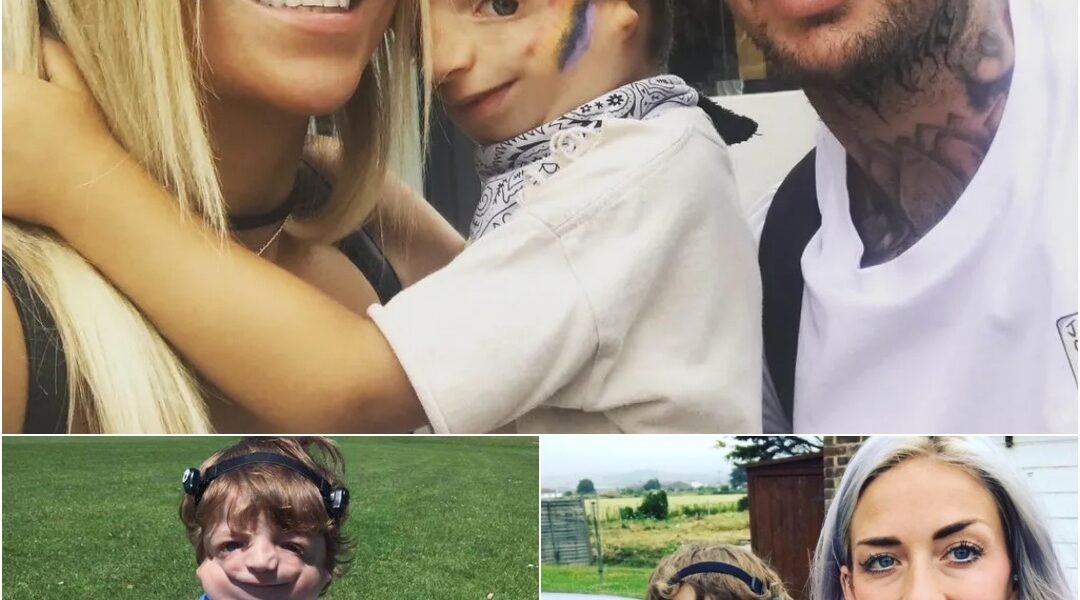

When you imagine welcoming your newborn into the world, you picture sleepless nights, soft cries, tiny fingers curling around yours, and the warm quiet of those first sweet cuddles. You do not imagine the shrill urgency of ambulances, the flash of blue lights cutting through the dawn, or the terrifying stillness of watching your newborn fight for her life. But that was the world that opened beneath Bernice and her family — not gradually, not with warning, but in a single shattering moment, just four days after their perfect little girl, Ivy, arrived.
She had seemed so perfect at first. Born in June 2021, Ivy looked like every dream they had ever whispered into the future: bright eyes, a delicate face, and the soft rhythm of a heartbeat that promised a lifetime of memories waiting to unfold. In those early hours, her parents held her close, breathing in that new-baby scent and feeling the world shift gently into something magical. They noticed a few things — a little more sleepiness than expected, a bit of difficulty feeding — but they were reassured each time. Babies vary, they were told. Some are just sleepy. Some take time to wake up to the world. And they wanted so desperately to believe that. To believe she was okay.
But on day four, the illusion shattered.
Ivy grew frighteningly drowsy, slipping beyond the reach of gentle shakes and whispered encouragements. She stopped feeding entirely. And that instinct, that primal sense that mothers carry in their bones, told Bernice that something was deeply, dangerously wrong. Her hands trembled as she dialed 999, her heart already bracing for what she feared might come. By the time paramedics arrived, Ivy’s oxygen levels had plummeted to 40%. Her tiny lips had begun to turn blue.
As the ambulance sped toward the hospital, Ivy’s heart stopped.
The world stilled. Paramedics fought to bring her back. They did — but as they rushed her through the hospital doors, her heart gave out again. For 45 agonising minutes, a team of doctors and nurses fought for the life of a newborn they had never met until that moment. A newborn whose life had barely begun. And somehow, against all odds, they brought her back again.

Only then came the explanation that tore through her parents’ relief: Ivy had a rare and dangerous congenital heart defect — pulmonary atresia with intact ventricular septum — a condition in which the pulmonary valve never formed properly, blocking the flow of blood from her heart to her lungs. Four days old, and she had already fought battles most people never face in a lifetime.
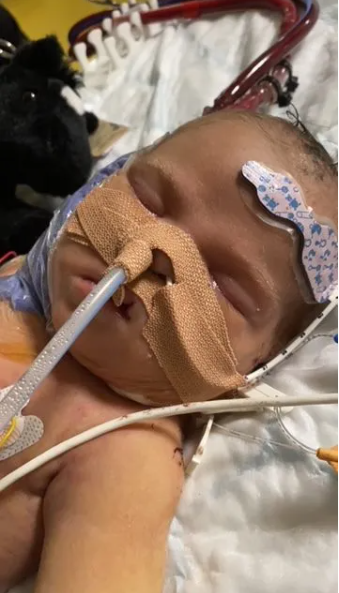
Ivy was transferred to the Pediatric Intensive Care Unit, her tiny body tangled in tubes and wires, machines breathing and pumping for her as she hovered in a fragile balance. Doctors prepared her parents for the worst. Multiple organ failure. A strong likelihood of brain damage. They waited for the CT scan with the kind of fear that steals sleep and air and hope. And when the results came back — her brain was unharmed — it felt like a miracle. A small one, but enough to keep them standing.
z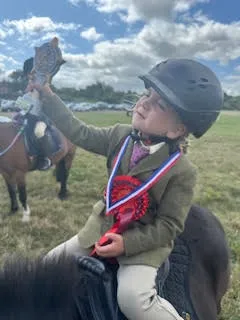
Nearly a month after her birth, Ivy underwent her first open-heart procedure. A balloon catheter was meant to open her heart and allow proper blood flow. But halfway through, her heart couldn’t take it. The team halted the surgery and whispered the hardest truth of all: they would have to wait, and hope she survived long enough to try again.
Days passed. Ivy’s tiny body weakened. Machines beeped solemnly beside her, each tone a reminder of how fragile she was. Then one night, everything changed again. Her condition deteriorated rapidly, and doctors made the decision to place her on ECMO — life support that would take over the work of her heart and lungs so her body could rest. The sight was devastating: her small frame surrounded by tubes, drips, and one massive, humming machine that now held her life in its circuitry.
But ECMO gave her a chance. And once she stabilised, surgeons tried again.

This time, the surgery worked.
The valve opened. Blood flow improved. Her numbers rose. And the next day, impossibly, her heart beat strongly enough that she was taken off ECMO. It was as if her little body, after everything, had finally found the strength to fight for itself.
Ivy remained in the hospital for 89 long days. Nearly three months measured not in hours but in milestones — a slightly stronger heartbeat, a successful feeding attempt, a quiet night, a day without new complications. She was eventually transferred to a local hospital, and after almost four months of hospitals, alarms, and fear, she finally came home. Home — where she belonged, where her parents could finally breathe again, where the ghost of those early days lingered but no longer dictated every moment.
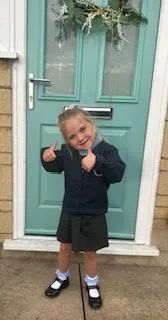
Now, years later, Ivy’s story reads like a miracle stitched together by medicine, instinct, love, and the fierce determination of a little girl who wasn’t ready to let go. In 2024, she was three years old and full of mischief, laughter, and fire. Her heart valve worked well. She ran and played as though she’d never known fear. And by 2025, she was four, thriving in school, growing stronger by the week. She rides her pony, Sooty. She competes in small riding events. She swims. She climbs. She giggles freely, the way children are meant to. And every time her parents watch her chase bubbles or run across a field, they remember the ambulance lights, the cardiac arrests, the machines that kept her alive — and they marvel at how far she has come.

Ivy still has regular check-ups, a reminder that her journey isn’t over. But the fear that once wrapped around her family’s hearts has been softened by an overwhelming, enduring gratitude. They are grateful for every doctor, every nurse, every paramedic who refused to give up on her. They are grateful for the charities that raise awareness of congenital heart defects, knowing early detection saves lives like hers. And they are grateful for Ivy herself — their miracle girl, their warrior, their reminder that life is fragile but also astonishingly resilient.
Her scar is not a mark of weakness. It is the signature of survival. And Ivy’s story is proof that even the smallest hearts can face the biggest battles — and win.