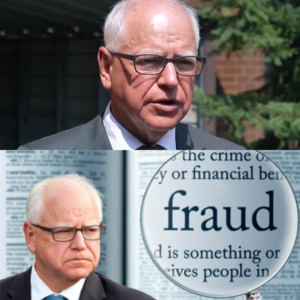
The $250 Million Betrayal: Shocking New Details Reveal the True Scale of Minnesota’s Welfare Fraud.

Industrial-Scale Betrayal: Inside the $9 Billion “Fraud Tourism” Pandemic Swamping Minnesota
ST. PAUL, MN — In what federal authorities are describing as a “staggering industrial-scale” criminal enterprise, the state of Minnesota has reportedly become the epicenter of a multi-billion dollar welfare fraud crisis. While Governor Tim Walz’s administration attempts to downplay the figures as “sensationalized,” federal investigators and whistleblowers are painting a far darker picture: a state government so paralyzed by political correctness that it allowed “fraud tourists” to rob taxpayers blind to the tune of potentially $9 billion.
.
.
.

The Magnitude of the Heist
For months, the headlines in Minnesota were dominated by the “Feeding Our Future” scandal—a pandemic-era scheme that saw $250 million diverted from hungry children to luxury cars and international real estate. However, new federal insights suggest that the $250 million figure was merely the tip of a massive iceberg.
Federal authorities now indicate that the total fraud spanning across various categories—including SNAP (Supplemental Nutrition Assistance Program), childcare subsidies, and pandemic relief—could reach a staggering $9 billion.
“The fraud is not small. It isn’t isolated,” a federal prosecutor stated in a recent briefing. “The magnitude can’t be overstated. What we see in Minnesota is not a handful of bad actors committing crimes. It’s a staggering industrial-scale fraud.”
“Fraud Tourism”: Minnesota as a Magnet
Perhaps the most unsettling revelation from the investigation is the emergence of a “fraud tourism” industry. Investigators allege that Minnesota’s lax oversight and generous benefits have made it a destination for criminals from around the country and the world.
“Minnesota has become a magnet for fraud,” the prosecutor noted. “People are coming to our state purely to defraud programs. This is a deeply unsettling reality all Minnesotans should understand.”
The investigation suggests that organized groups targeted Minnesota specifically because the state’s regulatory agencies were perceived as “soft targets.” By exploiting the “good faith” nature of emergency spending during the COVID-19 pandemic, these actors built a sophisticated infrastructure designed to siphon off public funds and funnel them into offshore accounts.
The “Race Card” and Regulatory Paralysis
At the heart of the political firestorm is the allegation that state officials, including Governor Tim Walz and Attorney General Keith Ellison, were warned years ago about the burgeoning fraud but failed to act.
According to state whistleblowers, many of whom are Democrats, warnings were ignored because the fraud was concentrated within the state’s massive Somali refugee population. Whistleblowers allege that state employees were terrified of being labeled “racist” or “Islamophobic” in the press if they scrutinized the suspicious spending patterns of certain community providers.
A June 2024 report from the Minnesota Department of Education (MDE) appears to back these claims, finding that the “threat of litigation and negative press from providers” affected how state officials used their regulatory power. Essentially, the government allegedly chose to protect its public image over the taxpayer’s wallet.
“They didn’t want to be called a name in the local or national press,” remarked political commentator Tomi Lahren during a heated panel discussion on the scandal. “So they allowed their taxpayers and all of us to be robbed blind.”

Walz Administration Pushes Back
Governor Tim Walz has dismissed the $9 billion figure, labeling the investigation as a “weaponization” of the legal system by his political opponents. The administration maintains that while “tens of millions” in fraud may have occurred, there is no concrete evidence to support the multi-billion dollar estimates circulating in Washington.
“You’re seeing weaponization here,” Walz stated in a recent press conference. “We’ll continue to fix it, but they’re coming up with numbers that just aren’t there. It’s sensationalized.”
However, the House Committee on Oversight and Accountability, chaired by James Comer (R-KY), isn’t buying the administration’s defense. Comer has intensified his investigation into the Walz administration’s handling of federal funds, determined to uncover why Minnesota’s oversight mechanisms failed so spectacularly.
Cultural Tensions and Public Outcry
The scandal has reignited a fierce debate over immigration and cultural assimilation. High-profile figures, including Rob O’Neal—the former Navy SEAL known for the bin Laden raid—have sparked controversy by suggesting that the nature of the fraud is tied to the cultural backgrounds of the perpetrators.
“Somalis are world-famous for being pirates,” O’Neal posted on X (formerly Twitter), referencing the organized nature of the fraud. “Of course they came here to steal and defraud us.”
While critics label such comments as racist, others argue that ignoring the demographics of organized crime prevents authorities from effectively stopping it. The debate centers on a difficult question: Did the Walz administration’s commitment to “inclusivity” create a blind spot that criminals exploited?

The National Implication
While the current focus is on Minnesota, investigators warn that this may only be the beginning. The “industrial-scale” methods discovered in the Gopher State are likely being replicated in other states with high refugee populations and similarly lax oversight.
“I don’t think Minnesota is where it should stop,” said Guy Benson. “I think Minnesota is where it should start because I have a feeling many other states… we can probably uncover some billions with a ‘B’.”
The federal investigation is currently tracing money trails that lead to several East African nations, suggesting that a significant portion of the stolen $9 billion has already left American soil. The difficulty of clawing back these funds remains a major hurdle for federal prosecutors.
Conclusion: A State in Search of Integrity
As James Comer and federal prosecutors continue to peel back the layers of this multi-layered scandal, the people of Minnesota are left wondering how their “Land of 10,000 Lakes” became the “Land of 10,000 Scams.”
Whether the final number is $500 million or $9 billion, the damage to public trust is immeasurable. The scandal serves as a stark warning to governments across the globe: When political optics take precedence over institutional integrity, the taxpayers are the ones who pay the ultimate price.
The Walz administration faces a long winter of hearings and subpoenas. As one whistleblower put it, “It’s bad. It’s overtly egregious. And it’s time for the truth to come into the sunlight.”