
On April 25, 1945, as World War II drew to a close, a train convoy stood a few kilometers from the Dachau concentration camp .
From a distance, it appeared as a shadow of wagons, motionless on winding tracks beneath a leaden sky. But as they drew nearer, the American reconnaissance soldiers spotted what would become one of the most gruesome reminders of the end of the Third Reich : the Dachau death train .
In the freight cars, death had taken on human form. More than two thousand corpses lay piled on top of one another, mingled, frozen with hunger and cold.
Some still seemed to be asleep, their mouths slightly open, as if hoping for a breath of air, a glimmer of light.
But the silence surrounding the train left no doubt: these passengers would never reach their destination.
The men of the 45th American Infantry Regiment , hardened by months of fighting in Europe, were stunned.
They had never experienced anything like it.
One of them later wrote in a letter to his family:
“We thought we had experienced war. On that day, we experienced hell.”
This accursed train came from the Buchenwald concentration camp , transporting prisoners whom the Nazis, in their final, desperate days, intended to transfer to Dachau. But the German retreat, the logistical chaos, and the boundless cruelty of the SS turned this journey into an endless ordeal.
For days, the carriages remained locked. No water, no food, almost no air.
The prisoners died one after another, and the survivors had to sit on the corpses of their comrades just to be able to breathe a little longer.
When the American soldiers finally opened the sealed doors, a suffocating stench hit them, a mixture of decay, fear, and injustice.
A few survivors, close to death, were dragged from the train cars.
Their skin clung to their bones, their eyes burning with madness. Some tried to speak, but no sound came out. Others instinctively raised their hands toward the daylight, as if yearning for freedom without yet understanding it.
The stunned military photographers immortalized the scene.
These images, which became icons of the Holocaust , showed the world the gruesome reality of Nazi crimes .
They left no room for doubt or forgetting.
Every photograph, every blank stare, carried the weight of millions of lost souls.
The inhabitants of the neighboring village were brought to the scene of the disaster. Some fainted, others averted their gaze.
The American commander ordered them to bury the dead so they could see with their own eyes what the regime they had allowed to flourish had wrought.
It was justice without words, a moral lesson engraved in mud and dried blood.
Yet amidst this horror, there were also acts of life.
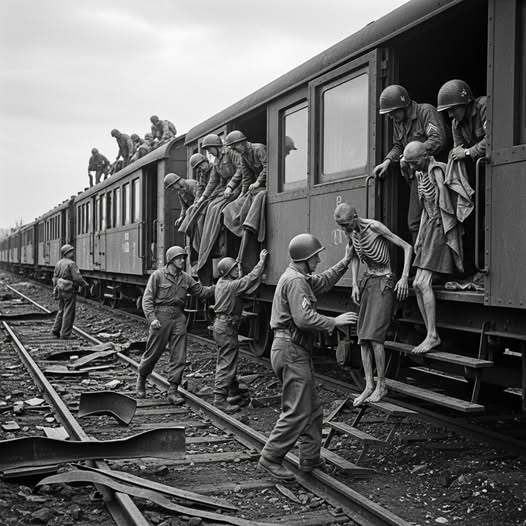
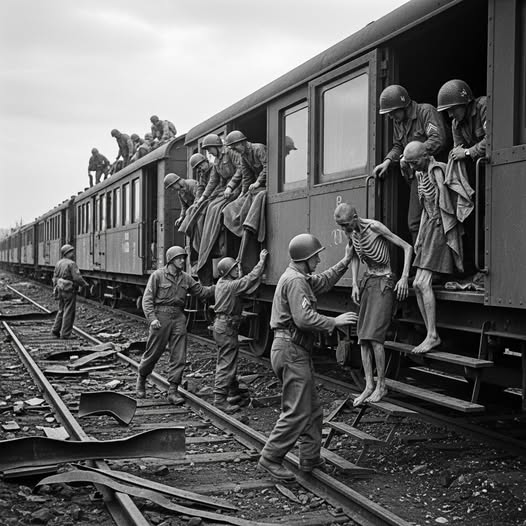
Soldiers helped survivors too weak to climb out of the train cars. They gave them water, blankets, a piece of bread.
Some took these emaciated men in their arms, without fear of dirt, disease, or death.
And in this touch—this simple gesture of humanity—something profound arose: compassion, true compassion.

An anonymous war photographer captured this moment: A soldier supports an emaciated prisoner as he steps off the train.
This image, now on display at the United States Holocaust Memorial Museum , has become a symbol of the liberation of Dachau . It depicts the clash of two worlds: the world of barbarity and the world of redemption.
On April 29, 1945, four days after the train’s discovery, American troops entered the Dachau concentration camp.
What they found there confirmed the systematic nature of the Nazi madness: thousands of prisoners still dying, ovens, meticulously kept records, and piles of ashes.
But for many, the image of the train remained the most powerful.
For it embodied the totality of all horrors—the journey to death, the inhuman silence, the absolute loneliness of the victims.
In the following days, journalists, doctors, and priests were brought to the scene of the disaster.
They took notes, wrote historical accounts , and collected the stories of the few survivors of the convoy.
Some reported that SS soldiers had shot those still in the wagons before fleeing.
Others only remembered the darkness, the cold, and the squealing of the wheels on the frozen tracks.
These tracks still exist today.
They lead to a small, simple memorial near the Dachau Memorial Site .
A metal plaque bears the inscription:
“In memory of the victims of the death train – April 1945.”
Nothing else.
And yet everything has been said.
Every year, visitors from all over the world pause here. Some lay down a flower, others simply touch the cold metal.
In the silence of this place, one sometimes thinks one can hear the murmur of the rails, like a whisper of the past.
It is not a cry for revenge, but a call to vigilance.
For this train, frozen in history, no longer carries corpses, but lessons of remembrance .
Holocaust historians agree that the Dachau extermination train was one of the most powerful testimonies to the end of the genocide.
It showed the world what words cannot describe: the cold, seemingly hateless, yet terrifyingly efficient machinery of death.
And paradoxically, from this horror arose a renewal—a renewal of human dignity , a refusal to remain silent.
Seventy years later, the few survivors of Dachau
still speak of that train. Their voices tremble, yet their words echo far and wide.
They do not tell their stories to preserve the memory of the pain, but to pass on the truth – so that the tracks of the past never again lead to oblivion.
The Dachau death train embodies the final breath of barbarity and the first glimmer of forgiveness.
A train frozen between two worlds, between shadow and light, that lives on in the collective memory of humanity.
And as long as someone, somewhere, closes their eyes and thinks of those silent carriages, the memory will live on.
For the duty to remember never dies.
LEAVE A RESPONSE