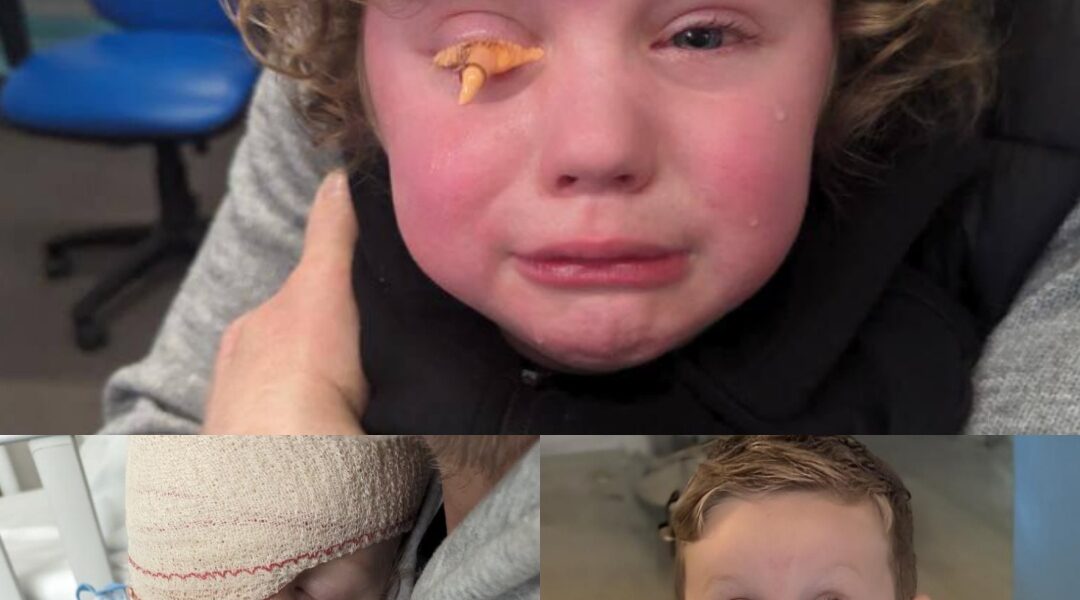

Teddy was only four years old when the world began to tilt beneath his feet — though he had no idea why. At first, there were small things: moments when he seemed to look past people instead of at them, times when his parents caught a strange reflection in his right eye, flashes of white in photos where there should have been red. Nothing that screamed emergency, but nothing that felt quite right either.
By September 2023, the truth finally came crashing in.
Doctors told his parents the word no family ever wants to hear — Retinoblastoma, a rare and aggressive childhood eye cancer. And just like that, childhood innocence collided with medical reality. The teddy bear he carried into the hospital suddenly seemed too small to hold all the fear that filled the room.
But what happened next would show just how extraordinary a four-year-old can be.

A LIFE-CHANGING DIAGNOSIS
The tumour in Teddy’s right eye was large — too large for doctors to save the eye. Chemotherapy alone wouldn’t stop it. Radiation wouldn’t be enough.
There was only one option: enucleation, the complete surgical removal of his eye.
No parent is ever prepared to hear that surgeons must remove part of their child to save the rest of them. Teddy’s mum later said she felt the world “fold in on itself,” as though reality was suddenly too heavy to carry.
The operation was scheduled quickly. There was no time to sit with the fear.
No time to bargain.
No time to ask “why us?”
Just time to act — because acting meant saving Teddy’s life.
And on the day of the surgery, Teddy walked into the operating room holding his favourite toy car, bravely trusting the adults who promised he would be okay.

THE DAY THE WORLD WENT DARK ON ONE SIDE
Enucleation is a word most people never hear. But for Teddy’s family, it became the turning point.
When he woke up from surgery, one side of his world was gone — not blurred, not dimmed, but replaced by stitches and swelling where his eye once was. The tumour had been removed completely, but the absence left behind a different kind of wound.
He reached up, touched the bandage, and asked the question no parent can ever truly prepare for:
“Will my eye come back?”
His parents held him tightly, fighting their own tears as they told him the gentlest truth they could. What mattered most was that Teddy was still here — still warm, still breathing, still theirs.
And even though he didn’t understand everything that had happened, he understood one thing deeply:
He had survived.

FREQUENT CHECKS — AND THE FEAR OF WHAT THEY MIGHT FIND
Unlike many children with Retinoblastoma, Teddy didn’t need chemotherapy. The tumour was removed before it could spread, and for that, his family will forever be grateful.
But cancer rarely leaves quietly.
A mutation was discovered in the tumour, one that raised questions and worries none of them had expected. To make sure nothing had spread or gone unnoticed, Teddy now travels regularly to
Great Ormond Street Hospital (GOSH) and Royal London for continuous monitoring:
-
eye examinations,
-
MRI scans,
-
detailed check-ups that peel back every layer of uncertainty.
Every visit brings a small, quiet fear. What if they find something this time? What if the mutation means more trouble is waiting?
It is a fear the family carries silently — but Teddy, in his innocent resilience, never lets it stop him from smiling.

LEARNING TO LIVE WITH A PROSTHETIC EYE
Every few months, Teddy visits the
National Artificial Eye Service, where skilled specialists create his fitted prosthetic eye. For adults, this process would be intimidating. For a four-year-old, it is overwhelming.
Moulds have to be taken. Measurements made. Adjustments refined. All while Teddy sits patiently, trying his best not to flinch as strangers lean close to his face.
The prosthetic eye helps him look like the little boy he was before cancer — whole, bright, unchanged on the surface. But beneath the surface, he is someone transformed. Someone who has already survived what many adults never will.
Soon, Teddy will begin play therapy — a gentle, child-centered way to help him overcome his fear of hospitals and people touching his face. These fears didn’t exist before cancer. They were learned through pain, through procedures, through the countless hands and tools that came too close too often.
Therapists will help him build trust again, rebuild a sense of safety, and relearn what it feels like to breathe easily in a hospital corridor.
It is healing not for his body — but for his heart.

A LITTLE BOY WHO REFUSES TO BE DEFINED BY WHAT HE LOST
Despite everything — the surgery, the follow-ups, the fear, the prosthetic eye — Teddy still shines.
He still laughs at silly jokes.
He still runs faster than his parents can catch him.
He still plays with his toy cars like the world is one big racetrack.
He still wakes up every morning ready to explore, ready to be loud, ready to live.
Retinoblastoma took his eye, but it did not take his spirit.
His family says he amazes them every single day — with his courage, his sweetness, and the quiet strength that seems too large for such a small child. It is the kind of strength that makes adults stop and wonder how children, in all their innocence, can be so incredibly brave.

A STORY THE WORLD NEEDS TO HEAR
Teddy’s journey is now part of the Go Gold campaign for Childhood Cancer Awareness Month — a campaign created not just to share stories of survival, but to remind the world of something urgent:
Childhood cancer doesn’t always look like what we expect.
It doesn’t wait.
And it doesn’t discriminate.
Sometimes, it shows up as a strange glow in a child’s eye.
Sometimes, it’s a headache, a limp, a fever.
Sometimes, it’s invisible until it suddenly isn’t.
But what it always brings — always — is a child who must grow up too fast and a family forced into a world they never asked to enter.
Teddy’s story is not just about loss or illness.
It is about resilience.
About love.
About a little boy who will not be broken.

A FUTURE FILLED WITH HOPE
Today, Teddy moves through the world with one eye — and more courage than most people will ever know. His prosthetic fits beautifully. His check-ups continue. His spirit continues to glow brighter than anything cancer tried to take.
His parents say they look at him and see not what he has lost, but everything he still is — joyful, curious, mischievous, unstoppable.
And though the road ahead will include more appointments, more MRIs, and more adjustments to his prosthetic eye, one thing remains certain:
Teddy is here.
Teddy is thriving.
And Teddy is showing the world exactly what it means to be brave.
His story is one piece of a much larger fight — a fight for awareness, for early detection, for research, and for every child who deserves a chance to live a full, beautiful life.
Go Gold for them.
Go Gold for Teddy.
“Fighting for Every Breath: Nicholas’ Story”.1914

When we found out we were going to become parents, our hearts were filled with indescribable joy and hope. We imagined every little moment with our future child: his first steps, first words, walks in the park, laughter filling the house, the simple, everyday happiness that seems so natural when watching other families. We dreamed of a calm, ordinary life, full of warmth, love, and safety for our son. Unfortunately, fate wrote a completely different story for us.
Nicholas was born at 29 weeks of pregnancy. He was so tiny, so fragile, that every little movement made our hearts race with fear. Instead of holding him in our arms and sharing those first tender moments, we had to watch him through the glass of an incubator, trembling with worry over every breath he took. Every monitor, every cable, and every alarm in the intensive care unit reminded us of how dependent our son was on medical equipment and specialists. The first moments we were supposed to spend together looked like a scene from the worst nightmare, where our dreams of parenthood were entwined with constant fear.
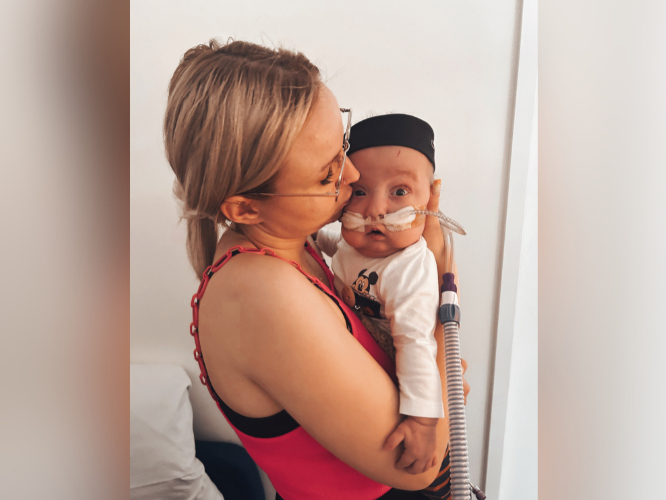
Our child spent a year and a half in the hospital. A year and a half of fighting for his life, during which we learned to live under the shadow of fear that never left our hearts. Every day, we wondered if he would survive the night. Every sound from the monitors, every irregular breath tested our endurance. There was no room for carefree parental moments—every moment was a fight.
As time passed, more diagnoses appeared, each increasing our fear: DiGeorge syndrome, a serious heart defect, polycystic dysplastic kidneys, chronic lung disease, low oxygen saturation, and poor weight gain. Our son does not move on his own, cannot sit, cannot speak. He is fed through a pump and must be connected to oxygen 24 hours a day—without it, he cannot survive. Every day requires constant observation, counting breaths, reacting to the smallest changes in his condition. Each day is a test of our strength, courage, and hope.
Yet, when we look at him in his stroller, surrounded by tubes and medical equipment, we see above all our greatest miracle. A boy who, despite the pain, smiles at us, who fights for every day of life, and who gives us a strength we never knew we had. Nicholas is our entire world. Every tiny gesture, every smile, every glance reminds us why we can never give up.
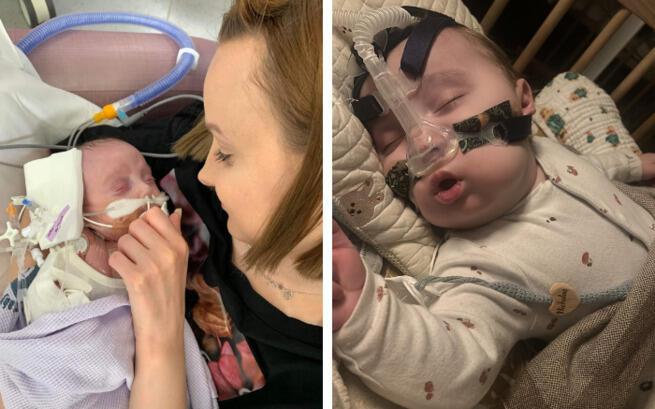
Nicholas requires constant care from specialists, expensive tests, advanced medical equipment, and medications that cost a fortune. We are with him 24 hours a day—not as a choice, but as the only way to give him a chance at life and a somewhat peaceful future. Unfortunately, due to constant hospital visits, travel to specialists, and unpredictable health crises, we cannot hold a steady job. We rely mostly on benefits, which barely cover our son’s basic needs, let alone the costly therapies and rehabilitation that could give him even a glimpse of a normal childhood.
We are parents who would give everything so our child could live and, even in the smallest way, enjoy what should be a normal childhood. Every day, we face questions that no parent should ever have to ask: Will he survive another day? Will he ever be able to eat, walk, or speak on his own? Will we see him happy like other children? Every day, we fight alongside him—for every breath, for every smile, for every small step forward that others might take for granted.
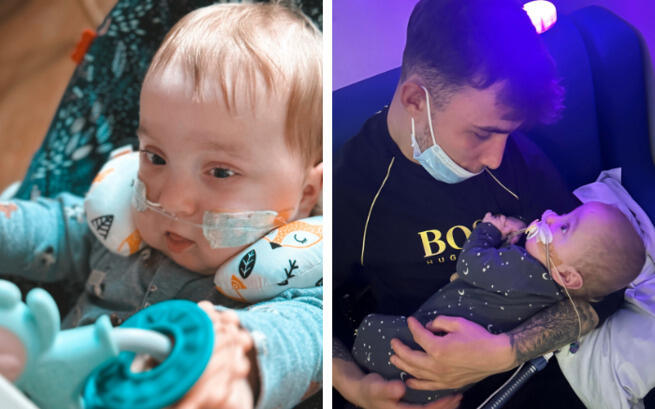
His life is a delicate mosaic of dependence on medical equipment, medication, and constant care. We are his eyes, hands, and voice. Every day with him teaches us patience, courage, and unimaginable strength. It teaches us that parental love knows no bounds, that true happiness can be found even in the darkest moments. Nicholas is our light that never goes out, even in the darkest times.
But we cannot do it alone. We need help. We need people to understand that every penny, every act of kindness, every prayer, or even sharing this story is a chance for our son to have a better tomorrow. A chance that one day we will hear his voice, see his first independent steps, hear his laughter that is not interrupted by alarms and medical equipment. A chance for him to experience life as every child should.
So today, we ask you from the bottom of our hearts: help us save our son. Every contribution, every act of kindness, every prayer is a step closer to giving him the childhood he deserves. Nicholas has only us—and the kindness of people like you.
There are no words that can fully express the pain and fear we face every day. There are no words that can fully describe the joy of the smallest progress, a tiny smile, every breath that gives him life. There is only the daily struggle, hope, and love that is stronger than anything else we have ever faced. Nicholas is our son, our miracle, our hope—and he deserves a chance.
Please, stand with us in this fight. Help Nicholas live. Help us give him a chance at a childhood every child deserves. Together, we can make sure our miracle—Nicholas Bieg—has the chance to grow, develop, and finally experience the joy that awaits him.
Because even though life wrote us a difficult story, we believe that the kindness of people can change his fate. Every act of generosity, every donation, every prayer brings him closer to life. Nicholas still has many days ahead, and together we can fill them with hope, love, and possibility.
Nicholas Bieg—our son, our miracle, our hope