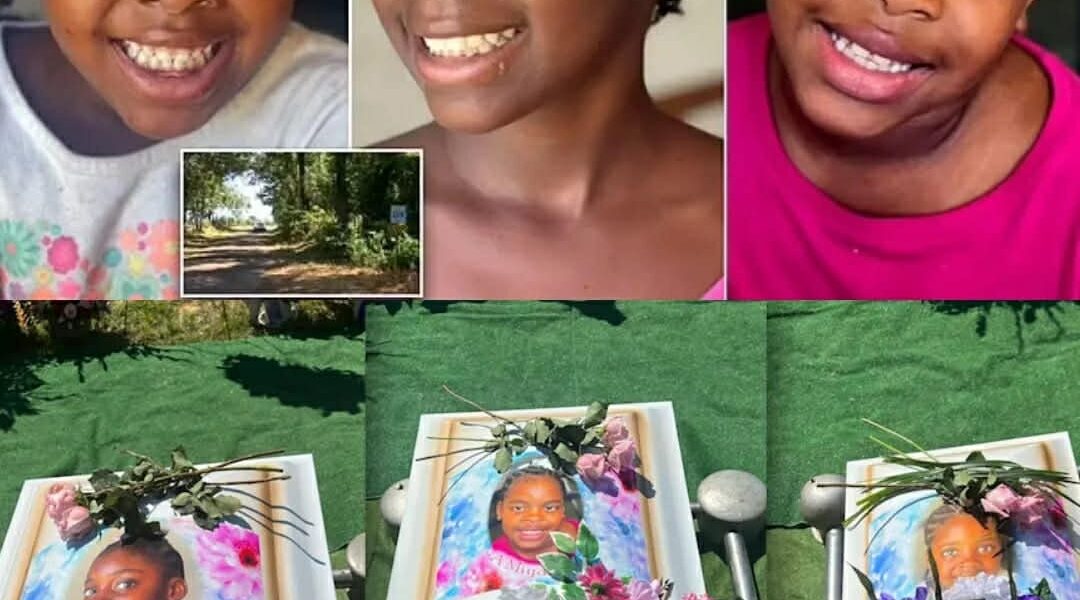

Late in the evening of July 29, 2022, on a quiet country road just outside Douglassville, Texas, the sun had long disappeared behind the pines.
The crickets had started their soft chorus.
The air hung heavy and humid, the kind of summer night where everything feels slow and still — except for the faint sense that something isn’t right.
In the home on the edge of Cass County, three little girls — Zi’Ariel Robinson-Oliver, just nine years old; her cousin A’Miyah Hughes, eight; and little Te’Mari, barely five — had spent the evening playing near the yard.

They were inseparable, sisters in spirit if not all by blood.
Neighbors often saw them skipping together down the dirt road, laughing, chasing bubbles, their braids shining under the Texas sun.
That night, they didn’t come back inside.
Their mother, Shammaonique Oliver-Wickerson, was at work trying to earn enough to keep the lights on and food on the table.
Inside the home was a man who had been staying there — someone the family knew, or thought they did.

Sometime around 9:30 p.m., neighbor Josephine Webster pulled into her driveway after a long day.
As her car headlights swept across the gravel, she noticed the man standing near the road.
His shirt clung to him, wet.
His jeans were soaked.
He looked frantic — nervous even — as he waved her down.
“I gave him my house phone,” Josephine recalled later. “He called the mother and said the girls hadn’t come back.”

At first, she didn’t think much of it.
But as the minutes stretched, her stomach began to tighten.
Why was he wet?
Why were the girls not home?
The sound of dogs barking broke the silence.
A light flickered on in another house down the road — and then another.
The small community, where everyone knew each other’s names and children, began to stir.

When one child went missing in Douglassville, everyone felt it.
When three disappeared at once, fear wrapped the town in its grip.
Law enforcement and volunteers began their search.
Flashlights swept through the woods.
Pickup trucks rolled slowly down the dirt road, men and women calling out the children’s names into the darkness.
Zi’Ariel!
A’Miyah!
Te’Mari!
But the only answers came from the wind and the low croak of frogs near the pond.

That pond had always been there — calm, still, unremarkable.
It sat behind the house, surrounded by trees and a horse pasture, its water murky and dark under the moonlight.
It had never been a place of fear.
Until that night.
As midnight passed, searchers grew desperate.
A mother’s cry echoed through the dark: “Please, God, let them be okay.”
Nearly five hours after they were first reported missing, the divers found them — three small bodies, motionless, side by side beneath the water.

The night turned cold, though it was July.
The world went silent.
At first, officials believed the deaths to be accidental.
Perhaps the children had wandered too close.
Perhaps they slipped.
Perhaps the pond had claimed them in silence.
But nothing about that night was ordinary.
And months later, the truth came crashing down like thunder: the girls had not drowned.
They had been strangled.
Each bore bruises and lacerations on their faces — marks of terror and resistance.
It was no accident.
It was murder.

The news shattered Cass County.
Parents clutched their children a little tighter that night.
Neighbors locked their doors for the first time in years.
The quiet little town where nothing bad ever happened suddenly became a place of whispers and nightmares.
Who could do such a thing?
Why those girls?
And what about the man seen wet that night?
Josephine’s words replayed over and over in investigators’ minds: “He was wet, all the way down. Not sweat. Water.”

Sheriff Larry Rowe told reporters the investigation was still active.
But behind that phrase — “active investigation” — lay months of frustration and heartache.
The mother pleaded for updates.
Reporters knocked on doors.
Leads came and went.
Rumors spread like wildfire through Douglassville’s coffee shops and church pews.
Some believed the suspect had fled the county.
Others whispered that the killer was someone close — someone they still saw in town.

In April 2023, the pain erupted publicly when civil rights activist Quanell X stood beside the grieving mother during a press conference.
“We come here angry as hell,” he said, his voice breaking through the heavy Texas air. “We are hurting with this mother. These little girls deserve justice.”
Standing beside him, Shammaonique Oliver-Wickerson could barely speak.
Her hands trembled as she held a photo of her daughters.
“They were my whole life,” she whispered. “Every morning I woke up for them.”
Her eyes filled with tears.
“It’s been so hard because we still don’t know what happened. We still don’t have answers.”
The balloons in the photograph behind her — pink, purple, and white — matched the ones neighbors would soon release into the sky.
A gesture of remembrance.
A cry of pain.
A mother’s message to heaven.
On July 29, 2023 — exactly one year after the tragedy — people from all over Cass County gathered near the home where the girls disappeared.
There were candles, teddy bears, flowers.
Children from the local elementary school brought cards with hand-drawn hearts.
Each balloon released into the evening sky carried a name.
Zi’Ariel.
A’Miyah.
Te’Mari.
The crowd watched until the last dot of color vanished into the clouds.
Some prayed aloud.
Some stood in silence, hands clasped, tears falling.
For a moment, the entire town seemed to breathe together — sharing the same sorrow, the same exhaustion, the same need for closure.

Inside the sheriff’s office, investigators continued to sift through evidence: phone records, timelines, witness statements.
They had interviewed dozens of people.
But still, no arrests.
No charges.
No answers.
“I’d like to see it come to an end,” said local journalist Raydeen Edwards, who had been covering the case since the beginning. “Somebody needs to go to jail for this.”
But the silence persisted.
The pond lay still again, as if keeping its secrets buried in the mud.
For Josephine and other neighbors, time hasn’t softened the memory.
“I still see their faces,” she said quietly. “They were such sweet girls. Always laughing, always together. It don’t feel right not hearing them outside anymore.”
In the evenings, when she walks past her window, Josephine sometimes looks toward the tree line.
The reflection of the pond glimmers faintly under the moonlight, and she remembers that night — the flashing lights, the searchers, the mothers crying.
Every sound feels like an echo from that day.
Every ripple feels like a ghost of the girls she once saw chasing butterflies.
The tragedy changed Douglassville.
Children no longer play near the pond.
Parents walk their kids to the bus stop instead of letting them go alone.
Church gatherings begin with prayer not just for the girls, but for justice — for truth, for healing.
And still, the question remains: who was the man soaking wet that night?
Where did he go?
Why has no one been held responsible?
It’s a question that haunts Cass County.
Even now, whispers rise whenever strangers pass through town.
Every unfamiliar car brings suspicion.
Every storm that fills the ditches with water reminds the town of that awful night.
But in the midst of grief, there are glimpses of strength.
Community members have turned their pain into action — organizing safety patrols, raising money to help the family, teaching children how to stay safe.
Churches have held vigils, each candle lit symbolizing a promise: We will not forget.
The mother, though still quiet and private, continues to speak with investigators whenever they call.
She keeps her daughters’ room almost exactly as it was.
Stuffed animals line the bed.
Crayon drawings still hang on the walls.
A small night-light glows softly beside a framed photo of the three girls — smiling, their arms wrapped around one another.
Every night, before she turns off the light, Shammaonique whispers the same words:
“I love you. I’m still fighting.”
Outside, the world moves on.
The laughter of other children fills the air.
But for those who remember, the silence after laughter can be deafening.
The case remains open.
The files sit thick with reports, photos, names.
Somewhere inside them lies the answer — hidden like a stone at the bottom of that pond.
A year has passed, yet it feels like time has stopped for the people of Douglassville.
Their lives now exist in two halves — before the pond, and after it.
The once-innocent patch of water now stands as a mirror of everything the town lost.
As the sun sets on another summer day, the sky turns gold above the treetops.
The pond glimmers again.
This time, it reflects not tragedy, but the quiet determination of a community that refuses to forget.
Because Zi’Ariel, A’Miyah, and Te’Mari were not just names on a case file.
They were daughters, cousins, students, dreamers.
They were love made small and bright.
And until the truth rises — until someone is held accountable — their memory will remain, rippling like light across dark water.
Tonight, the pond lies still.
Tomorrow, the world will keep asking.
But Cass County will not rest.
Not until justice comes home.
Because three little angels are waiting.
And they deserve peace.
“From the Ashes, Something Fought to Live—And He Refused to Walk Away”.5208

The fire began like a whisper — a thin thread of smoke curling into the night sky, unnoticed at first, harmless even. But fires have a way of changing their nature without warning. Within minutes, that quiet flicker stretched itself into a hungry blaze, leaping from tent to tent inside the makeshift camp. Flames roared upward, swallowing canvas, wood, memories, and hope in one long breath.
People scattered. Sirens wailed. Fire crews stormed in with headlights slicing through the smoke, their boots thundering over gravel and ash. Among them was firefighter Elliott Brown, a man known for rushing toward danger with the same calm determination others might show while stepping into a grocery store.
He had seen fires before. He had seen devastation, loss, collapse. But something about this one felt different — angrier, more alive. By the time the blaze was finally pushed back, the camp was little more than blackened earth and skeletal frames of what used to be shelter.
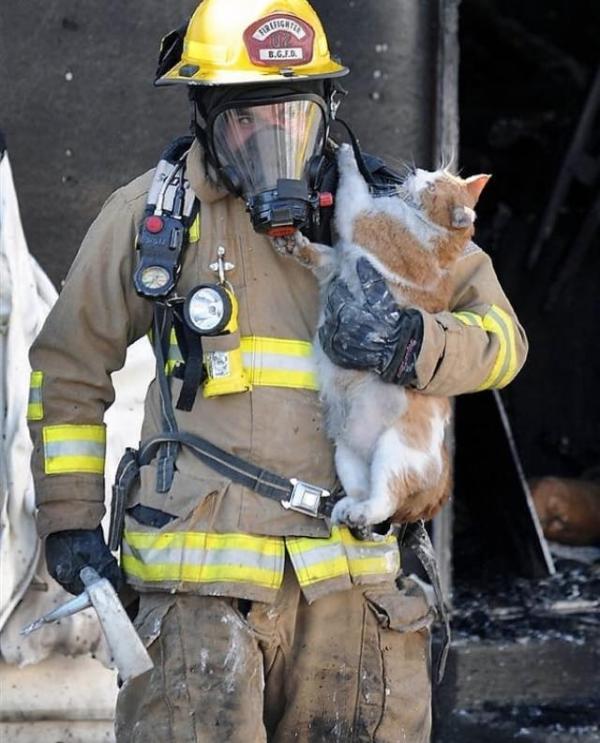
Elliott pulled off his mask, letting the cool air sting his smoke-raw lungs. The world around him crackled softly — small pops of collapsing debris, metal cooling, dying embers whispering their last breath. The immediate danger was gone.
At least, that’s what he thought.
Then he heard it.
A sound so faint, so fragile, it barely rose above the settling ash — not a human cry, not a shout, but a tiny, trembling mew. The kind of sound an animal makes when it has nothing left but instinct.
Elliott froze.
There it was again.
He turned, following it. Past a charred tent pole, past a melted plastic bin, past a pile of still-smoldering blankets. He pushed aside a burnt tarp with his gloved hands, and that’s when he saw her.
A kitten — no bigger than his hand — curled into herself like she was trying to disappear into the earth. Her fur was singed and patchy. Her whiskers were burned down to curved stubs. Her paws were blackened with soot, and her tiny chest rose and fell in uneven, desperate breaths.
She was alive. Barely.
Elliott felt something in his heart shift — the kind of feeling firefighters aren’t supposed to admit to while on a call. Compassion. Grief. Protective instinct. All tangled into one sudden wave.
“Hey, sweetheart…” he whispered, lowering himself to her level. She flinched at first, a reflex born from fear, but she didn’t run. She didn’t have the strength to.
Gently, he slid his arms around her, lifting her as if she were made of glass. The kitten let out a small cry, then pressed her face weakly against the thick fabric of his jacket. Elliott held her closer, letting her feel the steady thump of his heartbeat — a rhythm stronger than the chaos she’d just escaped.
“You’re safe now,” he murmured.
Around him, the camp was a skeleton of what it had been. Smoke drifted through the air like ghosts. But in his arms, a tiny ember of life still glowed.
He carried her to a safer spot and knelt on the ground. With one hand, he reached for his water bottle. With the other, he cupped his palm and poured a small stream of water into it. The kitten stretched out her pink tongue and drank — slow, shaky, but determined.
“Good girl,” he whispered. “Stay with me.”
Minutes later, rescuers from McKamey Animal Center arrived on-scene. One of them, a woman named Lacey, knelt beside Elliott and gasped softly.
“Oh my goodness… she survived this?”
“Yeah,” Elliott said, his voice low. “She’s a fighter.”
They wrapped the kitten in a warm towel. Elliott hesitated before letting go, his hand lingering on the small bundle of fluff. The kitten mewed once more — softer now, but filled with something new… trust.
“We’ll take good care of her,” Lacey promised.
“I know,” Elliott said. And yet, his heart tugged as she disappeared into the ambulance van.
THE DAYS THAT FOLLOWED

News travels quickly, especially stories that shine through tragedy like light through smoke. People wanted to know about the kitten — how she was, if she made it, who saved her.
They named her Ember, because she was found in the ashes but refused to go out.
Her healing was slow. She needed medical care, bandages, ointments. Her whiskers took time to grow back. Her paws were sore and tender. But every day, she fought. Every day, she got a little stronger.
And Elliott? He asked about her after every shift. He stopped by the shelter on his days off, just to sit with her while she slept. Sometimes he talked to her, even though she couldn’t understand the words — telling her about the firehouse, about the other firefighters, about the strange twist of fate that brought them together.
Something formed between them. Not ownership. Not obligation. Something simpler. Something pure.
A bond.
THE DAY SHE RETURNED
Weeks later, Ember trotted into the fire station with the confidence of a kitten who had conquered the worst the world could throw at her. Her fur had grown soft. Her eyes were bright. Her paws no longer trembled when she walked.
When she spotted Elliott, she let out a tiny, joyful chirp.
He knelt, opening his arms almost without thinking.
She climbed up his sleeve, onto his shoulder, then pressed her small head against his chin — purring loudly, endlessly, gratefully.
There were no flames now. No smoke. Just a firefighter and the life he refused to leave behind.
“She was just a tiny spark,” Elliott said softly, stroking her head. “But she reminded us why we run into the fire.”
Because sometimes bravery isn’t about saving buildings or beating back flames.
Sometimes it’s about noticing the smallest cry in the middle of chaos.
Sometimes it’s about choosing compassion when the world is burning.
Sometimes it’s about rescuing a life others might have overlooked.
And sometimes… it’s about finding a reason to hope in the middle of ashes.
Ember became the station’s unofficial mascot — a reminder that even in devastation, life can rise again.
A reminder that courage comes in all sizes.
A reminder that every spark matters.