Jewish People and History: Stories Behind Historical Images of Jews During World War II

Every historical image tells a story. Whether happy or sad, these pictures convey emotions that are hard to describe. Take a look at 47 historical photos of Jews during World War II and discover the stories behind them.

|
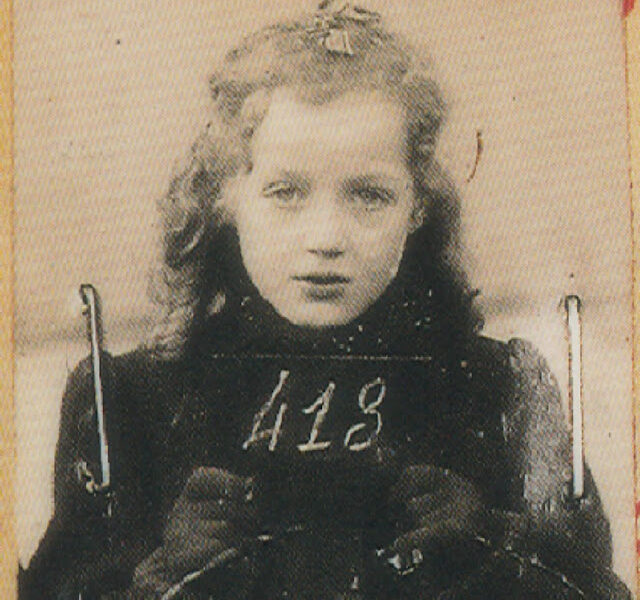
| Anny-Yolande Horowitz (born 1933, murdered in Auschwitz-Birkenau in 1942). She had blonde hair, blue eyes, a rosy complexion, was of medium height, and had very cute handwriting, like a little girl. |

|
| Children learn in a secret school in the Kovno ghetto. |
 |
| Eight sweet Jewish refugee girls in the garden of the children’s home in Zuen. Rosalie Blau (now Johnson), Toni Rosenblatt, Ruth Rosenblatt, Regina Rosenblatt, Lotte Nussbaum, and Inge Jose. |
 |
| The Jewish sisters Eva and Leana Münzer pose with dolls. Their parents placed them in the care of a Catholic family. Shortly after the Münzers’ deportation, a dispute arose between the husband and wife of the family that had hidden the two Münzer girls. The husband then denounced his wife and the Jewish children to the SS. The three were immediately arrested and deported to Westerbork. On February 8, 1944, the girls were deported to Auschwitz, where they were murdered three days later. |
 |
| Eva and Leana Münzer, two Jewish sisters, sit on a sofa in their house in The Hague. They were murdered in February 1944 at the ages of six and eight. |
 |
| Eva Münzer, betrayed by the husband of the woman who had hidden her, was murdered together with her little sister Leana in Auschwitz-Birkenau. |
 |
| Eva, Alfred and Leana Munzer in The Hague (only Alfred survived). |

|
| Feigele Blacher, Pessah Cofnas and his wife Rivka in Eišiškės (Feigele was murdered, Pessah and Rivka survived in Siberia). |
 |
| Four Jewish teenage girls, members of the Zionist youth movement Hashomer Hatzair in Eisiskes, pose in their uniforms. Pictured from right to left: Breine Plotnik, Sara Ginunski (name unknown), and Mikhele Plotnik. All were killed by Germans in the mass shooting in Eisiskes in September 1941. |
 |
| French-Jewish Resistance couple. |
 |
| Genia Gross, beauty from Chelm, Poland, who was killed in the Holocaust. |
 |
| Girls sew French flags in the DP camp Hagenow. |
 |
| A group photo of Jewish orphans who survived Terezín with the wife of Czech President Edvard Beneš and the wife of American Ambassador Laurence Steinhart. Each child holds a new toy. |
 |
| Hannah Kastan, who was hidden during the Holocaust and survived with her non-Jewish paternal grandparents, stands outside in Berlin holding a teddy bear. |
 |
| Helen Verblunsky in the Kovno ghetto, she survived and emigrated to Canada. |
 |
| Henia Wisgardisky in the Kovno ghetto with a doll. She and her family lived in the Zeilsheim displaced persons camp for several years before emigrating to Palestine. The family later moved to Canada. |
 |
| Hildegard Wolff, German-Jewish survivor, reads at home. |
 |
| Jewish girls from Germany in a children’s camp (summer camp for children) in Horserod, Denmark. |
 |
| Jewish girls in Purim costumes in the Ulm DP camp. |
 |
| Jewish girls of the Zionist movement in Lodz (only five of the girls pictured survived the war). |
 |
| Jewish children in the Zeilsheim DP camp. |
 |
| Jewish refugee father and daughter in Vilnius, once part of Poland, now part of Lithuania. |
 |
| Jewish refugee girls from Germany, including Anne and Margot Frank, hold a tea party with their dolls in a private home in Amsterdam. |
 |
| Jewish refugee students in Nairobi, Kenya. |
 |
| Jewish youth sing at the Youth Aliyah School in Berlin. |
 |
| Jews from Subcarpathian Rus’, selected for death at Auschwitz-Birkenau, wait in a clearing near a grove before being led to the gas chambers. Members of the Pinkas and Gutmann families are pictured. Golda Pinkas Berkovics is at bottom right, Moshe Leib Pinkas is the child in the foreground. Behind him is Sheindele Pinkas. At bottom left, Rivka Gutmann holds her daughter in her arms. All are from Maramaros. |
 |
| Pretty girl from the Jewish ghetto in Warsaw. |
 |
| Man with a young member of the Zionist Betar group. |
 |
| Portrait of a young girl who was one of the hundreds of thousands of children murdered in the Holocaust. |
 |
| Jewish refugee children on Tongshan Road, Hong Kong. |
 |
| Selma Schwarzwald, a Polish Catholic living underground during the war, dressed for her First Communion. She survived the war and became a doctor. She died in New York City in 2002. |
 |
| Selma Schwarzwald, a Jewish child who lived in hiding as a Polish Catholic during the war, poses with a novice nun at a summer camp for orphans at a monastery in Rabka, Poland. |
 |
| Studio portrait of the Englander family, taken on the eve of Lillian’s emigration to the USA. Pictured are (from left to right): Rozi, Ettela (Adolph’s wife), Anush (standing), Ali (Adolph’s youngest son), Magda (Adolph’s daughter), Shlomi (standing), and Lillian Englander. Shlomi Englander died shortly after this portrait was taken. Rozi went into hiding with her niece Magda. She was captured and deported to Poland in 1942. Anush was killed in 1942 along with her husband and child. Adolph and Ettela Englander were deported to Auschwitz in 1944 along with their two children, Ali and Magda. Only Magda survived. |
 |
| Studio portrait of two sisters in Eišiškės. Rivka Dubczanski is pictured on the right, her sister Masha on the left. Both Dubczanski sisters were murdered by the Germans during the mass murder operation in Eišiškės in September 1941. |
 |
| Cute Jewish refugee children on the family farm, Kenya. |
 |
| Teenagers and girls in the Warsaw Ghetto. |
 |
| Three Jewish siblings in Cologne. |
 |
| Two young girls stand with bread and bowls full of food in front of a house in the Kovno ghetto. |
 |
| Young German-Jewish teenagers wearing party hats gather for a birthday party in a room decorated with streamers. |
 |
| Young girl sits on the bench “Only for Aryans”. |
 |
| Young girls from Eišiškės, 1941. On September 21, 1941, a unit of the Einsatzgruppe marched into Eišiškės and killed the approximately 4,000 Jewish residents; sadly, they were among those killed. |
 |
| Young survivor sings in the Ulm DP camp. |
 |
| Young survivors celebrate Hanukkah at the Displaced Persons Camp Landsberg, 1945. |
 |
| Young Zionists gather in the Lodz ghetto. |
 |
| A Jewish couple in the Kovno ghetto. |
 |
| A touching photo of two teenage sisters, survivors of the Holocaust, in a camp for displaced persons. |

|
| Adorable young children perform a Purim play at the DP camp in Cremona, Italy. |
LEAVE A RESPONSE